Significance of Kalasha Sthapana During Puja
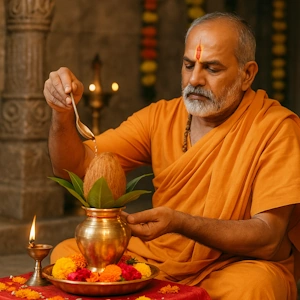
We do kalasha sthapana and invoke devatas onto it for worship.
There is a standard procedure.
Of course, there are some variations also depending on the text that you are following.
But broadly, what is the significance of each of these steps? Let us see that.
First of all, the ground on which the kalasha is placed is prayed to —
not only the ground, swarga also —
both are prayed to,
that they flow their goodness into this place,
that they keep this puja under their control,
and also fill it with abundance.
Kalasha is placed on top of a heap of grains —
rice or barley or wheat grains.
The mantra chanted here says —
once in the past, the herbs (meaning the grains)
went to Soma Deva.
Soma Deva is the king of all oshadhis.
They went to Soma Deva and said that wherever we are invited, called in,
we will fulfill all desires.
On top of the heap of grains, darbha is laid.
It is like providing asana for the kalasha.
In any puja there are two elements which are purifying: water and darbha.
Darbha has got the power to purify even water.
That's why in homa, we sieve water through pavitra made from darbha grass.
If you touch water with darbha or bring the two together,
if at all any impurity is there in water, that gets removed.
Then the kalasha is placed.
Kalasha is filled with water.
Even if you are filling the pot with ordinary water,
it is addressed with the names of all the punya nadis such as Ganga, Yamuna.
By doing this, the water is turned divine.
Chandana is added to this water.
What is the property of chandana? Fragrance.
Fragrance spreads — like how the fame of a noble person spreads.
Pujas such as these — these noble acts —
can be done only by those whose mind and deeds are noble.
And these pujas bring prosperity.
Fragrant herbs like cardamom, clove, vetiver, khus are added.
Just like the grains, these are also meant for achievement of the desire for which the puja is being done.
Plants and herbs have positive energies of their own.
They contribute towards the success of the ritual.
Durva grass is added.
Have you noticed — durva is a grass that spreads out fast?
It sprouts out of every single joint.
Like this, we want our prosperity, name and fame also to spread.
After this, tender leaves are put in the kalasha.
Five kinds of leaves are to be put.
Normally we see only mango leaves.
These leaves are the residing places of oshadhi devatas.
These trees are divine trees, and the oshadhi devatas reside in them.
And they are also the nourishers of cows.
Cows turn them into milk which is again offered to devatas in various forms.
See, what is happening here is — we are picking up natural objects with divine content
and strengthening their divine power by chanting appropriate mantras.
Seven kinds of mrittika (soil) are put in the kalasha —
a little bit each —
from places where horses, elephants and cows stand,
from confluence of rivers,
from below the wheels of a chariot,
from a junction of four roads,
from termite mound.
Here, the prayer is that may the land be auspicious and comfortable for us
and devoid of dangers and troubles.
A supari (arecanut) is put in the water.
Arecanut represents all plants — that bear fruit, do not bear fruit, blossom and do not blossom.
May they all prevent us from committing sins.
Five kinds of gemstones are put in the water.
They represent the divine energy of Surya Deva and bring luck.
Gems are always associated with prosperity.
Piece of gold is put in the kalasha invoking Surya and Indra.
These two devatas are as brilliant as gold.
They are prayed to watch over Deva Mata Aditi and Asura Mata Diti —
meaning, with an intention of promoting goodness and controlling evil.
The kalasha is then adorned with clothes.
The mantra here indicates that good attire contributes to one's personality.
A well-dressed person always creates an impression. People listen to him.
Hereafter there are two systems.
Mostly in North India, you will see a bowl fitting on top of the mouth of the kalasha.
This is filled with rice.
The idol of the devata you are going to worship is placed on top of this, and invocation is done.
This is called purna patra.
Purna means completeness — lack of any defect or shortfall.
This is what purna patra stands for.
Coconut is a purna phala.
In South India, in the place of purna patra, this purna phala is placed and invocation is done.
In some cases, a koorcha with darbha grass is also put.
This is meant to destroy any evil force trying to cause obstacle in the puja.
They are destroyed at the sharp tips of the koorcha.
So, none of these is arbitrary.
Every item has a significance.
When you do kalasha sthapana knowing this, your entire approach would change.
Rather than doing it mechanically,
your entire approach towards the ritual would change.





English
Rituals
Click on any topic to open
7
30
Astrology
Bhagavad Gita
Bhagavatam
Bharat Matha
Devi
Devi Mahatmyam
Ganapathy
Garuda Puranam
Glory of Venkatesha
Hanuman
Kathopanishad
Mahabharatam
Mantra Shastra
Mystique
Practical Wisdom
Purana Stories
Radhe Radhe
Ramayana
Rare Topics
Rigveda Explained
Rituals
Sages and Saints
Shiva
Spiritual books
Sri Suktam
Story of Sri Yantra
Temples
Vedas
Vishnu Sahasranama
Yoga Vasishta
26
17
10
0


