Do Not Get Caught in Silly Matters

We magnify things unnecessarily, give over-importance to things.
Comforts, home, furniture, food, taste, prestige, locality, citizenship, pension, stock market, gains, losses.
All these do matter, you can’t avoid them.
But let them not be the only agenda in your life.
Let them not overpower you. Don’t enslave yourself to them.
Is there a better thing to do? Don’t know.
But at least don’t lose your freedom. You are born free. Don’t become a slave of these silly matters.
Dva suparna sayuja sakhaya samanam vriksham parishasvajate.
Tayoranyah pippalam svadavatt yanashnannanyo abhi chakashiti.
Two similar birds are sitting on the same tree. One is eating fruit and the other is simply watching. The tree is the body and the two birds are Jeevatma and Paramatma. The bird which is the Jeevatma thinks that it is undergoing all the pleasure and pain. It considers itself responsible for it. It is deluded. It is worried about its lack of freedom.
Samane vrikshe purusho nimagno’nishaya shochati muhyamanah.
Justam yada pashyatyanyamishamasya
Mahimanamiti vitashokah.
But the grief of this bird who suffers, the Jeevatma, will be gone if it realizes the greatness of the other bird, Paramatma.
But this bird called Jeevatma is so self-absorbed in its own problems that it doesn’t bother to lift its head and look at the other bird.
This is why it is said – you should listen to the stories of how saints lived. How the other kind of birds live. Sitting in the same tree, they live a different kind of life.
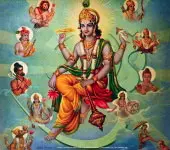
This other bird, Paramatma, mentioned in the Upanishad is Sri Hari. Even while occupying the same body which the Jeevatma occupies, he is only watching.
One very important point here, don’t be confused that Jeevatma and Paramatma are two different birds occupying the same body. Paramatma covered by sheaths such as ignorance is called Jeevatma. Meaning, you remove those yellow glasses you are wearing and you will have clear vision. The sheaths cause the distortions in perceiving reality.
Esha sarvabhutantaratma apahatapapma – he is the antaratma of all beings and sinless, blemishless.
Na mam karmani lipyanti – karma doesn’t affect me, karma doesn’t get attached to me.
Pashya devasya mahatmyam mahimanam cha Narada
Shubhashubhaih karmabhih yo na lipyati kadachana.
That is his greatness – karma, good or bad, does not attach to him.
Sambhogapraptiriti chen na vaisheshyat.
How can the Paramatma be present within the body along with Jeevatma and still not experience pleasure or pain as the Jeevatma experiences?
Vaisheshyat – because it is different from Jeevatma. Experience is based on the result of karma. The sensory organs take the pleasure and pain to the Jeevatma for it to experience. You caused pain to someone in the past. You have to undergo the same experience. This is because of the karma you generated and which got attached to you as Jeevatma.
Karma doesn’t get attached to Paramatma. It is always free. It doesn’t have the compulsion of going through an experience. This is the difference between Jeevatma and Paramatma.
A mother watches her son being beaten up in a boxing ring. She feels the pain because she is attached to her son. For an outsider, it is only a game. Both are watching the same game. One feels the pain. The other doesn’t.
There are thousands and thousands of pages written about the beauty of Sri Hari. Thousands and thousands of stotras written about his beauty.
Our sages were the first ones to realize that beauty is only skin deep. There is not a single sage who has not sung praises about Sri Hari’s beauty.
Why is this so? How could these elevated souls be so impressed by his beauty that is only skin deep?
Because his beauty is not worldly. It is not limited to a visual treat. It is not limited to what you see with your eyes.
It strikes a chord somewhere else. It touches you somewhere inside. You are overwhelmed.
Otherwise, do you think it would have been easy to get these ugra tapasvis carried away by just physical beauty?
-
What is the difference between the doer and the witness? - The doer is the mind-body with habits and desires. The witness is pure awareness that stays unchanged. Know the difference and you stop being pushed around inside.
-
If awareness is free, why do I still suffer? - Suffering bites when you identify only with the doer. Awareness knows the pain but is not bound by it. Shift identification and the grip loosens.
-
Is detachment the same as being cold? - No. Detachment is caring without clinging. It cleans up judgment and makes action sharper.
-
How do comforts quietly turn into chains? - When they define who you are or start dictating your priorities. Tools become masters; you become the servant.
-
What does real freedom look like in daily life? - The power to choose your response by dharma, not by impulse, fear, or social pressure.
-
Why does karma bind an individual but not the supreme? - Ownership binds. The individual says ‘I act’ and collects results. The supreme is complete and claims nothing, so nothing sticks.
-
How do I check this for myself? - Sit still. Watch breath, thoughts, and feelings rise and fall. Notice that the watcher remains the same. Repeat till this becomes obvious.
-
What practice gives fast clarity? - Daily japa or meditation, straight self-inquiry, and one act of service a day. Same time, every day. No excuses.
-
How do I balance ambition with inner freedom? - Values first, skill second, rewards third. Drop goals that demand you bend your values. Long term, this wins.
-
When does enjoyment become a problem? - When it demands repetition at any cost, twists judgment, or becomes your identity. Enjoy, then let go.
-
What is the point of beauty in spiritual life? - Sensory beauty pleases the eye. Spiritual beauty wakes up devotion, steadiness, and courage. It changes how you live.
-
How do I handle pain without drama or denial? - Acknowledge it, act where you have agency, accept what you do not, learn the lesson, return to practice.
-
How do stories of saints help? - They model priorities, discipline, and surrender under pressure. Take principles; do not cosplay their lifestyle.
-
How do I face fear of losing success or status? - Tie self-worth to character and effort, not outcomes. Outcomes swing; character stands.
-
What is a quick decision test? - Will this choice increase clarity, compassion, and self-mastery? If yes, proceed. If no, rethink.
-
How should I treat relationships? - Serve without bargaining, speak truth kindly, set clean boundaries, and never make another person your identity.
-
What does surrender look like in practice? - Do your best by dharma, offer the result inwardly, and stop replaying outcomes in your head. Then move on.
-
What is the end state? - Stable inner freedom while living fully. The person does the work; awareness stays steady, loving, and free.





English
Vishnu Sahasranama
Click on any topic to open
7
30
Astrology
Bhagavad Gita
Bhagavatam
Bharat Matha
Devi
Devi Mahatmyam
Ganapathy
Garuda Puranam
Glory of Venkatesha
Hanuman
Kathopanishad
Mahabharatam
Mantra Shastra
Mystique
Practical Wisdom
Purana Stories
Radhe Radhe
Ramayana
Rare Topics
Rigveda Explained
Rituals
Sages and Saints
Shiva
Spiritual books
Sri Suktam
Story of Sri Yantra
Temples
Vedas
Vishnu Sahasranama
Yoga Vasishta
26
17
10
0


