Confidence Of Vibhishana In Rama Nama
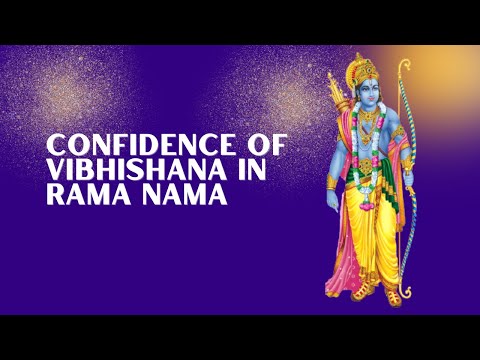
Today we will look at the meaning of the Divya Nama Vrishakarma and also take a glance at Vibhishana's Rama bhakti.
अमोघः पुण्डरीकाक्षो वृषकर्मा वृषाकृतिः
Vrishakarma धर्मलक्षणं कर्मास्येति वृषकर्मा
While looking at the meaning of the Vrishakapi, we have already seen how Vrisha stands for dharma.
So not getting into it again.
Whatever Sri Hari does is dharma.
That's why even on earth, when Valmiki wanted to write about someone who never ever deviated from dharma, not even once, not even by an iota then the name suggested to him was that of Lord Rama.
रामो विग्रहवान् धर्मः
Rama is dharma embodied.
श्रॆयस्करं धर्मरूपं कर्म यस्य प्रचक्षतॆ | वृषकर्मॆति विख्यातः शुभकर्मप्रदॊ मनुः ||
What is special about karma based on dharma?
Any action is karma.
But if the karma is based on dharma it will lead to shreyas.
Auspiciousness, here and hereafter, both.
Vrisha is bull.
The primary act of the bull is the fertilization of the cows, which leads to abundance.
More cows means more milk.
More hungry stomachs satisfied.
More yajnas performed.
This act of the bull is called sechana, showering.
Like how the rain clouds shower.
Do the rain clouds get any benefit by showering?
That's for us.
So that we get drinking water, the land becomes fertile, and heat is reduced.
We are the only beneficiaries.
In the same way, all actions of Bhagawan we are the whole and sole beneficiaries.
Can we ask the rain clouds, that you rain now.
It doesn't happen like that.
Bhagawan also showers his kindness upon us whenever he wants.
Not necessarily when we ask for it.
This incident is after Vibhishana took over as the king of Lanka.
Once a ship got stranded in the sea.
It was stuck.
The sailors thought Samudra Devata is angry with us due to some reason.
So they decided to sacrifice a man, offer narabali to propitiate Samudra Devata.
They picked up the most frail and weak man and dropped him in the sea.
He didn't die.
He managed to stay afloat, swim and reached Lanka's shore.
The Rakshasa guards caught him and produced him before Vibhishana.
His figure reminded Vibhishana of Lord Rama's state when he had met him for the first time.
The Lord was in deep grief due to separation from Seetha matha and had become frail.
Vibhishana jumped down from the throne and said: I am so lucky that I could see someone who brought to my mind that form of the Lord.
The man was treated with a lot of respect.
Well taken care of.
He spent some time in Lanka.
But he was not all that happy.
Once Vibhishana asked him he said: I want to go back.
Vibhishana gave him a lot of gold and gems as gift, brought him to the seashore, wrote Rama Nama on his head, and said this Rama Nama will take you back home.
He waited.
After some time the same ship came from which he was dropped into the sea.
The sailors recognized him and offered to take him back home.
In the middle of the sea, when they realized that he had a lot of gold and gems with him, they snatched them all and again dropped him into the sea.
But this time, he just started to walk over the water.
They were shocked to see this.
And got scared.
They immediately took him back into the ship and he reached home safely.
See the power of the divine name.
It is not that troubles will not come in life.
That is a false hope.
Troubles can come in anybody's life any time.
But if you have the protection of the Divya Nama you can easily come out.
-
What does Vrishakarma really mean for my daily choices?
It means do the work that carries the stamp of dharma. If a task helps truth, fairness, and responsibility, do it. If it props up ego or shortcuts, drop it. Chanting 'Vishnu Sahasranama' trains the mind to pick the dharmic option without drama. -
How do I test if an action is dharmic, not just convenient?
Ask: does this action bring long term good to more than just me, and can I say it aloud without shame? If yes, proceed. Seal it with 11 names of Bhagavan before you start. -
Why is Rama called dharma in human form, and what does that change for me?
It removes excuses. Dharma is not abstract theory; it is lived. Recite 'Sri Rama Rama Rameti' 108 times before tough decisions. You will act clean and firm. -
If Bhagavan does only dharma, why do storms still hit my life?
Because a clean path does not cancel weather. It gives shelter. Keep a daily round of 1 mala of 'Vishnu Sahasranama' and 1 mala of 'Om Namo Narayanaya'. You will still face rain, but you will not drown. -
What is shreyas in practical terms?
Shreyas is the outcome that stays good tomorrow, not just today. Name-japa aligns your impulse with that longer horizon. Short term pain, long term peace. -
Can a name actually change events, or only my attitude?
It changes both. The mind becomes steady and options you could not see become obvious. People respond better to a calm, steady you. That is not small; that is decisive. -
How does nama japa help physical health without sounding mystical?
Slow, steady chanting regulates breath, lowers pulse, and cuts stress chemistry. Less gut churn, fewer headaches, better sleep. Body follows mind; mind follows the Name. -
I feel weak willed. How do I start without failing on day three?
Pick a tiny non-negotiable: 5 minutes after waking, 5 minutes before sleep. Same place, same beads. Keep the count low but daily. Consistency beats heroics. -
Family friction is draining me. What is a dharmic reset that actually works?
Stop debates. Start a shared 3-minute nama japa before dinner. No lectures, just chant and eat. Tone of the house changes in weeks. People soften when the Name becomes routine. -
How do I keep work ambition dharmic and not slip into clever cheating?
Tie targets to service. Before a meeting, chant a short stretch of the Sahasranama. Ask for strength to win without dirt. You will negotiate hard and still sleep well. -
What should I do when I am cornered and cannot see a way out?
Sit, straighten the spine, and chant 'Vishnu Sahasranama' slowly with breath. Do not plan outcomes during the chant. After one round, act on the first clean step that appears. -
Is there a sign that the Name is protecting me and I am not just imagining it?
Decisions become simpler, fear shortens, and outcomes stop swinging wildly. Even when hit, you recover faster. That stability is the sign. -
How do I align my daily routine with Vrishakarma without turning life upside down?
Fix three anchor points: morning japa, pre-decision japa, and night gratitude japa. Keep doing your normal work, but keep these anchors fixed. Dharma piggybacks on rhythm. -
What do I chant when my mind is scattered and breath is shallow?
Take one name and loop it with breath: inhale ‘Om Na’, exhale ‘mo Narayanaya’. After three minutes, move to the Sahasranama. The scatter will settle. -
How do I handle guilt over past wrong actions while moving to dharmic work now?
Acknowledge, repair what you can, and start japa. The Name does not pamper guilt; it burns it and pushes you to do the next right action. That is the only proof you need.
Isn't the idea that 'whatever Sri Hari does is dharma' just blind faith?
Not blind faith, but definition. Dharma is not something external that even Bhagavan has to follow. What he does becomes dharma. Just like laws in a country are laws only because the sovereign authority declares them. Rama is called 'Ramo vigrahavaan dharmah' — he is dharma embodied, not subject to it from outside.
Why compare Bhagavan’s actions to rain clouds? Clouds are natural, not divine.
The point is about effect, not personality. Clouds don’t benefit from the rain they pour; only the earth and beings do. Likewise, Bhagavan doesn’t gain anything from his actions. All benefit flows to the world. The analogy explains selfless showering, not identity.
Isn’t the bull analogy outdated? Fertilization, milk, yajnas — why link that to Vishnu’s karma?
The imagery is symbolic. The bull sustains society through fertility, food, and ritual support. Bhagavan’s dharmic actions sustain the cosmic order in the same way. Old examples like cattle are chosen because they were central to life. The underlying truth — selfless abundance — remains valid even today.
Walking on water just because someone wrote Rama Nama on his head — isn’t that fantasy?
It is not a physics demonstration but a truth about the power of nama. The narrative shows that divine protection transcends ordinary obstacles. Whether you interpret it as a miracle or as inner strength expressed outwardly, the message is clear: Rama Nama carries a force beyond human calculation.
If nama protects, why did the man face trouble twice — being thrown into the sea again?
Because nama doesn’t erase challenges; it carries you through them. The shipmen’s greed created trouble, but the second time the man did not sink. Trouble is part of life, but with nama, one rises above and survives. That’s the lesson.
How can words have such power? They’re just sounds.
Words shape thought, and thought shapes action. Mantras and divine names are not ordinary sounds — they are vibrations aligned with eternal truth. When the mind unites with them, it awakens inner strength and attracts unseen grace. That’s why repeated remembrance transforms outcomes.





English
Vishnu Sahasranama
Click on any topic to open
7
30
Astrology
Bhagavad Gita
Bhagavatam
Bharat Matha
Devi
Devi Mahatmyam
Ganapathy
Garuda Puranam
Glory of Venkatesha
Hanuman
Kathopanishad
Mahabharatam
Mantra Shastra
Mystique
Practical Wisdom
Purana Stories
Radhe Radhe
Ramayana
Rare Topics
Rigveda Explained
Rituals
Sages and Saints
Shiva
Spiritual books
Sri Suktam
Story of Sri Yantra
Temples
Vedas
Vishnu Sahasranama
Yoga Vasishta
26
17
10
0


