A Brief Inquiry Into the Nature of Atma
Today, we will discuss the meaning of the divya nama achyuta and also a brief enquiry into the nature of atma.
अच्युतः – स्वरूपसामर्थ्यात् न च्युतः न च्यवते न च्यविष्यते
He has never ever fallen from his glory. He doesn't fall from his glory. He will never fall from his glory in the future also. Chyuta means fallen, someone who has fallen from his position or power or nature or qualities. The Lord never falls from any of these.
Others fall in the sense someone is all-powerful Devendra only for a certain period called the manvantaras. After that he comes out of that position and someone else becomes Indra. Same with Brahma, Brahma lives for hundred years which is a duration of 432 billion years; after that Brahma dies and another Brahma takes over. Nothing of this sort happens with the Lord. He is always the same. Same qualities, same power, same position, same qualities, no birth, no death, no ascent to position, no retirement, nothing for him.
निर्वाणं परमं सौख्यं धर्मोऽसौ पर उच्यते | तस्मान्न च्युतपूर्वोऽहमच्युतस्तेन कर्मणा ||१६||
He is always in the state of nirvana. What is nirvana? Nirvana is the state of complete freedom. No attachments, no compulsions for him. He never comes out of that state. Hence he is achyuta.
तेभ्यः प्रपन्नेभ्यः च्युतः अपगतः नेति – he never separates himself from those who take refuge in him, surrender to him.
न च्यावयति इति अच्युतः
He doesn't allow his devotees to slip and fall from their path.
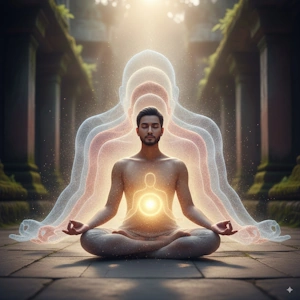
Now atma. What is atma? We have three atmas: the shareeratma, the antaratma, and the vishuddhatma. Shareeratma is the physical body made up of hands, legs, head, hair. The antaratma is made up of mind, intelligence, ego, all the thoughts and emotions that occupy and run through them. All the signals.
If you look at it physiologically, corresponding to every thought or emotion there are signals active in the body, running around. Ego is like a charged-up state, you can say. Just as the body is made of cells which is a collection of molecules suspended in a fluid which ultimately you can split down into molecules and atoms and subatomic particles which is just dense energy, vibrations of certain patterns, what we sense as matter is dense energy. So even the physical body is just a lot of energy. Inside that body also there are just signals, again energy running here and there as thoughts, emotions, memories. These are the two.
Beyond these is the vishuddhatma or jeevatma which is a replica, miniature of the paramatma, which is ever pure. This is the vishuddhatma or jeevatma. The other two are built around this pure core called jeevatma. This jeevatma manifests itself into various beings. Before manifestation it is just pure knowledge. Knowledge about everything. Awareness about everything. With potential to be anything. Potential to be everything.
A person is a CA; he will not be able to treat a patient. A doctor may not be able to fly a fighter plane. Because he doesn't have the knowledge to do it. You cannot turn a lump of clay into a car that can actually carry passengers. They all have limitations. But this jeevatma can turn into anything. Because it has the knowledge to become anything. It is made up of the raw material which can become anything.
So, this jeevatma initially waits like a bird whose wings have not grown, with infinite potential to become anything. Then Sri Hari gives wings to this bird and makes it active.
So, is this atma the physical body? No. Is this atma the mind? No. Is this atma the internal needs such as hunger and thirst? No. Is this atma the mind? No. Is this atma the faculties of vision, hearing? No. Is this atma the memory? No. Is this atma the intelligence? No. Is this atma the observer inside you, which can see your body, see the thoughts in your mind — 'I am angry now, I am happy now', this part of your mind which can observe the other part of your mind and say that 'I am happy now, I am scared now'? No, not even that. It is none of these.
It is so minuscule that if you want to say its size, take a hair, your own hair, split it lengthwise a hundred times, take the tip of one of these, split that into 100 times; jeevatma is smaller than that. Today quantum physics talks about quarks, the smallest particles, but they don't have a definite shape or size, they don't have particular dimensions. Our jeevatma is still smaller than this. But with infinite potential, it can turn itself into a huge range of mountains under the command of Sri Hari paramatma, which the scientific quark may not be able to do.
But wait, science is coming closer to that. It says that the volume of a subatomic particle depends on the space within which you want to confine it, and its existence at a particular point in space is a probability rather than reality. And this atma doesn't die with the body. This atma cannot be described as this or that, not this and not that, not even with comparisons. The more we try to define it, the more farther from truth we get. Even the most spiritually evolved intellects will not be able to grasp the nature of the atma. We can say it is beyond the annamaya kosha, the manomaya kosha, but we can't say what is in there.
You go on peeling an onion layer after layer hoping to find something at its core but end up with nothing there. This is something like that. But there are three things about the atma. It is there for sure. It has all the knowledge and awareness in it. And it is in a state of bliss. This is called sachchidananda.
-
Why is chanting Vishnu sahasranama considered protection in today’s uncertain world?
Because every name of Bhagavan Vishnu is like a shield. When the mind repeats them, it builds an inner wall against fear, greed, and deception. Just as locks protect your home, the sahasranama protects your thoughts and decisions. -
How does nama japa help when people around us misuse sacred names for selfish gain?
Chanting corrects the vibration. Even if someone twists or misuses a holy word, your steady repetition restores its purity in your heart. Bhakti keeps the name untouchable, no matter what the outside world does. -
Can regular chanting really bring clarity in financial and family decisions?
Yes. A calm, bhakti-filled mind is sharper. When confusion arises about money, health, or trust, the sahasranama recitation makes your thoughts steady, like still water reflecting clearly. Families that sit together and chant see fewer misunderstandings. -
Why is physical health linked with the discipline of daily nama japa?
The rhythm of chanting regulates breath, reduces stress hormones, and improves focus. This lowers unnecessary tension in the body, easing sleep and digestion. Just as exercise strengthens muscles, japa strengthens nerves. -
How does bhakti help a family when faced with falsehood or misleading influences?
When one member anchors the home in chanting, it creates a vibration that guides everyone. Children learn that truth and devotion matter more than external noise. Even elders find courage by hearing the repeated names of Bhagavan. -
What practical step can I take if my trust in people is shaken?
Fix a time for Vishnu sahasranama chanting daily. Begin with even a few names. This practice becomes your unshakable foundation. When people outside try to mislead, your heart will already know what feels false and what feels aligned with dharma. -
Why is the grace of Bhagavan described as never failing?
Because unlike positions or powers that change hands, his grace is steady. Devendra may change, Brahma may change, but Vishnu’s protection through his names never lapses. Your chanting keeps you connected to that permanent source.
If atma has no size, shape, charge, or location, on what basis do you claim it exists?
On the basis of the one fact you cannot deny: awareness is present. You can doubt objects, theories, even the body in a dream, but you cannot doubt that you are aware. That undoubtable aware-presence is what we call atma.
Awareness is a brain function. Prove it is not just neurons firing.
Neurons fire, signals flow, but the fact of experiencing those events is not identical to the events. Data on a hard drive is not the act of reading it. Brain events are correlates; awareness is the witness of those correlates. Correlation is not identity.
If awareness is the witness, show a measurement. Without a meter, this is belief.
Some realities are self-evident, not instrument-evident. Logic itself cannot be measured by an instrument; yet you use it to validate instruments. Awareness is the precondition for all measurement. It is known by direct self-presence, not by a third object.
If atma survives death, show one verifiable transfer of memory across lives.
Memory continuity is not the criterion for the survival of the experiencer. Deep sleep erases memory episodes nightly, yet the experiencer continues. Atma is the continuing subject, not a scrapbook of memories.
If atma is bliss, why do brain chemicals alter mood?
Chemicals modulate the instrument, not the substratum. Tune a radio and the music clears or distorts; the broadcast is unaffected. Bliss is the baseline nature of atma; chemistry alters the mind’s reception, not atma’s nature.
If jeevatma is a miniature of paramatma, you are multiplying absolutes. How can the absolute have parts?
It is not a part in the material sense. It is like one space appearing as ‘room-space’ and ‘pot-space’ by boundaries. Remove boundaries and there is only space. Jeevatma is the absolute seen through a limiting framework.
If atma cannot be harmed or changed, why call actions ‘falling’ or ‘rising’ at all?
‘Fall’ and ‘rise’ describe the states of body-mind conduct, not atma’s substance. Like a spotless mirror that seems stained because of dust on its surface, the mirror remains untouched; only the reflection is affected.
You say paramatma never falls. Prove immutability. Everything observed changes.
Immutability is established by contrast. Everything changing presupposes a constant that makes change knowable. Without a changeless reference, change cannot even be recognized. That changeless reference is the absolute.
If atma is beyond thought, every statement about it is nonsense. Why should I accept any of this?
Statements about atma are pointers, not containers. A map is not the terrain, yet it can take you to the terrain. Dismissing all pointers because they are not the thing itself confuses guidance with destination.
If atma is real, induce it in a lab. Switch it on and off.
You cannot switch off the very condition that makes ‘on’ and ‘off’ meaningful. What goes off is mental content. Even in deep sleep, absence is known after waking because the knower persists. The lab can silence contents; it cannot silence the knower.
If individuality is only a limiting framework, why do moral laws matter?
Because action and consequence unfold within the framework, just as rules of chess matter inside the game. The board is one wood, but moves still have outcomes. Unity at base does not cancel responsibility in expression.
If atma is present equally in all, why do capacities differ so widely?
Because the instruments differ. Same electricity, different wattage. The variance is in body-mind equipment and conditioning, not in the aware substratum.
Show a case where awareness exists without objects. Otherwise, it depends on objects.
In deep sleep there is no object, yet on waking you report: I slept well, I knew nothing. That report shows an ongoing aware-presence that outlasted objects and noted their absence.
If everything reduces to energy, why add atma to the picture?
Energy is a describer within the observed world. Atma is the fact that the observed world is present to a knower. Physics models the movie; atma is the lit screen on which the movie appears.
If words like sat-chit-ananda are only pointers, why trust your tradition at all?
Because the method is consistent: start from what cannot be denied (I am aware), distinguish the changing from the changeless, and test every claim against direct experience. Tradition is a disciplined pathway, not blind belief.
Final challenge: give one crisp criterion that separates atma from everything else.
Everything else is an object that appears and changes. Atma is the subject that never appears as an object and never changes. If it can be observed, it is not atma; if it is the observer, it is atma.





English
Vishnu Sahasranama
Click on any topic to open
7
30
Astrology
Bhagavad Gita
Bhagavatam
Bharat Matha
Devi
Devi Mahatmyam
Ganapathy
Garuda Puranam
Glory of Venkatesha
Hanuman
Kathopanishad
Mahabharatam
Mantra Shastra
Mystique
Practical Wisdom
Purana Stories
Radhe Radhe
Ramayana
Rare Topics
Rigveda Explained
Rituals
Sages and Saints
Shiva
Spiritual books
Sri Suktam
Story of Sri Yantra
Temples
Vedas
Vishnu Sahasranama
Yoga Vasishta
26
17
10
0


