The Vedic System of Idol Worship of Sri Hari
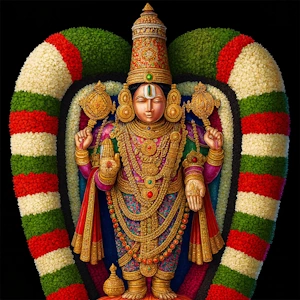
Today we will look at the meaning of the divya nama vrishakapihi.
vrishakapihi –
कपिर्वराहः श्रेष्ठश्च धर्मश्च वृष उच्यते
तस्माद् वृषाकपिं प्राह काश्यपो मां प्रजापतिः
Kashyapa prajapati was the one who called bhagawan vrishakap.
This has two parts vrisha and kapi.
वर्षणात् सर्वकामानां धर्मो वृषः
Vrisha means bull. In the veda the bull stands for dharma. You can see the stature of the bull, calm and composed, steady, slow, confident. Compare the expression and movement of bull and a deer. They are completely different. Fertilisation of the cows by the bull leads to their multiplication. Multiplication of the cows stands for abundance. Bull is the cause behind abundance. Bull stands for abundance.
In the same way bhagawan Sri Hari showers abundance through which all materialistic desires can be achieved. Not only materialistic desires, proper utilisation of resources can lead to spiritual progress also. This is one aspect of bhagawan. But here for us bhagawan does not have to do this individually. He achieves it through dharma. Those who live life virtuously following dharma, they achieve abundance naturally. Because bhagawan himself is dharma.
The other aspect is his varaha aspect, where he rescued the earth.
कात् तोयात् भूमिमपादिति कपिः
Kapi here does not mean monkey. It means varaha, the varahavatara in which he rescued the earth from under water by lifting her with his tusks. This is the protective aspect of bhagawan.
Both the blessing with abundance and protective aspects of bhagawan are in a single name.
In Bhagawata 11th skandha bhagawan says:
I am worshipped through three methods – vaidika, tantrika and mishra.
At a practical level today, vaidika worship is called vaikhanasa, tantrika is called pancharatra, and we have a mix of both systems also.
In Tirupati temple vaikhanasa is followed. In Srirangam pancharatra is followed.
We will look at vaikhanasa a little more in detail.
The Sri Vaishnava movement in the south India picked up momentum under Nathamuni, Yamunacharya and Ramanujacharya. Before this it was mostly vaikhanasa. Vaikhanasa is a completely vedic system. In Vaikhanasa system only veda mantras are employed. The divya prabandhas written in Tamil by the revered alwars are not used in vaikhanasa system.
Vaikhanasa was a rishi who wrote both kalpa sutra pertaining to idol worship and temple worship and also grihya sutra pertaining to domestic rituals. His followers form a particular vaishnava community called vaikhanasas. They are there in the states of Tamil Nadu, Andhra, the original Andhra, and Karnataka. Vaikhanasas insist on following the agni karya or homa karya at home as well as at temple and then do the worship of the idol of Sri Hari.
Vaikhanasas believe that agni is the visible god here on earth and Sri Hari Mahavishnu is the most supreme god. If you worship both, then you have covered the entire spectrum of gods. Here also if you see, homa is non idol worship. We have this at one end and idol worship of the lord at the other end. Vaikhanasa system consists of homa, archana of the idol, japa and dhyana.
The idol worship also follows the pattern of yajnas. In vedic yajnas we have three agnis – garhapatya, ahavaniya and dakshinagni in three separate kundas.
In vaikhanasa temple also there are three idols – dhruva bera, kautuka bera and utsava bera. Bera means idol. In Tirupati if you see, the big idol is the dhruva bera. There is a small replica of that just at the base of the big idol which is called kautuka bera or bhoga murti. The routine worship is done on this. Then there is utsava murti that comes out in processions.
The connection with yajna is that dhruva bera is garhapatyagni, kautuka bera is ahavaniyagni, utsava bera is dakshinagni. This is the tretagni system of yajna.
There is panchagni system also in which two more agnis, आवसथ्य and सभ्य, are there. Corresponding to these there are two more idols – bali bera and snapana bera. Vaikhanasa mode of worship is for universal welfare just like how yajnas are performed for universal welfare.
The kings of the past used to perform ashwamedha, rajasuya, such yajnas for the benefit of the entire kingdom. They would be yajamanas in such yajnas. In the same way the yajamana or the worshipper in a vaikhanasa temple is the ruler. Daily worship is carried out on his behalf. And it would benefit the entire region or state or country or planet earth or the universe depending on the outlook.
There are a total of 128 books in vaikhanasa agama with about 4 lakh verses. See how elaborate it is. Sage Vaikhanasa is the founder of this system. Vaikhanasa is a manasa putra of Lord Sri Hari himself while the other rishis are manasa putras of Brahma. Atri, Bhrigu, Marichi and Kashyapa have written these 128 books.
The contents of these books are construction of temples, making of idols, pratishta vidhi at temples, daily worship, utsavas or festivals, and prayaschittas. Four lakh verses in one branch of vaishnava agama, all about idol worship. Like this there are thousands of other books and crores of verses in them, all about temple and idol worship.
And there are those who still say that idol worship is not there in sanatana dharma. Vaikhanasa system gives equal importance to bhakti and idol worship. They complement each other.
Vaikhanasa means visheshena khanati – digging deeper and deeper into the divine principle and understanding divinity more and more.
We are not getting into the philosophy and worship procedures in vaikhanasa which is huge by itself. You can imagine 4 lakh verses.
-
Why chant Vishnu sahasranama when life already feels busy?
Because it organizes the mind. A fixed daily count anchors attention, cuts noise, and restores clarity. With clarity, choices improve, conflicts drop, and energy returns. -
How does nama japa help with stress and sleep?
The steady rhythm of ‘Om Namo Narayanaya’ slows breathing and heart rate. Tension releases, sleep deepens, and morning fatigue reduces. Consistency locks these gains in. -
Isn’t silent prayer enough—why use names?
Names are precise tools. Each name carries a defined meaning and recalls a virtue of Sri Hari. Repetition engrains those virtues into thought and action. Vague intention cannot do this as reliably. -
What if family members have different routines—how to bring harmony without forcing anyone?
Keep a short shared slot: 5–7 minutes after dinner. One person leads, others listen or chant softly. End with a single shanti verse. Small, predictable, respectful. Harmony grows from rhythm, not pressure. -
How can chanting improve patience with children and elders?
Japa trains pause before reaction. When the mind is trained to return to the name, it also returns to calm during family friction. Fewer sharp words, more steady guidance. -
Will chanting reduce anger and cravings?
Yes. Name repetition interrupts the impulse loop. Each return to the name weakens the urge and strengthens restraint. Over weeks, the baseline of irritability drops. -
I struggle with overthinking during japa—what is the fix?
Use breath-linked counting. Inhale: ‘Om Na-mo’, exhale: ‘Na-ra-ya-na-ya’. One breath is one bead. The body’s rhythm keeps the mind from wandering. -
What is a simple, traditional daily plan that actually sustains?
Morning: one mala of Vishnu sahasranama split into ten-name packets. Evening: 108 of ‘Om Namo Narayanaya’. Weekly: one full sahasranama aloud on a fixed day. Keep the same place and time. -
How does this practice help decision-making at work?
A mind trained to return to the name does not get dragged by panic. You see options clearly, choose the dharmic one, and execute without inner noise. Fewer errors, cleaner outcomes. -
What about physical health—can chanting be part of fitness?
Sit with straight spine, slow nasal breathing, and a gentle abdominal movement. This tones the vagal response and steadies blood pressure. After japa, take a 10-minute brisk walk to seal the calm. -
I miss days and feel guilty—does that break the benefit?
No. Resume the very next slot without drama. Steadiness beats intensity. Record the day’s count in a small notebook to keep continuity visible. -
How to keep the practice reverent at home without elaborate setup?
A clean corner, a small image of Sri Hari, a lamp, and a beads mala. Begin with a single shloka, chant, and end with a short prayer for the well-being of all. Simplicity sustains sanctity. -
Can group chanting help a tense household?
Yes. A weekly 15-minute group sahasranama recitation softens egos. Shared sound knits people together. Arguments lose sharp edges when voices have just moved in unison. -
What if pronunciation is imperfect—should I pause till I learn?
Do not pause. Chant steadily while improving one name at a time. Intention, steadiness, and respect carry the practice; refinement follows. -
How do I measure progress without becoming mechanical?
Track three signs: quicker recovery from irritation, fewer scattered thoughts per round, and a natural pull to start japa on time. When these rise, you are on the right track. -
How does chanting relate to dharma in daily conduct?
Names of Sri Hari remind you that protection and order flow from Him. The reminder nudges you to truthfulness, duty, and restraint. Dharma becomes your default, not a forced pose. -
What is a firm starter routine for the next 21 days?
Rise, wash, light lamp, sit facing east, one mala of ‘Om Namo Narayanaya’, read 10 names of sahasranama with meanings, close with shanti. Evening repeat the mala. Sunday: one full sahasranama aloud with family listening.
How can a bull represent dharma? It is just an animal.
Symbols in the Veda are not random. The bull is calm, steady, powerful, and the source of fertility for cows. These qualities stand for dharma — strength, stability, and abundance. That is why the bull is used as the symbol.
You say abundance comes through dharma. Isn’t it really just hard work and resources?
Hard work and resources matter, but without dharma they collapse. A corrupt system can have resources and effort but no prosperity. Dharma is the principle that ensures fair use and right distribution, turning effort into lasting abundance.
Why call Varaha a kapi if kapi usually means monkey?
Sanskrit words have multiple roots. Here kapi is from ‘ka’ (water) and ‘pi’ (to drink or absorb). It refers to Varaha who lifted the earth from the waters. Context fixes the meaning. It has nothing to do with monkey in this case.
Isn’t this just mythology? Where is the evidence?
The point is not archaeology but meaning. Varaha lifting the earth shows that preservation of the world is divine responsibility. It encodes a principle — when chaos floods existence, a higher power restores order. Myth is a coded language for truth.
You claim Vaikhanasa is fully Vedic. But where is the proof?
The Vaikhanasa texts themselves are sutras using only Veda mantras. No Tamil prabandha or later compositions are used in its rituals. The structure of worship directly mirrors the Vedic yajna model — three fires, three idols, ritual homa. That is internal proof.
Why compare idols with yajna fires? Aren’t they unrelated?
In yajna, garhapatya, ahavaniya, and dakshinagni have distinct roles. In temple, dhruva, kautuka, and utsava idols take those roles. The mapping is deliberate. It shows continuity: idol worship is not a break from yajna, but its extension in a new form.
How can daily temple rituals benefit an entire kingdom? That sounds exaggerated.
It is the same logic as yajna. In yajna, the yajamana is the king and the benefit extends to his people. In temple, the ruler is yajamana, and the deity’s worship is invoked for collective welfare. The system is structured that way.
Four lakh verses on idol worship? Isn’t that overblown?
That number is recorded in the Vaikhanasa tradition itself. The vastness is not surprising. Every detail — from temple layout to idol consecration to festivals to corrective rituals — is documented. When added up across 128 texts, it easily runs into lakhs of verses.
If idols are central, why does the Veda talk so much about fire?
Fire was the visible deity in open-air rituals. When society moved into permanent settlements, the same principle shifted into temples. Agni and Vishnu together complete the worship spectrum: Agni as the conveyor, Vishnu as the supreme. Temples combined both.
If idol worship is so Vedic, why do some deny it in sanatana dharma?
Because they read only selected texts. The Vaikhanasa Agamas, Pancharatra, and temple practices show otherwise. Idol worship is not an addition from outside — it is a natural evolution of yajna into permanent, community-centered worship.





English
Vishnu Sahasranama
Click on any topic to open
7
30
Astrology
Bhagavad Gita
Bhagavatam
Bharat Matha
Devi
Devi Mahatmyam
Ganapathy
Garuda Puranam
Glory of Venkatesha
Hanuman
Kathopanishad
Mahabharatam
Mantra Shastra
Mystique
Practical Wisdom
Purana Stories
Radhe Radhe
Ramayana
Rare Topics
Rigveda Explained
Rituals
Sages and Saints
Shiva
Spiritual books
Sri Suktam
Story of Sri Yantra
Temples
Vedas
Vishnu Sahasranama
Yoga Vasishta
26
17
10
0


