Why the First Six Children of Devaki Had to Die
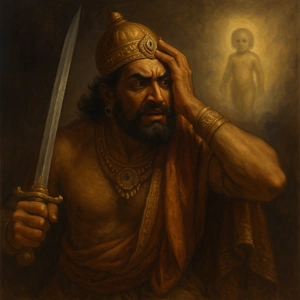
Today we will be looking at the meaning of the divya nama anuttama of the Lord and also why the first six children of Devaki and Vasudeva couple had to die miserably at the hands of Kamsa.
अनुत्तमः –
न त्वत्समोऽस्त्य प्यधिकः कुतोऽन्यः says Gita.
There is no one equal to you or greater than you.
उत्तमः – means greatest – other than you who is the greatest. There cannot be anyone who is the greatest of all other than you.
अविद्यमाने उत्तमो यस्मात् सः अनुत्तमः – there is no one greater than or nobler than him. Hence he is called anuttamaha.
उत्तमो नास्ति यस्मात्.
Kamsa smashed and killed the first six sons of Devaki Vasudeva couple. In fact, Kamsa had let go. When Vasudeva went to him with the first child as he had promised, Kamsa had said that I am not bothered about this child. It is the eighth child who will be a threat to me. But then Narada went and instigated him after which Kamsa killed every child including the first one.
This incident raises many doubts such as if this can happen in Krishna’s family, then what protection are we talking about by taking refuge in him? If the Lord did not bother to protect his own elder brothers, why would he protect us? These questions are characteristics of Kali Yuga. These doubts are characteristics of Kali Yuga. Earlier, people would simply accept them as his leelas. They just happened.
But today it is not like that. We are looking for reasons not to be a believer than be a believer.
So, a little bit of explanation here.
We give a lot of importance to death. But the rule is that nothing is permanent. Even the universe once it is created it has to go after 4.32 billion years. If you build a house, how long will it stay, 50 years, 100 years, 200 years maximum? Then you know what happens to it, its condition. What do you do, you demolish and build a new house. You feel excited about this. You don’t look at it as if you are killing the house, destroying the house. It is a positive thing. When the new house comes up you feel good about it. So this demolition is natural. It has to be there.
In the same way, the body is only a house or vehicle for the atma. It has to be discarded and a new body acquired. Then only there is progress for the atma. An atma cannot progress if it stays in the same body for long. It gets used to it. It gets entangled in the problems that happen in and around that body. This the Lord doesn’t want. He wants everyone to progress and eventually merge into him.
Death is natural. And reasons of death are many.
ये ते सहस्रमायतुं पशह मृयोः मर्त्याय हन्तवे says Veda. Mrityu devata has thousand, ten thousand ways of causing death.
We are only sentimental about death because being with someone is a habit. You don’t like breaking habits. Even if your newspaper doesn’t come at the specified time one day, you are upset. If salt is a little less in the food one day you are upset, you are angry. Sentiments are connected to habit. You are habituated to someone’s love and care. When that ends, you are upset. You don’t know what to do. You are not even bothered that that atma is soon going to acquire another body and continue its progress towards the final destination.
Your son or daughter gets admission in a premier institute and you don’t want him or her to go because you can’t bear the pain of separation. Aren’t you stunting their growth when you are doing this?
This is what happens at death also. They are moving forward, to a better state, a better body. Aren’t we too selfish when we grieve death of someone too close?
Our scriptures are very clear. They don’t allow rites to be performed if there are tears in the eyes of the performer, the son, or whoever it is. There is no scope for grief at death in our scriptures. In fact, the body should be submitted to agni as soon as possible, before sunset because otherwise you are becoming a hindrance in the progress of the deceased person. The rites are your contribution, your help in his or her progress, like packing bags, taking him or her to the railway station, airport, bus stand. This is how our scriptures look at death.
There is no rest in peace in Sanatana Dharma. There is no rest. They are setting out on a journey to a better level, to a higher level. You should say bon voyage than rest in peace. There is no time to rest.
Now coming to the killing of the first six children. These children are part of the Lord only, his six divine qualities. The Lord is famous for his six qualities. Why is he called Bhagawan? Because he has bhaga.
What is bhaga?
ऐश्वर्यस्य समग्रस्य वीर्यस्य यशसः श्रियः
ज्ञानवैराग्ययोश्चैव षण्णां भग इतीरणा
He is Bhagawan because he has these six qualities:
Aiswarya – lordship, rulership
Veerya – courage, valour, unrelenting stability of mind, doesn’t get upset about anything
Yashaa – fame
Shri – wealth
Jnana – knowledge
Vairagya – detachment, dispassion
Isn’t the Lord showing us a great principle here through this drama of his?
Rulership, power came alone, as the first son he was not there. Power, rulership that came without the Lord by its side soon perished.
Courage, valour that came alone, as the second son he was not there. Courage and valour that came without the Lord by its side soon perished.
Fame that came alone, as the third son he was not there. Fame that came alone, that came without the Lord by its side soon perished.
Wealth that came alone, as the fourth son he was not there. Wealth that came without the Lord by its side soon perished.
Knowledge that came alone, as the fifth son he was not there. Knowledge that came without the Lord by its side soon perished.
Vairagya that came alone, as the sixth son he was not there. Dispassion that came without the Lord by its side soon perished. Dispassion is bright and shining when there is Lord’s presence in it. Otherwise dispassion is lethargy or dark depression.
But then when he came as Krishna, as paripoorna tama, all these qualities also came with him, built into him, as part of him. Then they all stayed together in him. They never went away anywhere. Even today we are singing about them. What a revelation. Anything that comes without the divine presence in it, it would soon perish.
As a small addition to this, Marichi’s sons – six sons once laughed at Brahma. Marichi is Brahma’s son only. Brahma cursed them to take birth on earth. They were purified by their presence in Devaki’s womb itself. Narada was impatient to restore them to their original state as soon as possible. That’s why he instigated Kamsa.
-
Why is Bhagavan called anuttama and how does that change my practice?
-
If none is above him, then chanting his names is not one option among many; it is the main line. Fix a daily slot for sahasranama, small but non-negotiable.
-
-
What do I do with the shock of innocent suffering like Devaki’s first six children?
-
Hold sorrow in one hand and nama in the other. Do one round of a chosen name offering grief as prayer. The heart steadies without becoming hard.
-
-
If everything passes, what is the point of effort?
-
Nama is the effort that never spoils. Ten minutes of sahasranama done today remains as strength tomorrow. Make perishable life carry imperishable sound.
-
-
How can chanting keep power, fame, or wealth from corrupting me?
-
Place achievements at his feet daily: after chanting, say one line of surrender. It keeps position in place and the person in peace.
-
-
Can nama japa help when courage fails at the last minute?
-
Yes. Before a tough call, chant one name for nine breaths, eyes half-closed, exhale longer than inhale. Action becomes clean, not noisy.
-
-
How do I use sahasranama when fear of prophecy or future grips me?
-
Do a fear drill: 12 names slowly, palms on heart, then write the worst fear and burn the paper. Fear loses its throne; duty regains it.
-
-
What does krama, the divine order, look like in my day?
-
Same start time, same seat, same first name. Three constants build inner order. Body learns the road; mind follows.
-
-
How do I include my spouse or parents without debate?
-
Invite, do not instruct. Light one lamp, chant five names together, then silence for 30 seconds. Let calm do the convincing.
-
-
What name should I use when mind is noisy?
-
Pick the name that softens your breath within three repeats. Stay with it for 21 days. Depth beats variety.
-
-
Can chanting touch physical health in a way I can notice?
-
Do one minute of slow nama per hour during work. Heart rate settles, jaw unclenches, evening fatigue drops. Track sleep and headaches for two weeks.
-
-
How do I handle anger after loss or injustice?
-
Put the person or event into the mantra: chant a round offering them to Bhagavan by name. Anger loosens when ownership shifts.
-
-
What if time is brutally tight?
-
Floor practice: three names on waking, three before sleep. On heavy days, one long 'Govinda' with full exhale. Never zero.
-
-
How do I keep chanting from turning into dry routine?
-
Begin with a one-line sankalpa: who or what you place at his feet today. End with 30 seconds of quiet. Intention in, stillness out.
-
-
Can children meaningfully join?
-
Give them one name for a week and a small tally card. Celebrate consistency, not volume. Let them lead the closing three names.
-
-
What do I do when travel breaks my rhythm?
-
Fix a travel count of 27 names anytime, anywhere. Use a tiny mala or counter app. Same count keeps the thread unbroken.
-
-
How do I use nama during hospital visits or caregiving?
-
Match the patient’s breathing and chant softly. Your steady rhythm becomes their borrowed calm. Prayer supports hands that serve.
-
-
Is group chanting stronger than solo?
-
Use both rails. Group for momentum on one day a week; solo for depth on the others. Momentum plus depth sustains.
-
-
How do I test if practice is actually working?
-
Watch inner metrics: quicker recovery from irritation, kinder words under pressure, steadier sleep, less doom-scrolling. If these rise, you are on track.
-
-
What is a safe way to scale up?
-
Keep a floor you never break and a ceiling you enjoy. Floor: 3 names. Ceiling: 108. Grow slowly, keep sweetness, and you will last.
-





English
Vishnu Sahasranama
Click on any topic to open
7
30
Astrology
Bhagavad Gita
Bhagavatam
Bharat Matha
Devi
Devi Mahatmyam
Ganapathy
Garuda Puranam
Glory of Venkatesha
Hanuman
Kathopanishad
Mahabharatam
Mantra Shastra
Mystique
Practical Wisdom
Purana Stories
Radhe Radhe
Ramayana
Rare Topics
Rigveda Explained
Rituals
Sages and Saints
Shiva
Spiritual books
Sri Suktam
Story of Sri Yantra
Temples
Vedas
Vishnu Sahasranama
Yoga Vasishta
26
17
10
0


