Wealth Science in Our Scriptures
Once a lady told that her young baby girl does not sleep at all – she keeps awake throughout the night – so others in the family are also not able to sleep.
You see all of them with drowsy eyes throughout the day because they are not able to sleep in the night.
Asked her what is the name of the child.
She said – Vinidra.
What does it mean? Vinidra means without nidra – sleepless.
Where did you get this name?
She says – that is name of Devi – she got it online.
For Devi it is ok – Devi can be Vinidra.
But if you name a child Vinidra – this is what happens – it will not sleep.
This is the problem with selecting names from those websites – called Hindu names for boys, Hindu names for girls.
People behind these websites, they do not know head or tail of what the name could mean or the consequences like this.
Many more experiences like this.
Another name – Kiyan – means how many? Kiyat is singular. Plural of that is Kiyan.
Where did this come from?
Jnana is probably what is meant here – Jnan.
Jnan when pronounced in Hindi became Gyan.
Gyan when copy pasted from website to website and linguistic aberrations and vernacular pronunciations should have become Giyaan and finally Kiyan.
And you have a boy who stares at your face with a question Kiyan? How many?
What how many?
How many do you want? How many are you?
This is what happens.
Another person asked me recently – I have named my child Videy – what could be the meaning of this?
After naming the child he is asking – what could be the meaning?
If you conjure a meaning out of this name, it could be visheshana deyam.
Something to be given away specially – visheshena deyam.
Is this what he wants to do with his child?
So coming back to Chandra – Chandra means something that gives ahlada – pleasantness.
चन्द्रां – तापत्रयतप्तान् स्वसमाश्रयणॊन्मुखान् आह्लादयन्तीम्
She gives happiness to those who are burning in the three kinds of tapas – miseries – adhyatmika, adhibhautika, adhidaivika tapas, happiness to those who take refuge in her.
That is why she is called Chandra.
हिरण्मयीं – हिरण्यादिसर्वधनप्रचुराम् –
She has all kinds of wealth in abundance with her.
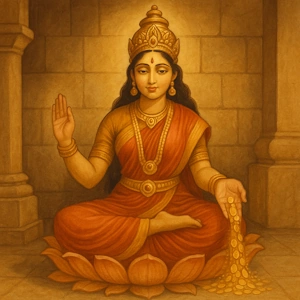
And she is called वामहस्तवसुप्रदा – she gives this wealth with her left hand.
That is why we see in photos of Lakshmi, gold coins pouring down from her left hand.
वसुधारामुदारां च हरिणीं वसुवर्षिणीम्
धनधान्यकरीं सिद्धि< वसुधां वसुधारिणीम्
निधिद्वयेनापि धनं प्रापयन्तीं मनोरथान्
Vasu means wealth.
Wealth flows down like a stream, like a waterfall from her left hand.
She rains wealth.
When she blesses, it is not a pot full or a few pot fulls of gold coins as we see in photos.
She rains wealth – money, grains, whatever you need.
Because she is Vasudhaa – because all these are under her command only, all these are with her only. She is Vasudharinee.
Shastras talk about different kinds of wealth.
पद्मिनी नाम या विद्या लक्ष्मीस्तस्याधिदेवता
This vidya, knowledge about wealth, is called Padmini – what you may probably call wealth management or asset management today.
This was called Padmini in scripture.
This knowledge called Padmini classifies nidhi, wealth, into eight different types.
तत्र पद्ममहापद्मौ तथा मकरकच्छपौ ।
मुकुन्दनीलौ नन्दश्च शङ्खश्चैवाष्टमो निधिः
Padma, Mahapadma, Makara, Kachchapa, Mukunda, Neela, Nanda, Shankha.
Padma is inherited wealth.
Mahapadma is earned through mining of gold, silver, copper and other metals.
Makara – wealth earned through weapons, providing security, professions employing force.
Kachchapa is money earned through dubious means, which involves deception, cheating, short changing others.
Mukunda is wealth earned through arts as professions like music, dance, acting.
Neela – is wealth earned making use of natural resources like agricultural produce, digging of wells, selling flowers, perfumes, beautifying creams.
Nanda is wealth earned through trading of precious metals and other articles like musical instruments, trading in general.
Shankha – wealth amassed by misers is called Shankha.
Lakshmi Devi is the goddess of all kinds of this wealth.
Nidhidvaya – some of these are desirable, some are not desirable – like money earned through unfair means, amassed by a miser – still she is the governing deity even for those kinds of wealth.
Again as an expansion of this nidhidvaya, it is said:
शंखपद्मनिधी लक्ष्म्यां पादयोरग्रतः स्थितौ
पश्यन्तौ मुखमन्योन्यं वमन्तौ विपुलं धनम्
The two kinds of wealth – Shankha and Padma stay at her feet, in front of her feet, facing each other – and wealth keeps on coming out of them.
Nothing much is known about Lakshmi Devi, not much literature is available, that is why we are elaborating a little more on her.
Chandram Hiranmayeem Lakshmeem.
Lakshmi means – सर्वसुरासुर मनुज मुनीन्द्रादिभिर्लक्षणीया प्रार्थनीया
सर्वैश्वर्यनिमित्तभूत दिव्य लक्षणसंपन्ना
Everyone prays to her – she is lakshaneeya of everyone – Devas, Asuras, humans, Rishis – everyone.
They are all oriented towards her.
She has all the lakshanas that indicate aishwarya.
Her attire, her ornaments, her beauty – everything indicates prosperity, aishwarya.
This is normal – beauty, aesthetics and wealth go hand in hand.
You will always see that places where affluent people live, where they move about are well decorated, beautiful.
It is not just that costly objects are found there, they are also beautiful to look at. Wherever Lakshmi is present you will find that place to be well decorated with a wealthy look.
This is because she has those lakshanas of wealth.
Wherever she is present that place will have a posh look.
She is present means – she is present everywhere.
We are talking about this one particular aspect of the goddess – as the provider of wealth.
Now – Jatavedo ma aavaha.
Jatavedo, Sri Hari is being addressed.
Ma aavaha – bring her to me.
Bring Lakshmi Devi who is Hiranyavarna, Harinee, Suvarna Rajata Srajaa, Chandra and Hiranmayee – bring her to me.
Sri Hari is being prayed to.
-
Do names influence a child’s mind and habits?
Yes. A name works like a daily suggestion. It shapes self-image, family stories, and how others respond. Choose meanings that reinforce calm, courage, and kindness. -
How should I choose a child’s name responsibly?
Verify the root and meaning across major Indian languages. Ask a learned elder. Avoid random web lists. Say the name aloud in daily sentences and check for unwanted meanings. -
Is wealth only money?
No. Wealth includes health, time, knowledge, skills, reputation, family harmony, land or tools, and money. Real prosperity is these working together. -
Why do some homes feel prosperous even before counting money?
Order, cleanliness, light, and beauty signal respect for resources. A tidy home trains the mind toward clarity and growth. -
Can the source of income affect peace and health?
Yes. Unfair earnings breed anxiety, conflict, and hidden costs. Clean earnings support steady sleep, better relationships, and clear decisions. -
How do I align prayer for prosperity with action?
Make a daily sankalpa, work diligently, avoid waste, upskill, and serve others. Prayer sets direction; disciplined action carries it through. -
What daily habit invites abundance without superstition?
Wake early, keep a simple puja room, write three gratitudes, review expenses, and give a small portion in charity. -
How does this view treat physical health?
Body is the vessel of dharma. Guard sleep, digestion, and breath. Simple food, regular movement, and sunlight are non-negotiable foundations of prosperity. -
What about family money talks without fights?
Hold a weekly 30-minute money meet. List income, bills, goals, and one small improvement. Write decisions. No blame, only next steps. -
How should partners handle love, money, and trust?
Share budgets and passwords, agree on spending limits, plan goals together, and celebrate small wins. Secrets poison both love and wealth. -
Can gentle chants or routines help children sleep and eat better?
Yes, as calming cues. Keep evenings quiet, use soft light, hum lullabies, and maintain consistent timings. If problems persist, see a doctor. -
What is a clean test before accepting money?
Ask: lawful, truthful, non-harmful, and value-creating. If any answer is no, decline it. Shortcuts steal future peace. -
What if a chosen name carries an awkward meaning?
Add an auspicious middle name or nickname, teach the positive sense you intend, and use it consistently. Do not be fatalistic; environment and guidance are stronger. -
How do I balance charity and savings?
Use a simple rule like 50-30-20 or a plan that fits your stage. Give regularly yet prudently, first secure essentials and emergency funds. -
How do festivals and rituals relate to prosperity?
They renew gratitude, unite family, and reset habits. Treat them as fuel for better conduct, not as substitutes for effort. -
What role do women and men play in prosperity?
Shared stewardship. Plan, earn, care, and decide together. Respect each person’s strengths; prosperity grows where dignity is shared. -
How to handle envy when others progress faster?
Turn envy into inquiry. Study their habits, adopt what is ethical and effective, and keep your lane steady. -
What should children learn about money early?
Chores linked to rewards, simple jars for spend-save-give, and stories that praise honesty and effort, not shortcuts. -
How do I know which opportunities to pursue?
Prefer work that builds skills, relationships, and reputation along with income. If it damages health or family time, the price is too high. -
What is a simple prosperity checklist for daily life?
Sleep on time, eat simple, move daily, track expenses, learn one thing, help one person, and keep your space clean.





English
Vishnu Sahasranama
Click on any topic to open
7
30
Astrology
Bhagavad Gita
Bhagavatam
Bharat Matha
Devi
Devi Mahatmyam
Ganapathy
Garuda Puranam
Glory of Venkatesha
Hanuman
Kathopanishad
Mahabharatam
Mantra Shastra
Mystique
Practical Wisdom
Purana Stories
Radhe Radhe
Ramayana
Rare Topics
Rigveda Explained
Rituals
Sages and Saints
Shiva
Spiritual books
Sri Suktam
Story of Sri Yantra
Temples
Vedas
Vishnu Sahasranama
Yoga Vasishta
26
17
10
0


