Vairagya Means a Shift of Focus
What is vairagya?
We have heard this — without developing vairagya, there cannot be any spiritual progress. Vairagya is a shift of focus — shift of focus of your attention. Away from worldly objects, whatever you see around you. Or rather, you would stop seeing many or most of them.
There is no effort involved. You don’t have to forcefully take your attention away from them. They become irrelevant to you. All these objects — they would neither invoke like nor dislike in you.
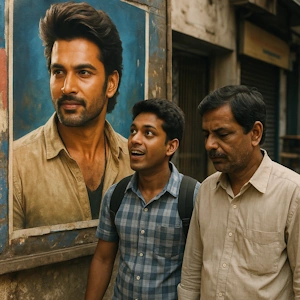
You see the poster of a film actor, a superhero. It will bring many thoughts in your mind — in a normal mind. It is simply a pleasure to look at him. This is natural. Merely looking at beauty brings pleasure in the mind.
This is natural — I want to be like him. I want his six-pack. I want his energy. I want his style. What if he suddenly lands up at my home — how great it will be. What if he becomes friends with me. These kinds of thoughts come to your mind.
Someone with vairagya — he wouldn’t even notice that poster. None of these things matter to him. So both the common man and the viragi — they both see the same poster.
It evokes so many thoughts in the common man’s mind — not just these — how successful he is, how much money he is making. Not always positive thoughts also — he is a womanizer, his moral side is weak, all kinds of thought.
If you have vairagya, you are not bothered. You will see the poster, through your eyes it will go into your mind. You may even recognize the person, but it will not evoke any such thoughts in your mind. This is vairagya — lack of raga, passion, attachment.
A biologist can develop this — because he knows that the body of the hero is just a collection of so many cells, which have a limited life — a few days, a few weeks — they get replaced. The body that he has today — after ten years, it is not even that body — all the cells would have died and they are all new cells. It is not even the same person after ten years.
A biologist knows all this. But still, he is fascinated by the hero. He has knowledge. Still, he is fascinated. Why? Because he doesn’t apply that knowledge in his personal life. For him, biology is just a livelihood. Biology is just a career. His personal vision, his personal perspective, is still underdeveloped, immature.
Any branch of knowledge — even absolutely materialistic knowledge — can give you vision.
There are those in the stock market — all kinds of graphs, analysis — they say, I am a market analyst, I know where which company is going. I can predict with 78% accuracy — that is my track record. You take a stock, they will tell you — on the 15th of November, what is going to be its price.
But does it happen like that? They will say — 230% by 15th of November — and the company would have gone into bankruptcy on that date.
Even they — the stock market experts — by making use of the knowledge that they have learned, that they use every day, they can also understand the fallacy of all this. How unpredictable everything is. It is not your prediction and your plan that is at work. It is somebody else’s.
Coming back to vairagya — even purely materialistic knowledge can lead you both ways. But through materialistic knowledge, if you are going the right way, then you should be blessed. Only then this happens.
Because materialistic knowledge inherently is only capable of taking your attention away from the truth — away from facts.
Don’t think that if you turn your head away when you see that poster — that is the solution. It could help. But that is not the permanent solution.
Scriptures point out how vairagya develops — some of them — there could be other reasons also.
Vairagya can come out of fear — fear of consequences. To enjoy something, you need to get it first. To get it, effort is required. While making effort, you may be incurring papa. Papa will land you in naraka. There is suffering in naraka.
So, let me stay away from the enjoyment itself — the consequence of which is suffering. By milking a cow and drinking that milk, am I not depriving its calf of what is meant for it? So, let me not drink milk at all. Cow produces milk for its own calf, not for me.
Even though I like milk, I know its nourishing value — let me stay away from it. Because the consequences of the papa by depriving the calf of its mother’s milk will be there — which I don’t want to suffer.
You will see this in many forms of ascetics. They will not put any effort towards anything. Or they will only go for the most harmless kinds of activities for the sustenance of the body. They will collect fallen grains from the field and consume — this is called unchavritti.
They will not do agriculture. They will not cultivate. They will not put their feet on the ground because they may kill insects. But sometimes, this thought can go astray also — because it is a product of human intelligence.
Instead of walking on your own, fearing that you will harm insects, four people will carry you in a palanquin kind of thing — this also we see. Instead of one pair of feet trampling insects, now there are four pairs killing four times the insects. This can also happen.
Vairagya can come out of intelligent thought. That rich Punjabi dish — seeing which your mouth starts watering — it has so much of fat content, cholesterol — today it will taste good, but it will get me disease, my health will suffer.
So, even though it is tasty today, let me stay away from it — this is vairagya through thought.
The difference between the earlier one and this is that — there, the consequences — you don’t really know whether they exist or not. You don’t know for sure whether there is naraka or not. But still, you have fear for naraka.
Here, you know that your cholesterol will go up if you go on taking that rich food. You are certain. What appears to be giving you joy is, in fact, giving you a problem. This conclusion you have developed out of thinking. This is also vairagya.
Vairagya can come out of sadhana. There is no thinking involved in this. Here, your focus simply shifts away from worldly objects — both pleasure-giving and pain-giving. They are not important to you anymore. They don’t matter to you anymore. You are focused on the divinity.
When you are sitting inside a cinema hall and enjoying a movie, it may be raining outside, there may be riots going on outside — you hardly notice. Your attention is elsewhere. Your focus is elsewhere.
Out of these three, vairagya that comes through sadhana is the strongest, most stable, ever-growing — and at one stage, it turns into atma jnana by itself — parama tatva jnana by itself.
This sadhana can be jnana sadhana also. Then it will never go away. Then nothing will pull you back into the world.
You don’t renounce the world. You also eat, drink, sleep, talk to others. You behave normally. But nothing binds you. You are not bonded. You are free — free from everything.
This is the state everyone should aspire for — the state of absolute freedom.





English
Rare Topics
Click on any topic to open
7
30
Astrology
Bhagavad Gita
Bhagavatam
Bharat Matha
Devi
Devi Mahatmyam
Ganapathy
Garuda Puranam
Glory of Venkatesha
Hanuman
Kathopanishad
Mahabharatam
Mantra Shastra
Mystique
Practical Wisdom
Purana Stories
Radhe Radhe
Ramayana
Rare Topics
Rigveda Explained
Rituals
Sages and Saints
Shiva
Spiritual books
Sri Suktam
Story of Sri Yantra
Temples
Vedas
Vishnu Sahasranama
Yoga Vasishta
26
17
10
0


