Is It Really Possible to Infuse Prana Into a Stone Idol?
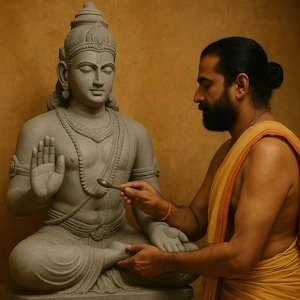
There are some doubts in the minds of many about Prana Pratishtha.
Prana Pratishtha done on idols. In temples.
Is it really possible to infuse life into a stone idol, or whatever material the idol is made of?
In the case of some, this is a natural curiosity.
In the case of some, this doubt is instigated.
Some sects, or one particular sect which claims to be part of Hinduism, has been doing this propaganda — that prana can never be infused into dead stone.
They say this is not there in the Vedas.
So, these are later money-making ventures of the priestly class.
This 'make-believe' is a money-making venture.
This is the propaganda. They even go to the extent of challenging the concept, asking — then why is the idol not walking around if it really has life?
Let’s look at what is the meaning of the word prana — meaning of meanings.
प्राणिति जीवति अनेन बहुकालम् — Prana is that by which a living being lives. Whatever that is.
If there is prana in something, then it is living. Otherwise, it is not.
So, basically, from a devotee’s point of view — what he wants is a living God, right?
One who will listen to him, answer his prayers.
That is the expectation of the devotee.
That’s why he doesn’t go in front of any dead stone and pray.
He would prefer to pray to a living God.
Is there anything wrong in it? Isn’t it his personal right?
So, imagine a situation where you walk into a temple, you are disturbed, in some kind of trouble.
An elderly person standing there tells you:
‘Pray to Him, pray to Her, your problem will be solved.’
Or
‘Don’t be stupid. That’s a dead stone in there. They are making money. Fooling you.’
Which one would you prefer?
It is your personal choice.
So, if you have faith, you would prefer to interact with a living God.
Another meaning —
सर्वभूतोत्पत्तिप्रलयहेतुरूपलिङ्गात् ब्रह्मण एव प्राणशब्दवाच्यता
Prana means Parabrahma, Paramatma — because Parabrahma alone creates, sustains, and destroys — everyone, everything.
This is another meaning of prana.
पञ्चवृत्तिके देहस्थे वायौ – प्राणः
प्राण, अपान, व्यान, उदान, समानाः — the five kinds of internal forces within the body responsible for all kinds of actions — breathing, digestion, circulation, excretion — all activities within the body. They are also called pranas.
प्राणः बले — prana means strength.
Prana means air — air that is in breath — तस्य कर्म नासाग्रतो बहिर्गतिः — it goes out from the nostrils.
That is how you identify it.
So many meanings.
Which one you want to take depends on your intelligence and your mental capacity to envisage the scope of each one.
If you have a small brain, you can go for the meaning — air or breathing — and say, ‘No, I don’t see the idol breathing.’
If you are more evolved, you can say — ‘Yes, this idol is Parabrahma. I don’t see any difference. Everything is Parabrahma.’
That depends on where you are.
Prana Pratishtha means infusing or applying any, many, or all of these concepts on an idol made of just stone.
Or negate. That is up to you. Up to your level of understanding.
Why do you have to even apply these concepts on a stone idol?
Let’s say you have a neighbour. A youngster, 25 years old.
He gets recruited into the police as an inspector. Undergoes training. Comes back.
Does he still move around in casuals, in short pants, and try to enforce law?
No, it doesn’t work that way.
The society gives him a uniform, a badge, a weapon, a vehicle.
That makes him stand out. Isn’t this also a make-believe?
But can he deliver in the absence of that?
We give him authority. By giving him that authority, we are showing our willingness to comply with his authority.
In the same way, when we infuse prana into a stone idol, we are expressing our willingness to accept that — yes, hereafter we are willing to accept that this is a living God in front of us, not just a stone idol as it used to be.
We all need this — to function. To function as a human being, as a society.
These presumptions and postulates — they alone turn into reality.
We presume — this is my father, this is my mother — and interact with them accordingly.
You remove these concepts — then it is animal living. The society will collapse.
There are hundreds of such presumptions, postulates, and codes with which we live our daily life.
We need these concepts. We need this structure.
If a judge calls the litigants and advocates to a coffee shop and hears them — will it work?
We need the court. We need the discipline.
Then only it delivers results.
Only such systems deliver results. Anything tangible.
So, if you want to say that Prana Pratishtha is a humbug, then you will also challenge the authority of police, of governments, of courts.
Somebody doesn’t just become an authority because you call him an authority, because he takes oath as a judge. They are all just humans.
Does it work that way?
So, essentially, Prana Pratishtha is for the benefit of the devotee.
It is an affirmation — that yes, this is a living God in front of me.
I can talk to Him. I can open up to Him. I can cry in front of Him — just like how I can do with a human being.
And He will reciprocate. He will answer my prayer. He will solve my problem. He will protect me.
Isn’t this a big support system? Don’t we all need such support systems?
Are we all strong enough to survive on logic and rationalism and scientism when troubles come?
You may be — so be you.
Why are you trying to interfere in others’ matters? What right do you have?
That these people with vested interests are trying to undermine — knowingly.
Now, another point.
Is this part of the Vedas?
Does Veda recognize that there can be godliness, divinity in stone?
Take Sri Rudram — Ninth Anuvaka:
नम इरिण्याय च प्रपथ्याय च नमः किंशिलाय च क्षयणाय च
Kim Shilah — Kshudrah Shilah — Lord Shiva is there even in small, small stones.
This is what Veda says — and you are propagating that it is not there in the Vedas.
‘God cannot be there in stones,’ you say.
But Veda doesn’t agree with you.
God can be even there in small stones. What is your problem?
Our rishis have said God is there in everything — including stones.
What is your problem?
अग्निर्भूम्यामोषधीष्वग्निमापो बिभ्रत्यग्निरश्मसु
Ashma means stone.
Agni Deva is there in bhumi, plants and herbs, in water, in stones.
What is your problem?
Don’t mislead people by saying that it is not there in the Vedas.
How many more examples do you want?
Now, another question has come up.
This is a genuine question.
Do the mantras used in Prana Pratishtha convey this meaning — that prana is being infused in the idol?
We will take two mantras, two commonly used mantras in Prana Pratishtha:
ॐ आं ह्रीं क्रों यं रं लं वं शं षं सं हं ळं क्षं हं सः अमुकदेवतायाः प्राणा इह प्राणाः
Here, if you see — first, Pranava, then:
आं – the Ankusha beeja
क्रों – Pasha beeja
ह्रीं – in between, after Ankusha – Hreem is the Shakti beeja, the force within everything. The power within everything.
Before Prana Pratishtha, the idol is just stone.
Now, with the Ankusha Shakti, Prana Shakti is being pulled into the idol and then made to sit there permanently with Pasha, a rope – Krom, Pasha Beeja. Prana is tied to the idol with the rope.
After that, the other Beejaksharas — we will not go into so much detail.
After the name of the particular devata is taken — Shivadevataayah, Vishnudevataayah.
प्राणा इह प्राणाः – the pranas of this devata are now present here.
The second mantra:
ॐ आं ह्रीं क्रों यं रं लं वं शं षं सं हं ळं क्षं हं सः अमुकदेवतायाः जीव इह स्थितः
The jiva, life of this devata, is also present here.
So in the mantra itself it is clear — prana and jiva are different.
Even without understanding this, is this propaganda happening?
ॐ आं ह्रीं क्रों यं रं लं वं शं षं सं हं ळं क्षं हं सः अमुकदेवतायाः सर्वेन्द्रियाणि वाङ्मनस्त्वक् चक्षुः श्रोत्र जिह्वा घ्राण पाणि पाद पायूपस्थानि इहैवागत्य स्वस्तये सुखेन सुस्थिरं सुचिरं तिष्ठन्तु स्वाहा
All organs — speech, mind, skin, ears, tongue, nose, hands, legs, excretory organs, genitals — may they all come here for our welfare.
May they all be here, comfortably, permanently. May they all be stable here.
What for? स्वस्तये — for swasti.
In earlier days, everyone used to understand these mantras — why it is being done.
Now, absolute ignorance — deliberately created ignorance.
We start doubting. We become vulnerable to this propaganda — ‘How can stone be God?’
Another mantra from Rigveda used in Prana Pratishtha:
असुनीते पुनरस्मासु चक्षुः पुनः प्राणमिह नो धेहि भोगम् ।
ज्योक्पश्येम सूर्यमुच्चरन्तमनुमते मृळया नः स्वस्ति
He Asunite — he pranadayini Devi —
Install vision, install prana, enable enjoyments, may the rising sun be seen every day.
There are many more mantras:
ॐ मनो मे तर्पयत वाचं मे तर्पयत — that is why it is being done.
ऐन्द्रः प्राणो अङ्गे अङ्गे निदीध्यत्, ऐन्द्र उदानो अङ्गे अङ्गे निधीतः
मनस्त आप्यायतां वाक्त आप्यायतां
अस्यै प्राणाः प्रतिष्ठन्तु, अस्यै प्राणाः क्षरन्तु च — not only installing prana — the power should radiate, flow out to bless the devotees.
अस्यै देवत्वमर्चायै मामहेति च कश्चन
This is how devatvam is given to a stone idol.
This is why devatvam is given to a stone idol.





English
Rare Topics
Click on any topic to open
7
30
Astrology
Bhagavad Gita
Bhagavatam
Bharat Matha
Devi
Devi Mahatmyam
Ganapathy
Garuda Puranam
Glory of Venkatesha
Hanuman
Kathopanishad
Mahabharatam
Mantra Shastra
Mystique
Practical Wisdom
Purana Stories
Radhe Radhe
Ramayana
Rare Topics
Rigveda Explained
Rituals
Sages and Saints
Shiva
Spiritual books
Sri Suktam
Story of Sri Yantra
Temples
Vedas
Vishnu Sahasranama
Yoga Vasishta
26
17
10
0


