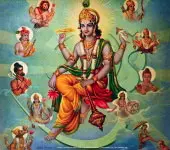
True Nature of Sri Hari

पूतात्मा
Now the name भूतकृत् indicates two things – rajoguna of creation and tamoguna in dissolution. Then भूतभृत्, through sustenance, shows satva guna. Question comes to us – whether Sri Hari has these three gunas?
The answer is पूतात्मा. Puta means pure, spotless. पूतात्मा – पूत आत्मा यस्य सः पूतात्मा – his nature is pure. He, as Paramatma, is pure. Even though he alone is all beings which suffer illusions and delusions, his true self is pure.
A teacher taught mathematics to the students of class 10. They did not study properly, wasted their time away, and failed in the board exams. But we never say that the teacher failed in the board exam. Only the students failed. So, even when what he created are affected by impurities, Sri Hari, as their atma, is always pure.
Upanishads explain how the Paramatma is pure through allegories –
अजामेकां लोहितशुक्लकृष्णां बह्वीं प्रजां जनयन्तीं सरूपाम्
अजो ह्येको जुषमाणोऽनुशेते जहात्येनां भुक्तभोगामजोऽन्यः
The female goat Ajaa gives birth to numerous lambs of red, white, and black colours. The goat is Prakriti, and the lambs are the beings with satva-rajas-tamo gunas – red representing rajoguna, white representing satvaguna, and black representing tamoguna. One male goat chooses to be with her, experiencing pleasure and pain. This is Jeevatma. Another male goat simply walks away – this is Paramatma, who does not want to undergo experiences.
The choice is yours, the decision is yours – whether you want to experience pain and pleasure or not. If you want to enjoy pleasure, then there is definitely going to be pain also. They come together. Or you can do away with both and walk away.
This walking away does not mean physical walking away from the world or from worldly responsibilities. Walking away means walking away from enjoyment and suffering. They still will be there. When you eat, your tongue will still recognize a delightful taste. When a mosquito bites, it is not that you do not feel it. But you do not bother any more – you stop worrying about dengue and malaria and the huge hospital expenses involved. You stop thinking about how you are not fortunate enough to live in a posh locality where there are no mosquitoes. You do not curse the municipal authorities for collecting tax from you and doing a shoddy job of mosquito control.
This is the only difference. The incident of mosquito bite will not trigger so many thought processes in your mind. The bite will still hurt, you will still hit the mosquito, you will still scratch – that is it.
When the mosquito bites you, you will not sit there looking at the mosquito, sympathizing with it, saying it has a right to food, you cannot stop it, you cannot harm it. As long as the body exists, these feelings of pleasure and pain will still be there. It is unavoidable. Or you should be paralyzed numb from head to toe.
Realization does not mean paralysis or numbness. It is an awareness – the true awareness of what things are, how things are, in their right quantity and importance.
-
Does Bhagavan have the three gunas?
No. He wields satva, rajas, and tamas as tools for sustaining, creating, and dissolving. They never stick to him. -
If he uses gunas, why is he still pure?
Because use is not the same as identification. Like a teacher using chalk does not become chalk, Bhagavan employs gunas without being limited by them. -
What does ‘pure nature’ actually mean?
Changeless, self-luminous awareness. Not increased by good deeds, not reduced by mistakes. Contact happens, contamination does not. -
What is the difference between jivatma and Paramatma?
Jivatma identifies with body and mind and so swings between pleasure and pain. Paramatma is the witnessing consciousness that never swings. -
If pleasure brings pain, should I avoid life?
Do your duty and enjoy what comes without clutching at it. Clinging breeds pain; clarity frees you while you still act. -
Does detachment mean abandoning family and work?
No. It means dropping inner addiction to outcomes while fully meeting responsibilities. -
After realization, will pain vanish?
Sensations remain, but the mental storm stops. You respond wisely instead of spiraling. -
Is it wrong to protect myself, like swatting a mosquito?
Self-protection is fine. Act with proportion and without cruelty or anger. -
How do I practice this in daily life?
Notice sensations, drop the storyline, act dharmically. Keep the mind satvic through clean food, honest work, steady breath, and regular remembrance of Sri Hari. -
What is the role of satva if the goal is beyond gunas?
Satva steadies the mind so you can clearly see. From that clarity you transcend all three. -
Why do scriptures use allegories and symbols?
To show how one reality appears as many. Symbols compress subtle truths into memorable pictures. -
Where does free will fit in?
You choose what to identify with. Choose clarity over craving, duty over drift. Results follow the larger order. -
How do I know I am progressing?
Quicker recovery from highs and lows, fewer resentments, more responsibility with less anxiety, deeper quiet within action. -
Can this path work in modern life with phones, deadlines, and noise?
Yes. Use tools; do not let tools use you. Bring the same inner steadiness to email and to prayer. -
Is devotion necessary or is logic enough?
Devotion powers logic with love. Loving Bhagavan makes letting go natural, not forced. -
What is the end state aimed at here?
Stable peace, clear understanding, compassionate action. Pleasure and pain arise and pass; you remain free.





English
Vishnu Sahasranama
Click on any topic to open
7
30
Astrology
Bhagavad Gita
Bhagavatam
Bharat Matha
Devi
Devi Mahatmyam
Ganapathy
Garuda Puranam
Glory of Venkatesha
Hanuman
Kathopanishad
Mahabharatam
Mantra Shastra
Mystique
Practical Wisdom
Purana Stories
Radhe Radhe
Ramayana
Rare Topics
Rigveda Explained
Rituals
Sages and Saints
Shiva
Spiritual books
Sri Suktam
Story of Sri Yantra
Temples
Vedas
Vishnu Sahasranama
Yoga Vasishta
26
17
10
0


