There Is Something Very Peculiar About the Hare Rama Mantra
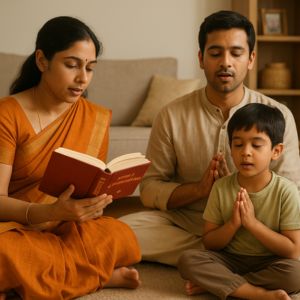
प्रभूतः – प्रभूतं means abundance. Sri Hari has jnana in abundance and aiswarya in abundance in him. Hence he is called प्रभूतः.
Be mindful of what I said abundance in him, not abundance with him.
प्रभूतः
भॊगॊपकरणं नित्यं निर्मर्यादं परं पदम् |
यस्य तॆन समृद्धत्वात् प्रभूत इति कथ्यतॆ
Means of enjoyment provided by him are boundless because they are not limited by the organs of enjoyment. He can provide ananda that is limitless. There is a limit to which you can enjoy through your senses. How much can you eat. Till your stomach is full. After that also if you are forced to eat, then it is a torture for you.
How many songs can you hear at a stretch? For a few hours, for couple of days, not more than that. After that either you get bored or you have to take rest. The pleasure that Sri Hari is capable of giving is brahmananda, it is continuous, it doesn’t have to stop. While enjoying brahmananda you don’t have to stop. You don’t feel bored. You don’t feel enough. You don’t have to take rest. Even when you are taking rest, brahmananda is still there for you.
He has this in abundance in him. Sri Hari can also give this to you. Hence he is called प्रभूतः.
The famous mantra Hare Rama Hare Rama …….. is very peculiar.
You take Om Namo Narayanaya – namaskara to Narayana – there is a kriya in this mantra – offering namaskara to Narayana. Same is the case with Om Namo Bhagawate Vasudevaya – namaskara to Bhagawan Vasudeva.
There are mantras with specific prayers – Dehi me tanayam Krishna tvamaham sharanam vrajaha – give me a progeny.
But in Hare Rama mantra there is no kriya pada, there is no prayer. All the terms in this mantra are in sambodhana.
Hare is sambodhana of Harih – you are simply addressing him, calling out to him – hey Hare. Krishna is sambodhana for Krishnah. If you have to call someone with the name Krishna you address him as Krishna, without the visarga. This is sambodhana vibhakti. Same is the case with Rama also. Ramah – as sambodhana – Rama.
So the entire mantra – there is no kriya pada. There is no prayer. You are only calling him, calling out for his attention. There is nothing that you are asking for. There is nothing that you are doing. You are only calling out to him so that his attention falls upon you.
You are simply addressing him as hey Hare, hey Krishna, hey Rama.
This is a matured devotee. He doesn’t know what to do. He doesn’t know what to ask for. This devotee wants Sri Hari to make him or her do whatever is appropriate. This devotee wants Sri Hari to make him or her ask whatever is appropriate if at all there is anything to ask. He doesn’t want to do anything on his own. He doesn’t have any need of his own, any prayer of his own. Sri Hari has to take over completely.
You are only calling his attention. And the devotee is confident about two things.
One – if you call out to him, you will get his attention.
Two – once you have his attention, he will take over completely. He will manage you completely thereafter.
-
If this mantra is only calling out, what am I actually doing.
You are opening a channel. Nama japa is a clean ping: your tongue moves, breath steadies, mind aligns. A clear, repeated call is noticed. That is the point. -
Why chant if I do not ask for anything.
Because asking is smaller than attention. When Sri Hari’s attention lands, guidance and protection follow. The right actions and the right asks show up on their own. -
How does sahasranama help a restless brain.
A thousand names force gentle focus shifts without boredom. It trains attention the way interval training builds stamina: brief pivots, steady rhythm, no strain. -
What is the simplest daily structure that never collapses.
One fixed seat, one lamp, one mala. 108 of a single nama first, then one sahasranama segment. Same time daily. Predictability beats motivation. -
How do I chant when I am emotionally numb.
Use the body to lead. Sit tall, soften jaw, chant slightly aloud. Count with fingers if mala is not handy. Feeling catches up to posture and sound. -
How do I keep from turning the practice into a transaction.
Close each round with: ‘All results at your feet, Sri Hari.’ That sentence cuts the ego loop and keeps the channel clean. -
What is the test that my japa is authentic.
You recover faster from anger, you keep promises better, and you reduce one harmful habit. If these three rise, the practice is real. -
How do I link chanting to physical health without fantasy.
Pair nama with breath: one name per exhale for 5 minutes. You will see calmer pulse, steadier sugar decisions, and better sleep onset. The name does not replace care; it makes care effective. -
Family resists group prayer; how do I avoid fights.
Keep a 90-second anchor before dinner. Low volume, no lectures. End with one round of gratitude. Rhythm first; belief matures later. -
Someone mocks the practice at home; what do I do.
Shrink the display, increase the discipline. Quiet consistency and kinder speech will outlast sarcasm. Results argue better than replies. -
How do I use sahasranama on a bad decision day.
Do ‘repair rounds’: pick 12 names, chant them slowly, then take one corrective action in the next hour. Japa without repair is noise; japa with repair is progress. -
Is faster chanting better.
No. Clear wins over quick. Choose a pace where every name lands. Ten minutes daily with clarity outperforms a rushed hour. -
What about travel and long workdays.
Use a 3-3-3 rule: three minutes at wake-up, three at lunch, three before sleep. Earbuds for sahasranama listening; whisper japa in queues. -
How can I bring children in without boredom.
Give them a chorus nama for 60 seconds and a single line meaning from today’s five names. Joy first; length grows later. -
What do I do when cravings or anger hit mid-chant.
Switch to a burst: one nama a bit louder for 60 seconds, then 30 seconds silence. Energy is neutral; you decide its direction. -
How do I avoid spiritual pride as the practice deepens.
Keep score on service, not status. Do one anonymous helpful act after each full sahasranama. Credit up, ego down. -
What is a weekly frame that actually sticks.
Daily: 5–7 minutes nama morning and night. Midweek: one sahasranama quarter with family. Weekend: full sahasranama once, unhurried, with a small charity act tied to it. -
If this mantra is only address, how do I know he answered.
Attention cleans life. Watch for three signatures: timely help you did not engineer, ease with right choices, and a softer heart at home. When these show, he answered.





English
Vishnu Sahasranama
Click on any topic to open
7
30
Astrology
Bhagavad Gita
Bhagavatam
Bharat Matha
Devi
Devi Mahatmyam
Ganapathy
Garuda Puranam
Glory of Venkatesha
Hanuman
Kathopanishad
Mahabharatam
Mantra Shastra
Mystique
Practical Wisdom
Purana Stories
Radhe Radhe
Ramayana
Rare Topics
Rigveda Explained
Rituals
Sages and Saints
Shiva
Spiritual books
Sri Suktam
Story of Sri Yantra
Temples
Vedas
Vishnu Sahasranama
Yoga Vasishta
26
17
10
0


