The King of Mantras
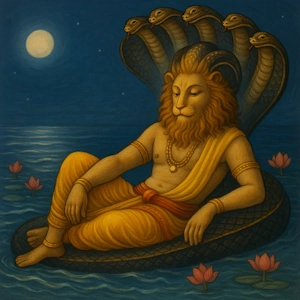
We shall briefly touch upon Shree Nrisimha Purva Tapaneeyopanishad.
The story we all know, but what are the higher spiritual aspects of the avatara of Sri Hari as Narasimha, we will take a brief look.
The moola mantra of Narasimha Swami is:
उग्रं वीरं महाविष्णुं ज्वलन्तं सर्व्तोमुखम्
नृसिंहं भीषणं भद्रं मृत्युमृत्युं नमाम्यहम
This mantra is called mantraraja – king of all mantras.
At the time of creation when Prajapati Brahma set about creating, he started observing tapas. First the desire to create comes in Brahma, then he observes tapas which is the means of creation.
What is this tapas of Brahma? There are several forms of tapas.
मनसश्चैन्द्रियाणां चैकाग्र्यं परमं तपः
Focusing the mind and the indriyas at a single point is called tapas.
And when Brahma did tapas – this Narasimha mantra appeared in his mind. It gave him the entire power to create. This mantra itself became the whole creation.
This mantra is in the meter called anushtup which has got 32 syllables in it. It is divided into four parts or padas of 8 syllables each.
Mantras are bound by meters or chhandas. A chhandas means a particular fixed number of syllables. Like anushtup means 8 syllables in each pada of the mantra. The other important chhandas are Gayatri, Ushnik, Brihati, Pankti, Trishtup, and Jagathi. Gayatri has 6 syllables, Ushnik 7, Brihati 9, Pankti 10, Trishtup 11, and Jagathi 12 syllables.
All mantras are composed conforming to one of the chhandas. There are also variations of these meters. Rigveda mantras and Atharva Veda mantras are composed in meters, whereas Yajurveda mantra is in prose. Samaveda is composed like music.
So, here for this Narasimha mantra, anushtup is the chhandas.
अनुष्टुभो वा इमानि भूतानि जायन्ते
अनुष्टुभा जातानि जीवन्ति
अनुष्टुभं प्रयन्त्यभिसंविशन्ति
Not just that the universe is created out of this mantra, the universe sustains in it, the universe dissolves back into it.
Bhooloka came into existence from the first pada of this mantra.
Antariksha came into existence from the second pada.
Swargaloka came into existence from the third pada.
And the Param Brahma is the fourth pada of this mantra.
It is not that the mantras are composed by someone in these meters. Mantras pre-exist even creation. Mantras are revealed to rishis. Every chhandas has certain features and qualities associated with it. So, when the mantra is revealed to them and they see the chhandas in which it exists, they realize what the mantra can be used for. The mantra may or may not convey a literal meaning. That does not matter. How it works, how fast it works, this is all seen from the chhandas.
Anushtup is a very powerful meter. It represents srishti, sthiti, and samhara – all three. It has all three properties.
It can create – whatever is not there, it can create, like health, wealth, peace, and fame.
It can protect – it can protect everything.
It can eliminate – eliminate diseases, eliminate grief, eliminate poverty, eliminate quarrels and fights.
The Upanishad says that the upadesha of this mantra should be given only to the most deserving of shishyas. It should not be picked up from anywhere and started chanting. It could be harmful. If at all, from a guru who knows the subject very well and is always by the side of the shishya and guides him.
The term 'him' is used because the Upanishad says it should not be chanted by women.
If properly initiated into this mantra, this itself can lead to moksha.
Bhagawan Narasimha Murthy can be meditated upon in two ways: as lying on top of Adishesha in the Milky Ocean, or as seated in yogasana with Adishesha spreading his hoods above his head.
If properly done, the sadhana of this mantra can immediately give darshana of Bhagawan.
जपात्तेनैव शरीरेण देवतादर्शनं करोति
तेनैव शरीरेण संसारान्मुच्यते
Liberation, mukti, is obtained while in the body itself. One does not have to wait till the end.
इदमेव मुख्यं द्वारं कलौ – this is the main gateway in Kaliyuga to moksha.
-
What does it mean to call a mantra the mantraraja or king of mantras?
It signals supreme potency and scope. This mantra is taken as a master key that covers protection, clarity, and liberation without needing auxiliary formulas. -
How can sound have creative power at all?
Sound carries pattern. Pattern shapes attention, intention, and action. In Vedic thought, ordered sound aligns mind with cosmic order, so inner order reflects as outer results. -
What exactly is tapas in practical terms?
Tapas is disciplined focus. You reduce distractions, hold one aim steadily, and let that intensity generate insight and strength to act. -
Why does the meter of a mantra matter?
Meter is structure. Structure controls rhythm, breath, and attention. That control stabilizes the nervous system and makes the practice repeatable and effective. -
What is special about the anushtup meter?
It is compact and balanced. Its four equal parts map neatly to creation, sustenance, transformation, and transcendence, so it is used for comprehensive aims. -
Is a mantra just positive self-talk?
No. Self-talk is casual and variable. A mantra is a precise, time-tested pattern that disciplines the mind and harnesses breath, posture, and meaning together. -
Do I need to understand every Sanskrit word for it to work?
Understanding helps, but the main driver is correct sound, rhythm, and attitude. Meaning plus method gives the best results. -
Why is initiation from a competent guru emphasized?
A guru gives the correct form, pace, and safeguards. That prevents errors, aligns ethics, and keeps the practice from becoming reckless or ego driven. -
Can a powerful mantra be harmful if used casually?
Yes. Wrong pronunciation, wrong intent, or wrong lifestyle can agitate the mind and amplify problems instead of resolving them. -
Why do some traditions restrict who may chant a mantra?
Restrictions arose from old social, ritual, and safeguarding norms. The core principle underneath is fitness: readiness, guidance, and responsibility matter. -
How do I test if I am a fit student without fooling myself?
Check honesty, steadiness, service attitude, and the ability to follow instructions. If you cut corners in small things, you will cut corners in mantra too. -
Is faith enough, or do I need method as well?
Both. Faith keeps you steady; method directs your effort. Faith without method is vague; method without faith becomes dry and short lived. -
What does it mean that a mantra can grant darshana while living?
It means a shift in perception now: clearer awareness of the divine presence, not just a promise after death. The sign is less fear, more compassion, and stable inner joy. -
If this mantra is so complete, why use any other practice?
Different minds need different entry points. Complementary practices like ethics, service, and meditation keep the gains and prevent ego inflation. -
Are results guaranteed or timeline bound?
No. Results track sincerity, correctness, and karma. You control effort and purity; outcomes follow when the field is ready. -
How do I keep the practice from becoming mechanical?
Guard three things: posture that supports breath, pronunciation that is crisp, and intention that is humble and grateful. Review these daily. -
What everyday changes show that the practice is working?
Quicker recovery from stress, fewer angry reactions, consistent sleep, clearer priorities, and a natural pull toward truthfulness and restraint. -
Why the insistence on ethical living along with mantra?
Ethics is the container. Without it, energy leaks through greed, deceit, and indulgence. With it, power turns into wisdom and service. -
What if I cannot find a guru immediately?
Prepare yourself: clean diet, truthful speech, daily quiet sitting, and study from reliable sources. This readiness attracts right guidance. -
How do I avoid superstition while staying devotional?
Track causes and effects honestly. Keep a simple journal of time, method, and mental state. Devotion plus clarity keeps you grounded and sincere.





English
Vishnu Sahasranama
Click on any topic to open
7
30
Astrology
Bhagavad Gita
Bhagavatam
Bharat Matha
Devi
Devi Mahatmyam
Ganapathy
Garuda Puranam
Glory of Venkatesha
Hanuman
Kathopanishad
Mahabharatam
Mantra Shastra
Mystique
Practical Wisdom
Purana Stories
Radhe Radhe
Ramayana
Rare Topics
Rigveda Explained
Rituals
Sages and Saints
Shiva
Spiritual books
Sri Suktam
Story of Sri Yantra
Temples
Vedas
Vishnu Sahasranama
Yoga Vasishta
26
17
10
0


