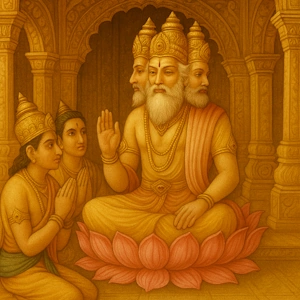
Brahma Gives Upadesha of Narasimha Mantra to Devas
He is both kinds of truth and honesty, rutha and satya, mental and verbal honesty.
He is param brahma.
He is the controller from inside of everything and everyone – antaryami, purusha.
His color is brownish yellow and black – the two colors that are present in his body – krishna pingala.
He is urdhwareta – of the yoga bhava.
He is viroopaksha – of fearsome eyes.
The Upanishad describes him with various names which are used to describe Sri Rudra like – neela lohita, shankara, uma pati, pashupati, pinaki, amitadyuti, ishanassarvavidyanam, ishwaraassarvabhutanam, brahmadhipati, brahmanodhipati.
Asserting that Mahadeva is not different from Sri Hari.
The Narasimhavatara is the same as Sri Rudra.
The mantra has 11 parts – ugram, veeram, mahavishnum, jwalantam, sarvatomukham, nrisimham, bheeshanam, bhadram, mrityumrityum, namami, aham – like the eleven Rudras.
The number eleven relates to Rudra.
Out of fear of papa, death and samsara, Devas approached Brahma and asked for a solution to cross the bhava sagara – Brahma gave them upadesha of Narasimha mantra.
What is the meaning of the term ugra in the mantra?
Ugra means उद्गृह्यते – अनुगृह्णाति – blesses.
We think ugra means – ferocious. Words may not mean what we think they mean.
He is ugra because he blesses. Blesses whom?
He blesses all the fourteen worlds and all the occupants of the fourteen worlds. He blesses the Devas. He blesses everything and everyone. Hence he is called ugra.
Ugram veeram.
Why is he called veera?
विरमति विरामयति विविधप्रकारेण प्रागुक्तान्प्रति रमति इति वीरः.
All those mentioned, the fourteen worlds, their occupants, the Devas, everything and everyone is his leela, play, his enjoyment, his amusement.
रम् क्रीडायाम्.
He plays with them. This creation, its sustenance and its elimination is his play.
Ugram veeram mahavishnum.
What is the meaning of mahavishnu?
Vishnu means, सर्वान् लोकान् व्याप्नोति.
He has entered, covered all the worlds, he is present in every atom in the whole universe. The prefix maha emphasizes this truth.
Ugram veeram mahavishnum jwalantam.
स्वतेजसा ज्वलति स्वकीयप्रकाशेन ज्वालयति.
What makes a lamp? You have the metal lamp, oil in it, the wick. All these do not make the lamp. Only when it is lighted and gives out light it becomes a lamp.
So a lamp becomes a lamp only when it gives out light.
All the beings are only lifeless matter when chaitanya is not present in it.
The giving of this chaitanya is called jvalanam – like lighting of the lamp.
He alone gives chaitanya to dead matter called prakruti – hence he is called jwalantaha.
अज्ञानदहनकर्ता – he burns away ignorance, hence jwalanta.
सर्वतः पश्यति सर्वतः शृणोति सर्वतो गच्छति सर्वत आदत्ते सर्वगः सर्वतस्तिष्ठति इति सर्वतोमुखः.
He sees everything, he hears everything, he goes everywhere, he is present everywhere – hence called sarvatomukhaha.
उग्रं वीरं महाविष्णुं ज्वलन्तं सर्व्तोमुखम.
Nrisimham.
This form – half lion half man – shows us that Sri Hari can assume any form that he wants. An earthly being, a lion, is born as a lion and stays as a lion. A man is born as a man and stays as a man. But the Lord doesn’t have any such restriction. He can take any form he wants, any combination.
Vishnu Sukta says –
मृगो नभीमः कुचारो गिरिष्ठाः
He is a lion, but nabheemaha – non-frightening for his devotees.
Kurta na charateeti kucharaha – is there a place that he doesn’t go, he is everywhere.
Girishtaha – his form as the lion roams around in the mountains.
Bheeshanam.
While he is non-frightening for his devotees, his form invokes fear in the evil minded. That is why he is called bheeshana.
He is bheeshana but he doesn’t fear anyone or anything.
And he is bhadra – most auspicious, most approachable, most accessible. Giver of everything that is bhadram – auspicious.
Mrutyumrutyuhu – mrtyu of mrtyu – slayer of death itself, killer of death itself. Slayer of the death of his devotees.
When someone is born, his longevity can be ascertained from the planetary positions at the time of birth. Death at the completion of this longevity is called normal death. And death before that is called akalamrutyu or apamrutyu.
That means a person need not live the full life he is born with. There are many reasons for this to happen.
So, Bhagawan is the mrutyu of both kinds of deaths. Apamrutyu or akalamrutyu we can understand – he can protect his devotee from premature or unnatural death.
But how can he avert normal death? If someone is born, he has to die.
To prevent death means to prevent rebirth. Only if there is a rebirth there is going to be another death. Bhagawan will not allow his devotee to be reborn again.
So the death his devotee will have on completion of his longevity will not be ordinary death that would lead to another rebirth. It will be moksha. In that sense his devotee will never die, he will only attain moksha.
So he is called mrutyumrutyum.
Namami aham – I bow before him, because everyone bows before him.
-
Why is the word ‘ugra’ linked to blessing rather than rage?
Because ‘ugra’ here points to intense benevolence. Bhagavan’s power removes obstacles and showers grace on all beings. The force is fierce against ignorance, not against devotees. -
How can fierceness and compassion sit together?
They target different things. Fierceness burns ignorance and adharma. Compassion protects seekers. Same fire that melts gold also burns trash. -
What makes someone ‘veera’ in this context?
True heroism is the joyful mastery of creation, sustenance, and dissolution. Bhagavan plays with the cosmos without strain, fear, or fatigue. -
What exactly does ‘Vishnu’ being all-pervading imply for me?
No place is outside divine presence. Every moment and every atom is within that awareness. You are never spiritually ‘offline’; responsibility and dignity rise from that fact. -
‘Jwalantam’ says he gives light. What is this light?
It is consciousness. Matter is inert until lit by awareness. Like a lamp is only a lamp when it shines, a body is only alive when consciousness illumines it. -
If consciousness comes from Bhagavan, where does ignorance go?
Ignorance is absence of light, not a separate substance. When awareness shines, confusion ends. The cure is presence, not a second substance. -
What does ‘sarvatomukham’ change about prayer?
He sees, hears, and reaches everywhere. Sincerity matters more than place or posture. You are already in range. -
Why a half-lion, half-man form at all?
To show absolute freedom. Bhagavan is not limited by species, elements, or categories. Form follows purpose; protection decides appearance. -
How can the same form soothe devotees and terrify the wicked?
Vision depends on inner state. A doctor’s scalpel heals for one and frightens another. The divine presence reflects what stands before it. -
What does ‘bhadra’ mean for daily life?
Auspicious, approachable, generous. You can turn to him without qualification. The door is open before you perfect yourself. -
‘Mrityumrityum’ sounds grand. What is the concrete claim?
He ends premature death by protection and ends the cycle of death by granting moksha. Ending rebirth ends death, full stop. -
Does this deny natural death?
No. It transforms it. For a devotee, the final passing becomes liberation, not a reset into another body. -
If he is the inner controller, do I still have free will?
Yes. Your choosing operates within his sustaining intelligence. You own your effort and accountability; he provides existence, power, and results. -
Why do scriptures equate Hari and Rudra at times?
To assert one non-dual reality appearing as different functions. Protection and dissolution are faces of the same truth, not rival gods. -
What is the point of linking eleven mantra parts with eleven Rudras?
To map devotion to cosmic functions. Each syllable anchors a facet of divine power, integrating worship with the universe’s workings. -
How does this mantra help with fear of samsara?
It aligns your mind to consciousness, burns ignorance, strengthens dharma, and opens you to grace. Fear drops when the knower wakes up. -
Words often mislead. How should I read sacred terms?
By their scriptural root meaning, not casual usage. ‘Ugra’, ‘veera’, ‘bhadra’ carry precise spiritual senses that refine your understanding. -
If he is everywhere, why worship at all?
Attention shapes experience. Worship focuses your mind, removes inner noise, and lets the ever-present reality be known directly. -
What practical change should I make today?
Sit for a few minutes, chant with attention, act honestly, and see every choice as seen by the all-pervading witness. That shift alters everything.





English
Vishnu Sahasranama
Click on any topic to open
7
30
Astrology
Bhagavad Gita
Bhagavatam
Bharat Matha
Devi
Devi Mahatmyam
Ganapathy
Garuda Puranam
Glory of Venkatesha
Hanuman
Kathopanishad
Mahabharatam
Mantra Shastra
Mystique
Practical Wisdom
Purana Stories
Radhe Radhe
Ramayana
Rare Topics
Rigveda Explained
Rituals
Sages and Saints
Shiva
Spiritual books
Sri Suktam
Story of Sri Yantra
Temples
Vedas
Vishnu Sahasranama
Yoga Vasishta
26
17
10
0


