Teachings of Sant Jnaneshwar
सर्वयोगविनिःसृतः
What is yoga?
Yoga has a completely different meaning.
Yoga also means sannahana.
Sannahana means a rope with which something is tied tightly.
We get attached to the world like this, to places, to people, to habits, to comforts. We get bound as if tied with a rope to all this. This binding is yoga. This is what prevents us from attaining complete freedom. But our Lord Bhagawan is not attached to anything. He is absolutely free.
सर्वसम्बन्धविनिर्गतः –
असङ्गो ह्ययं पुरुषः – this purusha is without any attachment. That is what Bhagawan Sri Hari teaches, detachment.
He is devoid of attachment, that is why he teaches us detachment, dispassion. That is his quality. That is what he teaches us.
There is another meaning –
सर्वैरपि शास्त्रलक्षणैः स्वमनीषिकापरिकल्पितैरपि योगैः उपायैः प्राप्तुं योग्यः सुग्रहः
Yoga also means methods prescribed in the shastras. He can be achieved through all methods prescribed in the shastras. Hence he is called sarva yoga vinisrutaha.
विनिःसृतः – विशेषेण वेदपरमगुह्यैरिव, especially those secret methods prescribed in the Vedas.
Whichever is the prescribed method, follow it fully. There are several methods – bhakti, nama japa, worship of his idol, homas. Any method, do exactly as the shastra pertaining to that method teaches. Don’t mix and make your own.
You can follow several methods, no problem, but don’t mix one with the other. Because you can attain him only if you follow the method and procedure prescribed in the shastras. Don’t modify the method on your own. Let shastras remain as they are. Pick any one method or many methods that suit you, but don’t mix them together.
Our scriptures suggest that we listen to stories of bhaktas. They are inspiring. This will help in boosting bhakti.
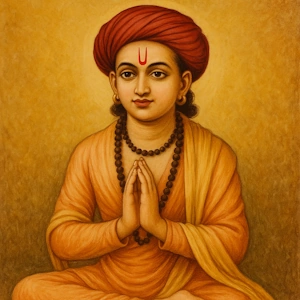
Sant Jnaneswar was the 13th century saint of Maharashtra who laid the foundation of the Vaarkari system of bhakti. Vaarkaris consider Vitthal of Pandharpur as the symbol of divine love.
Sant Jnaneswar's guru parampara was the Nath Sampradaya. His guru was his own elder brother Nivrittinath whose guru was गहिनीनाथ. The guru of Gahininath was Gorakhnath.
During his childhood, the family of Sant Jnaneswar suffered ostracism at the hands of orthodox villagers.
Jnaneswar's father Vitthalpant, even though he was married, took up sanyasa after abandoning his wife Rukmini. She lived in Alandi praying for the return of her husband. She didn’t even know that he had taken up sanyasa. He was initiated into sanyasa by Sripadswami.
Once when Sripadswami was on a pilgrimage to Alandi, he saw Rukmini doing parikrama of an ashwatha tree. When she saw the Swami, she did pranama at his feet. Swami blessed her – 'you will have many pious children' – but then soon realized that she was none other than the abandoned wife of his new shishya. He went back and insisted that Vitthalpant give up sanyasa and go back to the life of a householder.
Vitthalpant's abandoning of sanyasa provoked the orthodox villagers and they excommunicated the family.
When Vitthalpant asked them what is the penance that I should do for giving up sanyasa, they said sacrifice your life. Accordingly, he went to Prayag and gave up his life by jumping into water. After a few months, Rukmini also did the same.
Even the children the villagers didn’t spare. They said get a clearance certificate from an assembly of orthodoxes at a place called पैठण that they have become pure.
While the assembly was harassing them, Sant Jnaneswar made a buffalo chant mantras in front of them and shut them up. Jnaneswar was just 15 then.
On the way back to Alandi, Jnaneswar delivered his first discourse on Bhagavad Gita at नेवासा.
This was an independent, unique and different perspective on Bhagavad Gita. It is called Jnaneswari. A great work.
Sant Jnaneswar propounded his own philosophy called chidvilas.
He was a jnani, a yogi and a bhakta at the same time, but placed bhakti above the other two. Bhakti should be the theme and emotion at the core of everyone's life.
Even in Gita he gave utmost importance to bhakti yoga. Nath Sampradaya is generally reckoned as one of yogic sadhana, but Sant Jnaneswar revealed that it has a prominent side of prema bhakti also.
Jnaneswari is very lucid, full of appropriate analogies, fragrant and poetic, meant for the common man. It is very fascinating.
Sankhya philosophy says that prakriti is inert and purusha is the consciousness which is superior to prakriti.
Mayavadis say that maya is a distorting limitation put on the supreme truth.
Advaitis say that the world is an illusion.
Jnaneswar refutes all these views.
He says God and Goddess are equal in stature. They are inseparable and stand for the ultimate divine love. Their existence as two is just like how there are two eyes but vision is the same, there are two lips but the sound that comes out through them is single.
Sant Jnaneswar does not consider the world as an illusion or ignorance. He said the world is a playing out of divine love of the divine couple with which they amuse themselves and it is for real.
This is like fragrance becoming the nose and then enjoying that fragrance. Jnaneswar says that the Lord doesn’t conceal himself or is not concealed within the layers that is the world as something mystical or secret. Rather the Lord gracefully expresses himself as the world.
An ornament which is made out of gold doesn’t conceal the gold or keep it out of sight. To realize God, the world is necessary.
There is a beautiful expression in Jnaneswari – Arjuna is a mirror in which the Lord sees himself in fair complexion. The shyama varna Lord sees himself in fair complexion.
Jnaneswar says when the finite individual tunes into the infinite, then bhakti is no longer a concept or an emotion, it becomes the one and only absolute reality at his core. It was always there, but this is when he realizes it.
All moral values are just expressions of bhakti. He says every external action, every interaction with the world should have compassion at its foundation.
He teaches how even routine activities can be performed in a spirit of worship and as divine service.
Sant Jnaneswar's approach towards the world is positive, healthy and realistic.
At the age of 22 he entered into jiva samadhi.
-
Why does chanting Vishnu sahasranama change my inner state faster than plain positive thinking?
Because naam is not an idea; it is a pointer to the living presence of Bhagavan. Repeating the names aligns thought, speech, and breath toward one reality. This single-pointing burns scattered impulses and produces steadiness. Positive thinking rearranges thoughts; naam dissolves their grip. -
How does nama japa actually help concentration when my mind keeps wandering?
The fixed syllable pattern acts like grooves for attention. Each name is a short loop that completes before distraction grows. Returning to the next name resets attention without friction. Over time, this builds the muscle of bringing the mind back on command. -
Is it useful to chant if I do not feel devotion yet?
Yes. Practice precedes feeling. Sound shapes mood. When the tongue moves in sacred names and the ear hears them, the heart follows. Do the action faithfully; devotion arrives as a consequence. -
What is the logic behind morning chanting being recommended?
At dawn, senses are quieter and habits are still forming for the day. Imprinting Bhagavan’s names first sets the baseline for choices that follow. Like setting a compass before the walk, you reduce moral drift during the day. -
How does this practice support physical health without turning it into a wellness fad?
Slow, counted japa with soft voice stabilizes breath and heart rate, lowers muscular tension in the face and shoulders, and improves sleep quality by evening repetition. These are side effects of a sattvic routine, not the main aim. Keep the aim as Bhagavan; health steadiness follows. -
My family argues. Can chanting practically reduce friction at home?
Yes. Fix a shared, short slot daily: five minutes of collective sahasranama or ten minutes of nama japa. Speaking the same sacred sequence synchronizes pace and tone. Common rhythm cools speech and creates a boundary that anger hesitates to cross afterward. -
What if I am busy and cannot complete the full sahasranama daily?
Keep a non-negotiable minimum: one mala of ‘Om Namo Narayanaya’ or ten names from the sahasranama with attention. On freer days, expand. Unbroken continuity is more powerful than occasional marathons. -
How do I know the chanting is not mechanical?
Insert a brief pause after each name and hold a clear meaning or image: protector, sustainer, remover of fear. Let the name land, then move on. Mechanical turns mindful when each bead has a tiny completion. -
Is there a traditional way to link chanting to ethical action?
Yes. Take a small vrata tied to the practice: after completing the day’s count, perform one concrete act of patience or service in Bhagavan’s name. Naam in the mouth, dharma in the hand. This integration prevents hypocrisy. -
I feel guilt about past mistakes. How does nama japa deal with that?
The names assert Bhagavan’s sovereignty over time and consequence. Regular chanting places your story inside his order. Guilt is then handled by clean atonement and forward dharma, not by rumination. Naam gives the inner authority to close the file and act rightly now. -
Can I use a phone app for counts, or should it always be a mala?
Use a mala if possible. The tactile loop teaches completion, and the beads prevent visual distractions. If a phone must be used, keep it in airplane mode and disable pop-ups. Tradition prefers objects that do not pull the mind outward. -
What pace and volume are best in a shared household?
Soft, steady, and audible enough for your own ear. Too loud excites the nerves; too silent collapses attention. In family chanting, set one moderate pace so elders and children can keep up without strain. -
How do I handle days of dullness or irritation toward the names?
Double down on humility. Sit anyway, shorten the count if needed, and finish it cleanly. Offer the dullness itself to Bhagavan as material for his grace. Consistency through dryness is proof of devotion, not failure. -
What signals show that the practice is bearing fruit?
Faster recovery from anger, easier truthfulness, cleaner sleep, less taste for gossip, spontaneous remembrance of a name in stressful moments, and a quiet gladness while doing routine duties. When these appear, increase gratitude, not pride. -
How can children or elders join without fatigue?
Use short clusters: ten names with clear enunciation, then a breath, then ten more. Keep sessions brief and daily. On holy days, extend with the full sahasranama. The goal is sweetness, not exhaustion. -
What is the safest way to combine sahasranama and nama japa?
Anchor the day with a fixed count of nama japa. Add sahasranama on top when time permits. Do not interleave or remix verses. Keep sequences intact and traditional. Purity of method preserves the power of the names.
If yoga means attachment, then why do you people also say yoga is liberation? Isn't that contradictory?
Words change meaning by context. 'Yoga' in one place is used as 'binding'. In another, it is used as 'the method to release from binding'. Language in shastra often carries layered senses. Both are valid depending on usage.
How can chanting mantras by a buffalo prove anything? That sounds like a fairy tale.
The point is not zoology. The buffalo episode demonstrates that spiritual power can overturn social arrogance. Whether one takes it literally or symbolically, the message is clear — divine force silences hypocrisy.
Why believe Sant Jnaneswar over Sankhya or Advaita? They say the world is illusion, he says it is real. Who decides?
It is not about personal whim. Sankhya, Advaita, and Jnaneswar all propose systems. Jnaneswar shows through lived experience and logic that the world functions with laws, order, and love. If it were sheer illusion, consistent human interaction would collapse.
You claim God and Goddess are equal and inseparable. Where is the proof?
The proof is in the structure of life itself. Nothing in nature exists alone. Energy and matter, male and female, light and shadow — all paired, yet inseparable. Divinity mirrors this truth.
If Bhagavan is free and detached, why does he create this world at all?
Creation is not out of need or compulsion. It is expression. Just as a singer sings though not forced to, or a child laughs without reason, Bhagavan manifests the world as play of love.
Why should bhakti be supreme over knowledge and yoga? Isn't that emotional bias?
Knowledge and yoga refine the mind and discipline the body, but bhakti transforms the core — the heart. A person with knowledge but no compassion becomes cold. A person with bhakti naturally includes both wisdom and discipline, but centered in love.
If the world is real, why do saints also renounce it?
They renounce dependence, not existence. A doctor may avoid sweets but does not deny their reality. Saints detach to show freedom, not to prove the world false.
How can stories and poems like Jnaneswari carry truth? They are just words.
Words shape thought, and thought shapes action. Mathematics too is only symbols, yet it builds rockets. In the same way, Jnaneswari uses words to open direct vision of reality.





English
Vishnu Sahasranama
Click on any topic to open
7
30
Astrology
Bhagavad Gita
Bhagavatam
Bharat Matha
Devi
Devi Mahatmyam
Ganapathy
Garuda Puranam
Glory of Venkatesha
Hanuman
Kathopanishad
Mahabharatam
Mantra Shastra
Mystique
Practical Wisdom
Purana Stories
Radhe Radhe
Ramayana
Rare Topics
Rigveda Explained
Rituals
Sages and Saints
Shiva
Spiritual books
Sri Suktam
Story of Sri Yantra
Temples
Vedas
Vishnu Sahasranama
Yoga Vasishta
26
17
10
0


