The Symbolism of Padmanabha Swaroopa
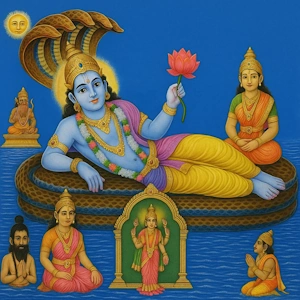
Today we will look at the meaning of the divya nama vasu and also look into the symbolism of the padmanabha form of bhagawan.
वसन्ति सर्वभूतानि यत्र
तेषु अयमपि वसति
All beings live in him, he lives in all the beings, hence vasu. This is very interesting. The divya nama vasu is associated with vasati meaning to live in. Like we live in a house. That house is him.
But where does he live? We would naturally think that the house is on the ground upon which it stands, but here the situation is different. Where does the lord live? Inside all that he has created. He sits inside everything that he has created and controls them from inside as antaryami. When we say that he orders the sun to rise from the east, he doesn't stand outside and order the sun. He is inside the sun. That's how he controls everything, the entire creation.
वसूनां पावकश्चास्मि – gita, sri hari says, he is agni among the eight vasus, he is one among the group of devatas called vasus.
The group of eight devatas called the ashtavasus: dhara, dhruva, soma, vishnu, anila, anala, pratyusha and prabhasa. Among them even though the name vishnu is there, bhagawan says that he is agni, energy. Every kind of energy, even the energy that causes movement or waves within atoms. That, he says, is him.
There is one more meaning.
वसतीति वसुः तॆषु प्रीत्या परमया स्वयम् |
You show the slightest inclination towards him, he will come and live in your heart. He is so kind and blessful. Hence sri hari is vasu.
Let us now look at the symbolism associated with the padmanabha form of the lord.
The world is made of tattwas. The components of the world or the universe are the tattwas.
The pancha bhutas - earth, water, fire, air and space. Prithvi, jalam, agni, vayu and akasha. What do they stand for? Prithvi for solid, water for liquid, vayu for gas, agni for all kinds of energies, and akasha for space, space which all created objects and beings occupy. These are the pancha bhutas.
In the padmanabha swaroopa the ocean upon which the lord sleeps is the space.
The lotus that comes out of his nabhi: its base is prithivi, its stalk is jalam, its petals are agni, the centre of the lotus is vayu. Collectively we can say the lotus is the prakriti. Brahma sits on top of that lotus means that it is with these four that brahma creates. Space or akasha is already there. The four elements are under brahma's control and with these he creates.
The bed of the lord made up of ananta, adishesha, is the manas, the tattwa which is mind. What is mind? Unprocessed information and spontaneous reaction to it, emotional reactions. There is no intelligence associated with the mind. Intelligence or knowledge is in buddhi.
Discretion is in the buddhi. Animals have mind, but their buddhi is very very tiny, not developed like us humans. Plants and trees, even their mind is underdeveloped. That's why they don't react like how an animal would. We have both. How much of buddhi one person has depends on his background, education, exposure.
There are many people who just function following the mind. For example the case of a road rage. Someone overtakes you and cuts in front of you when you are driving. You get into a fight with him, hit him, then land up at the police station. This is functioning according to the mind.
When he cuts you off, thinking, oh maybe he is taking a critical patient to the hospital, or what am I going to gain by getting into a fight with him. This is application of intelligence. This intelligence is knowledge, gained systematically, information refined and retained so that it can be referred to and followed as and when required. This is buddhi or intelligence or knowledge. Bhagawan's body stands for the intelligence or knowledge. This is the symbolism associated with padmanabha.
-
If Bhagavan lives in all beings, how does my chanting reach him?
When you chant the sahasranama, you are speaking to the indwelling Lord who already hears from within. The sound cleans your attention, steadies breath, and lets the antaryami guide thought and action. -
How does nama japa improve my decision making in messy everyday situations?
Repeating a name anchors the mind so buddhi can act. Count on a mala, keep a steady pace, and pause before speaking. The calm gap you create is where clear choices appear. -
Why does focusing on one divine name matter when there are a thousand names?
One name, taken with shraddha, concentrates scattered energy. A focused beam works better than a diffused glow. Use a daily sankhya, like 108 or 1008, and complete it without break. -
What is the practical link between chanting and physical energy?
Soft, rhythmic recitation naturally aligns breath. Longer exhale reduces pulse and eases muscle tension. Ten minutes of steady japa after sunrise improves stamina for the day. -
Can sahasranama help with anger or road rage type impulses?
Yes. Commit to a quick rule: three beads before any reaction. Those few seconds drop you from raw emotion to composed response. It prevents words and acts you will regret. -
How does Padmanabha symbolism guide my routine at home?
Treat space as sacred: keep a clean, uncluttered corner for japa. Treat breath as vayu, posture as prithvi, gentle voice as agni, water for washing hands as jala, and silence as akasha. Your practice mirrors the order of creation. -
What should a family do if members follow different schedules?
Fix one common slot, however small. Even five minutes together for reciting a set of names builds harmony. End with a brief silence and a simple wish for each other’s well-being. -
Is it better to chant fast and finish counts or go slow and fewer?
Go steady and intelligible. Every name should be heard by your own ear. Quality locks attention; attention locks transformation. Increase counts only after steadiness is natural. -
How do I keep the mind from wandering to chores, screens, and worries?
Use a clear sankalpa before you start: today I offer these 108 names with attention. Keep a paper nearby to jot intrusive tasks, then return to the bead. Train, do not fight. -
Can I use recorded audio or should I chant myself?
Both help, but your own voice engages body, breath, and mind together. Use recordings to learn tune and pace, then take ownership and chant audibly at a gentle volume. -
What is a respectful way to involve children without forcing them?
Give them a small role: ring the bell once, hold the mala pouch, or lead the final shanti. Short, joyful participation grows natural affection for practice. -
How does nama japa support sleep and recovery?
A slow round of 27 beads at night lengthens exhale, softens thoughts, and settles the nervous system. Sleep comes quicker and deeper, which directly improves recovery and mood. -
If I miss a day, do I have to compensate with double the next day?
No guilt stacking. Resume your fixed count the next day and guard the slot. Stability over weeks beats occasional marathons. -
What change should I watch for as proof that the practice is working?
Quicker return to calm after disturbance, kinder speech under pressure, and a natural pause before decisions. These are clear, measurable signs that bhakti is shaping your inner world. -
How do I respectfully keep the practice at work without drawing attention?
Use finger counting in pockets or a small wrist mala during breaks. A silent mental recitation between meetings keeps clarity without display. -
Is there a simple weekly plan that stays traditional and doable?
Morning: 108 names with clear pronunciation. Evening: 54 names and brief silent sitting. One weekly extended session of 1008 names. Maintain a clean place, washed hands, straight spine, and conclude with shanti and goodwill for all.
If the Lord is inside everything, why don’t we see Him when we open up matter under a microscope?
You don’t see electricity when you split a wire either, but it powers the bulb. The Lord as Antaryami is the principle of order and control, not a visible lump of matter. Instruments detect material fragments, not the consciousness that governs them.
If the Lord controls the Sun from within, why do we need physics to explain sunrise and sunset?
Physics describes the how, not the why. Gravity and orbital mechanics explain the process, but why such precise laws exist and hold consistently is answered by the idea of a conscious regulator. Physics maps the script, the Lord is the scriptwriter.
Why call Him Vasu just because beings live in Him? Isn’t that just empty wordplay?
Not wordplay, but logic. You cannot live without space, energy, and elements. If the very basis of your existence is also alive and aware, calling that Vasu — the indweller — points to the fact that He is both container and companion.
You say He is energy itself. Then why not just stop with energy, why bring in a deity?
Energy is impersonal and blind. Yet it flows in precise patterns — electrons orbit, atoms vibrate, stars burn predictably. The word deity here names the intelligence that makes energy behave in order, rather than chaos.
What proof is there that He lives in the heart of a devotee? Isn’t that emotional imagination?
Proof lies in transformation. A person inclined even slightly towards devotion shows calmness, courage, and clarity out of proportion to external inputs. That inner shift is evidence of a presence that enters when invited — the Vasu principle at work.
The symbolism of Padmanabha seems like forced mapping of elements to body parts. Why should we take it seriously?
Because symbolism is not decoration, it is compression. Instead of writing textbooks on cosmology, psychology, and metaphysics, a single image encodes it all. The lotus from the navel with its layers mirrors the layered structure of reality. It’s not random, it’s a compact diagram.
Mind and Buddhi — aren’t they just brain functions? Why separate them?
Because reaction and reflection are not the same. Mind reacts instantly — fear, anger, desire. Buddhi reflects, compares, recalls knowledge, and chooses. Both happen in the brain but are clearly different modes. Calling them Manas and Buddhi makes the distinction sharp.
If animals and plants also have mind, why can’t we measure it like human thought?
Because their scale is different. An ant reacts to sugar but won’t debate philosophy. A plant bends to sunlight but doesn’t chase prey. The spectrum of mind is visible in their actions. Measurement tools miss it, but behavior reveals it.
Why equate Bhagawan’s body with intelligence? Isn’t that just human projection?
No. Intelligence here means the cosmic faculty that organizes raw matter into galaxies, life forms, and ecosystems. Calling His body intelligence is not to humanize Him, but to point to the fact that creation itself is sustained by a structured knowing.





English
Vishnu Sahasranama
Click on any topic to open
7
30
Astrology
Bhagavad Gita
Bhagavatam
Bharat Matha
Devi
Devi Mahatmyam
Ganapathy
Garuda Puranam
Glory of Venkatesha
Hanuman
Kathopanishad
Mahabharatam
Mantra Shastra
Mystique
Practical Wisdom
Purana Stories
Radhe Radhe
Ramayana
Rare Topics
Rigveda Explained
Rituals
Sages and Saints
Shiva
Spiritual books
Sri Suktam
Story of Sri Yantra
Temples
Vedas
Vishnu Sahasranama
Yoga Vasishta
26
17
10
0


