Sri Hari Shows Us How to Live Like a Man
सम्भवः
सम्भवति जगदस्मादिति सम्भवः – the universe comes into existence from him.
At times he reveals himself as the avataras to show that he is there, hidden somewhere as a treasure, encouraging his devotees to search for him. Those are his avataras. Even though the avatara has disappeared, no longer visible to us, the devotees are encouraged to look around — possibly he is there somewhere as one of us.
धर्मसंस्थापनार्थाय संभवामि युगे युगे
I take avatara, appear in every yuga for establishing dharma — hence sambhavah.
अथ दुष्टविनाशाय साधूनां रक्षणाय च
स्वेच्छया सम्भवाम्येवं गर्भदुःखविवर्जितः
To destroy the evil and protect the noble, he does so. He doesn’t have to. He is not compelled to undergo the garbhadukha — the miseries of mortal life. He does so out of his own choice.
And when he does that, he lives it full. He doesn’t act as if, 'I am above all this, I am not affected by all this'. He shows how to face situations that come in day-to-day life.
If you see, Bhagawan doesn’t merely play the role of a protector when he comes down to earth. He does a lot more. He teaches a lot more. He shows us how to live. He uses that opportunity of having taken an avatara for a lot more.
Sri Hari sent Akrura to Hastinapuri to take stock of the Pandava’s situation there. Earlier itself, popularity of Pandavas among the people was increasing. Now with Akrura coming, it was looking as if the Lord was also concerned about their welfare.
Extreme intolerance, jealousy and anger overpowered Duryodhana. The Laksha Gruha — house made of wax and other highly inflammable materials — was built, and Pandavas and Kunti were sent there to spend the night. The conspiracy was to set it on fire when they were asleep.
Vidura, who saw this in advance, made an escape route also in a very secret manner. Pandavas came out when it was set on fire and went into hiding. It was necessary to create the impression that they perished in the fire, because now serious strategizing was required as matter was getting serious.
A hunter woman and her five sons who came accidentally (it can’t be accidental — it must be part of Sri Hari’s plan only) — they died in the fire and their charred bodies were mistaken to be those of the Pandavas and their mother.
Upon hearing the sad news of the fake death of Pandavas and Kunti, Sri Hari, Balarama and Saatyaki came to Hastinapuri.
This is what we have to see — Bhagawan knows very well what has happened. Still, he is acting. He is acting out all the obligations of a family man. His aunt and her sons have died apparently. He won’t even tell his own people what really happened.
Bhishma, Gandhari, Krupacharya and Dronacharya were truly sad. Sri Hari sympathized with them. Dhritarashtra and Duryodhana acted as if they were sad. Sri Hari sympathized with them also.
He didn’t preach the same philosophy he later preached to Arjuna on the battle ground — that Atma is anaswara – nainam chindanti shastrani.
He sympathized with them, consoled them, asked — who would perform their last rites?
Kauravas said, we can’t — elder brothers don’t do rites of younger brothers. Dhritarashtra said, I am blind, I am not capable.
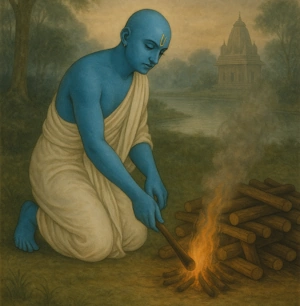
Bhagawan said, I will do.
See the simplicity, see the practicality. Paramatma says, I will do their death rites. I will tonsure my head and do their death rites.
Finally, Saatyaki was entrusted this task.
In the meantime, Mata Satyabhama’s father Satraajit was killed in Dwaraka. Sri Hari was the son-in-law. Satyabhama did not have a brother. So Sri Hari only had to do his last rites.
What I am trying to say is — the omnipresent, omnipotent, omniscient Paramatma visiting the family of the deceased, consoling them, offering to perform their rites — again rushing to Dwaraka to perform his father-in-law’s rites.
And we mortal philosophers with half-baked knowledge say — don’t do my rites once I am gone, Atma is anaswara.
Children say — my father was an evolved person, he was jeevan mukta, he has clearly instructed not to perform his last rites, just donate the body to a medical college and no shraadha. So we didn’t do anything. We don’t do anything.
And there — Bhagawan Sri Hari himself volunteering to do the rites of his aunt and her sons and rushing to Dwaraka to perform his father-in-law’s rites.
When are we going to learn how to live?
Why would someone all-powerful choose to live a human life, with all its pain and mess?
Because showing the way is more impactful than preaching from afar. When Bhagavan lives among us, facing every difficulty head-on — grief, duty, social pressure — he sets a living example. That hits harder than any philosophy. It tells us: dharma isn’t for saints alone. It's meant to be lived — fully, practically, and sometimes painfully — by all of us.
Why does the Lord perform death rites? Isn’t he beyond all that?
Yes, he’s beyond it — and that’s exactly why he does it. Because being beyond doesn't mean being above. He doesn't skip human responsibilities just because he's divine. If Paramatma can humbly tonsure his head and light the fire for a relative’s last rites, then who are we to claim exemption in the name of spirituality?
What’s the point of grief if we know the soul is eternal?
Because we’re still in a body. Grief is part of love. Even if you know someone has only changed clothes, the absence of their voice and warmth aches. Bhagavan knew the Pandavas were alive, but he still wept, because his role as a relative demanded that emotion. Emotion isn't weakness — it's humanity, and he honored that.
Isn't it more evolved to detach from rituals like shraddha?
Not when detachment becomes an excuse. True detachment doesn’t skip duties — it performs them with dignity and without ego. Sri Hari didn’t abandon rituals. He led them. Shraddha isn’t about superstition; it’s about closure, gratitude, and continuing the bond of care across realms. Even evolved souls need to honour relationships the right way.
Can a householder really be spiritual if they’re caught in family obligations?
Not only can they — they must. Dharma doesn’t shine in caves alone. Bhagavan showed that by tending to family, caring for in-laws, and facing grief with grace, you’re walking the path. Spirituality in slippers, not just saffron. It’s not about escaping life, but elevating it.
Why didn't Bhagavan reveal the truth immediately? Isn’t hiding it a form of deceit?
Because timing is dharma too. Sometimes truth, if told too soon, can cause chaos. Bhagavan didn’t lie — he simply bore the pain silently, because the bigger plan needed space to unfold. Holding back for the greater good is not deception — it’s wisdom.
What does this teach about handling jealousy and plotting in families?
Even when Duryodhana schemed, Bhagavan didn’t barge in with thunder and punishment. He sent Akrura first — quiet observation, not open confrontation. This teaches us: don’t react blindly. Step back. Understand the full picture. Plan your next move with clarity, not emotion.
Why did Sri Hari sympathize even with those who pretended to be sad?
Because compassion isn’t a reward — it’s a way of being. Bhagavan offered sympathy even to the hypocrites because he wasn’t acting based on their character; he was acting from his. That’s a lesson: our goodness shouldn't depend on others' sincerity.
How should one act in situations where truth must be hidden for safety?
Like Bhagavan — stay composed, maintain the larger picture, don’t panic, and do your duties fully. If the truth being hidden is not for selfish gain but to protect dharma or loved ones, then it's a temporary silence, not dishonesty.
What’s the physical and emotional cost of abandoning ancestral rituals today?
Families that cut off these duties often see a rise in disconnection — between generations, among siblings, even in their own children. There’s emotional emptiness that no modern freedom fills. The subtle peace that comes from doing the right thing — lighting a lamp, offering food, remembering the departed — nourishes the heart and stabilizes the home.
Why do some so-called ‘modern’ people treat rituals as unnecessary drama?
Because they confuse ritual with superstition. But rituals are structured emotion — grief given a dignified outlet, love shaped into responsibility. When done with sincerity, they don’t bind us — they free us from lingering guilt and give the soul peace.
Does being religious mean surrendering logic and practicality?
Absolutely not. Look at Bhagavan’s life — strategic, thoughtful, emotionally intelligent. He didn’t float through life with miracles. He planned, acted, empathized, and responded. That’s the model: be spiritual, but stay rooted in reality. Dharma is not a fantasy — it’s fiercely real.





English
Vishnu Sahasranama
Click on any topic to open
7
30
Astrology
Bhagavad Gita
Bhagavatam
Bharat Matha
Devi
Devi Mahatmyam
Ganapathy
Garuda Puranam
Glory of Venkatesha
Hanuman
Kathopanishad
Mahabharatam
Mantra Shastra
Mystique
Practical Wisdom
Purana Stories
Radhe Radhe
Ramayana
Rare Topics
Rigveda Explained
Rituals
Sages and Saints
Shiva
Spiritual books
Sri Suktam
Story of Sri Yantra
Temples
Vedas
Vishnu Sahasranama
Yoga Vasishta
26
17
10
0


