Why and How Sri Hari Lifted Up Mount Gowardhana
भावनः
सर्वेषां भोक्तृणां फलानि भावयतीति भावनः।
Every action has a result which the performer of the action has to undergo. He thinks about all these results. भावयति means चिन्तयति. He alone thoughtfully assigns these results.
जनित्वा उज्जीवयति यो जनान् स्यात् भावनस्तु सः
He is concerned about his creation. He protects his creation. Hence he is called bhavanah. He shows this every time, everywhere.
The Gopas used to perform Mahendra Yaga to propitiate Devendra every year. Once elaborate preparations were being made for this Yaga. Young Lord Krishna asked Nanda Gopa in amidst the Gopa Sabha — why are we worshiping Indra?
Nanda Gopa said, because it is the means for both enjoyment and moksha. Without pleasing him, man cannot be happy.
Lord said — Indra is someone who has reached heaven by his good karma. He will be there for some time. Then he has to come out. I think we should worship Sri Hari Parmatma instead. He alone is conferring the parama pada of moksha to man.
And we should do these by means — cows, learned Brahmins, yajna, noble men, Agni, and Veda. That alone can assure happiness in iha loka and para loka. And we have a vibhuti of Sri Hari right here in the middle of us — the mountain Gowardhana, who has originated from his vaksha sthala.
So instead of worshiping Indra, let's worship Sri Hari this time.
So with whatever arrangements were made, they worshiped Gowardhana.
Indra became annoyed. The yajna for Indra had already started. The invocation had already happened. Then they all left him behind and went for Gowardhana.
Indra called the Samvartaka clouds — they are the clouds that cause torrential rains at the time of pralaya. They all rushed towards Vraja to destroy Vraja as Indra's vengeance for disrespecting him. And Indra came mounted on Airavata to watch.
He forgot that the very Airavata upon which he was sitting came out during churning of milky ocean, which Sri Hari himself mercifully permitted to get Indra out of his curse.
This is the problem with arrogance — you forget the ways you have walked.
It was a Shukla Pratipada of Karthika Masa. It started pouring in the afternoon all of a sudden, along with fierce hailstorms and deadly thunderbolts. Bhagavati Yogamaya directed the thunderbolts towards Kalindi. It became ice cold all of a sudden.
Everyone started running towards Krishna, their only resort. They thought it was pralaya. Gopikas lifted their infants to their bosom and rushed towards the Lord's home, crying for help — we have offended Indra, he is going to destroy us.
But there was something very unique — nobody cried to Indra for pardon, nobody said forgive, nobody blamed young Krishna for whatever had happened. They were only rushing towards him, seeking his help. They knew he can save them, he would save them — absolutely certain, there was not an iota of doubt.
Bhagawan was inside the house. When he heard the cries, he rushed out. Worried Yashoda rushed after him, asking him to come back.
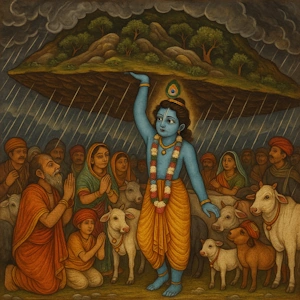
He rushed towards Gowardhana mountain and with the little finger of his left hand lifted it up in the air.
He told everyone — bring everyone, all the cows, all the calves, everything here. This place under the mountain is big enough to protect the three worlds from anything and everything.
They all ran back towards their own respective homes, brought all the cows, calves, all their possessions. The worry on their face disappeared. Here’s our Lord, who is capable of saving the three worlds, who has lifted the huge Gandhamadana on his little finger. What is there to fear?
Indra said — I will pulverize this mountain. I will flush everyone out. But see the situation. The Gopas and Gopikas were out in the open — while rushing towards, while running after him, while going back to get the cows and other possessions, while coming back with them — Indra could do nothing to even one of them.
And he says he is going to destroy them.
Indra must have lost his sight because — there on top of Gowardhana was rotating, throwing fierce flames all around, the thousand-spoked Sudarshana Chakra, and right at its centre, Lord of Lords Mahadeva stood with his jata wide open and spread out. The rainwater simply started getting vaporized with the terrific heat.
And there under the mountain, the Lord standing with the mountain resting on his little finger — in yellow clothes, with vanamala around his neck, Sreevatsa hidden beneath a pearl garland, lotus petal-like eyes, peacock feather adorning curly hair dancing around his beautiful forehead. They were all looking at him, mesmerized by his beauty.
Someone joked — your hand must be tired, pass on the mountain to brother Balarama. That was quite possible. Balarama is Anantha, on whose single hood the earth rests till pralaya.
And the Lord started playing murali. Everyone went into a trance of ananda.
Seven days and seven nights passed like seven seconds. The clouds dried out. They didn’t have a drop of rain in them.
And when Indra looked down, he saw the jata of Mahadeva, the Chakra of Sri Hari. Then only he realized what grave offence he had committed. Who was behind this whole episode. He ordered everyone back to deva loka.
Bright sun appeared in the sky. There was not a drop of water anywhere.
Everyone came out from under the Gowardhana.
The Lord said — the cows and calves must be hungry, let’s take them for grazing.
This is how he protects those who are devoted to him. He won’t allow a drop of water to fall upon them.
-
Why shift worship from a powerful deva to Sri Hari, who is beyond the devas?
-
Devas operate within karma; Sri Hari authors karma and its results.
-
Seeking the highest cause gives stable protection, not seasonal favors.
-
-
What does it mean to respect tradition yet correct it when needed?
-
Dharma allows course correction when a practice misplaces the goal.
-
Reverence is kept; the compass is reset toward the supreme.
-
-
Why did the people run to the Lord instead of asking the offender for mercy?
-
Bhakti trusts the source, not the symptom.
-
When the root is held, branches settle on their own.
-
-
Is it right to defy a powerful authority if the conscience points higher?
-
Yes, when the motive is alignment with truth, not ego.
-
Courage anchored in devotion is safer than compliance rooted in fear.
-
-
What is the lesson in the Lord lifting with the little finger, not with display of rage?
-
Divine strength is quiet, precise, and effortless.
-
Real power protects without theatrics and invites calm in the crowd.
-
-
Why was no one blamed for the crisis, not even the youth who steered the decision?
-
Bhakti replaces blame with belonging.
-
A united heart receives grace faster than a divided mind searching for faults.
-
-
What is the health lesson in gathering under one shelter?
-
Collective safety lowers panic, heart rate, and harmful stress hormones.
-
Shared prayer and steady breathing regulate the nervous system and prevent rash actions.
-
-
How should a family respond when elders are afraid but duty calls?
-
Acknowledge fear respectfully; act firmly for the common good.
-
Reassurance plus leadership preserves dignity and saves time.
-
-
What does strategic silence from the Lord teach during a storm of accusations or panic?
-
Do first, explain later. Impact outruns argument.
-
Peaceful action cuts through noise better than debate.
-
-
Why does devotion not cancel planning and logistics?
-
Bhakti sharpens practicality: move people, cattle, supplies, and secure space.
-
Faith is a multiplier for preparation, not a substitute.
-
-
What is the inner practice when danger feels endless?
-
Fix the mind on one form of the Lord and keep the breath even and slow.
-
Alternate between remembrance and simple work; rhythm steadies the brain.
-
-
How do we read divine help when nature itself turns hostile?
-
The same nature becomes a shield when the cause is righteous.
-
Grace bends elements without breaking dharma’s order.
-
-
What is the relationship lesson from everyone standing together under one mountain?
-
Shared shelter builds long-term trust; survival memories bind families.
-
After the crisis, keep the habit of daily check-ins and shared meals to retain cohesion.
-
-
Why resume ordinary work right after deliverance?
-
Returning to routine grounds emotions and prevents spiritual pride.
-
Duty after grace proves gratitude; it keeps the heart clean.
-
-
How does this story redefine strength for householders?
-
Strength is the ability to protect calmly, organize wisely, and console gently.
-
A householder’s spirituality is measured by safety given to dependents.
-
-
What should one pray for in similar storms of life?
-
Clarity to choose the highest refuge.
-
Steady hands to move family and neighbors into practical safety while remembering the Lord.
-





English
Vishnu Sahasranama
Click on any topic to open
7
30
Astrology
Bhagavad Gita
Bhagavatam
Bharat Matha
Devi
Devi Mahatmyam
Ganapathy
Garuda Puranam
Glory of Venkatesha
Hanuman
Kathopanishad
Mahabharatam
Mantra Shastra
Mystique
Practical Wisdom
Purana Stories
Radhe Radhe
Ramayana
Rare Topics
Rigveda Explained
Rituals
Sages and Saints
Shiva
Spiritual books
Sri Suktam
Story of Sri Yantra
Temples
Vedas
Vishnu Sahasranama
Yoga Vasishta
26
17
10
0


