Purusha Sukta: The Origin of Creation
Mantra 1
ॐ स॒हस्र॑शीर्षा॒ पुरु॑षः । स॒ह॒स्रा॒क्षः स॒हस्र॑पात् । स भूमिं॑ वि॒श्वतो॑ वृ॒त्वा । अत्य॑तिष्ठद्दशाङ्गु॒लम् ।
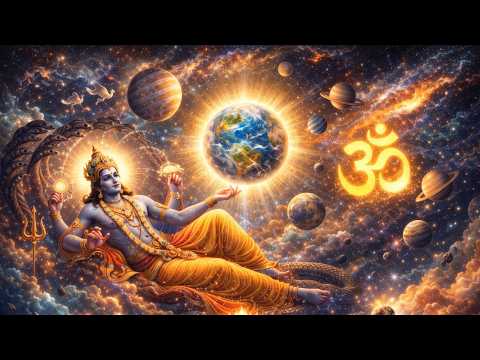
The verse literally translates to describing the cosmic being, Purusha, who possesses a thousand heads, a thousand eyes, and a thousand feet. Encompassing the earth from all sides, this supreme entity transcends it by ten fingers. The word thousand here is not a strict numerical limitation but a metaphorical expression denoting infinity, boundlessness, and omnipresence. The ten fingers metaphorically signify that the ultimate reality extends beyond the manifested universe, existing in a realm beyond physical dimensions and human comprehension.
In the cosmological context, this verse introduces the Purusha, the primordial cosmic person from whom the entire creation emanates. It establishes the foundation of Vedic cosmology, where the universe is not crafted out of nothing but is a modification or an extension of the divine being itself. The imagery of myriad sensory organs symbolizes the all-seeing, all-knowing nature of the divine that watches over and orchestrates cosmic functioning.
Philosophically, this verse establishes the panentheistic view of the Vedas. God is immanent within the universe, completely pervading all existence, yet simultaneously transcendent, existing beyond the limitations of space and time. The ten fingers symbolize the ten directions, meaning consciousness overflows the bounds of the material cosmos, remaining eternally detached yet universally supportive.
Mantra 2
पुरु॑ष ए॒वेदꣳ सर्वम्᳚ । यद्भू॒तं यच्च॒ भव्यम्᳚। उ॒तामृ॑त॒त्वस्येशा॑नः । यदन्ने॑नाति॒रोह॑ति ।
The literal meaning of this verse declares that the Purusha constitutes all of existence, encompassing everything that was in the past and everything that will be in the future. Furthermore, this cosmic being is the supreme lord of immortality, simultaneously growing and transcending through the consumption of food. The concept of food here represents the material realm which undergoes continuous cycles of growth, decay, and transformation.
In the theological context, this verse firmly establishes the sovereignty of the cosmic being over both the eternal, unchanging celestial realms and the perishable, changing physical universe. The imagery portrays a divine entity who allows a portion of itself to participate in the mortal cycle of life and death, symbolized by the ingestion and manifestation of food, while retaining its immortal essence completely intact.
Philosophically, this verse reveals the profound non-dualistic vision of the Vedic seers. Time itself, categorized into past, present, and future, is subsumed entirely within the omnipresent reality of the divine. The assertion that God grows by food illustrates the law of cause and effect governing the material world. It signifies that while the Supreme Reality creates and enters the realm of mortality and change, its fundamental nature remains eternally complete and unblemished.
Mantra 3
ए॒तावा॑नस्य महि॒मा । अतो॒ ज्याया॑ꣳश्च॒ पूरु॑षः । पादो᳚ऽस्य॒ विश्वा॑ भू॒तानि॑ । त्रि॒पाद॑स्या॒मृतं॑ दि॒वि ।
Literally translated, the verse proclaims that such is the immense greatness of this cosmic being, yet the true Purusha is infinitely greater than this manifested glory. It states that all living beings and the entire material universe comprise merely one-fourth of his total existence. The remaining three-fourths of his being exist immortally and unchangingly in the radiant, celestial domain of heaven.
From a cosmological perspective, this description serves to awe the listener by quantifying the unquantifiable. It portrays the creation of the cosmos not as an exhausting effort that depleted the creator, but as a minor projection of a much larger, boundless divine entity. Only a fractional spark of the infinite divine potential descends to form the myriad galaxies, celestial entities, and earthly life forms, leaving the vast majority of the divine undisturbed.
The deeper philosophical significance points to the dual nature of reality as both immanent and transcendent. The manifested universe is celebrated, yet it is recognized as a limited, partial expression of the Absolute. The unmanifested consciousness remains pure, supreme, and completely independent of the material creation. This ensures that the ultimate reality is never entirely confined by the limitations of space, time, or physical causation.
Mantra 4
त्रि॒पादू॒र्ध्व उदै॒त्पुरु॑षः । पादो᳚ऽस्ये॒हाऽऽभ॑वा॒त्पुनः॑ । ततो॒ विश्व॒ङ्व्य॑क्रामत् । सा॒श॒ना॒न॒श॒ने अ॒भि ।
The literal translation of this verse states that three-quarters of the Purusha ascended upwards, while one-quarter of his essence came down here to manifest again. From this single quarter, he strode out extensively across the universe, encompassing both that which eats and that which does not eat. The distinction points to the division of the world into animate beings and inanimate matter.
Scripturally, this verse depicts the deliberate descent of the divine force into the realm of physical creation. It illustrates a cosmic journey where the supreme lord willingly projects a fragment of his immense being downward to animate the terrestrial plane. By striding across both the eating and non-eating entities, the cosmic person breathes life into the diverse flora, fauna, and elemental forces, establishing a deeply interconnected earthly ecosystem.
On a philosophical level, this verse underscores the cyclic nature of cosmic manifestation and the all-pervasive presence of the divine. Consciousness permeates every aspect of reality, asserting omnipresence across all polarities. The divine is equally present in conscious, subjective beings and unconscious, objective matter. This establishes a worldview where the sacred is not distant but intimately woven into the very fabric of daily physical existence.
Mantra 5
तस्मा᳚द्वि॒राड॑जायत । वि॒राजो॒ अधि॒ पूरु॑षः । स जा॒तो अत्य॑रिच्यत । प॒श्चाद्भूमि॒मथो॑ पु॒रः ।
Literally, this verse explains that from the original Purusha, the cosmic entity known as Viraj was born, and subsequently, from Viraj, the individualized Purusha emerged. Upon being born, this entity expanded significantly, multiplying and spreading extensively across the entirety of the earth, expanding both behind and before to fill the vast spatial dimensions.
In the cosmological framework, Viraj represents the cosmic womb or the universal intelligence that acts as the intermediary between the unmanifested absolute and the manifested material world. The dynamic described here is a continuous interplay of generation. The supreme being projects the universal material form, and then willfully re-enters this very manifestation as the animating soul, bringing dynamic energy and expansive proliferation to the newly formed terrestrial landscape.
Philosophically, this reflects the intricate dual nature of the creative process found in advanced Indian thought. It highlights the relationship between the macrocosm and the microcosm. The unmanifest consciousness projects the universal physical reality, representing Prakriti or the material matrix. It then individualizes itself as the Jiva, the witnessing soul, to actively experience creation. This continuous cycle of manifestation demonstrates that every individual life is a direct reflection of the supreme universal consciousness.
Mantra 6
यत्पुरु॑षेण ह॒विषा᳚ । दे॒वा य॒ज्ञमत॑न्वत । व॒स॒न्तो अ॑स्यासी॒दाज्यम्᳚ । ग्री॒ष्म इ॒ध्मः श॒रद्ध॒विः ।
The literal meaning of this verse describes the profound moment when the celestial gods performed a grand sacrifice using the Purusha himself as the primary oblation. In this primordial ritual, the various seasons were utilized as the essential sacrificial components. Spring served as the clarified butter or ghee, Summer acted as the burning fuel wood, and Autumn was offered as the final sacred oblation.
In the traditional narrative, this depicts the first cosmic sacrifice, an event entirely devoid of conventional material items, as nothing but the divine existed. The cosmic forces and deities orchestrated this ritual to shape the universe. By equating the shifting seasons with ritualistic elements, the text establishes that the fundamental machinery of time and nature is an ongoing, sacred performance initiated by divine beings for the sake of universal order.
The philosophical significance is immense, positing that creation is fundamentally an act of supreme self-sacrifice. The universe does not operate on acquisition but on the principle of continuous self-giving and transformation. Time itself is the sacred medium through which existence evolves. It teaches that life is sustained by a continuous cycle of offering and consumption, requiring individuals to view their own actions as contributions to a greater cosmic sacrifice.
Mantra 7
स॒प्तास्या॑सन्परि॒धयः॑ । त्रिः स॒प्त स॒मिधः॑ कृ॒ताः । दे॒वा यद्य॒ज्ञं त॑न्वा॒नाः । अब॑ध्न॒न्पु॑रुषं प॒शुम् ।
Literally translated, the verse specifies the parameters of the great cosmic ritual, noting that there were exactly seven enclosing sticks surrounding the fire, and twenty-one sticks of fuel were prepared. As the celestial gods meticulously conducted this expansive sacrifice, they took the supreme cosmic being, the Purusha, and bound him to the sacrificial post, treating the creator as the designated sacrificial animal.
In its cosmological context, this binding of the primordial giant is a dramatic illustration of setting the structural boundaries of the universe. The seven enclosing sticks correspond to the seven meters of Vedic poetry or the seven mythical oceans, while the twenty-one fuel pieces represent fundamental cosmic elements, such as the vital breaths, sensory organs, and elemental forms. The gods act as cosmic architects enforcing universal order.
Philosophically, this verse delves into the necessary limitation of the infinite to produce the finite universe. The boundless, formless reality must willfully accept restriction and confinement to manifest as a structured cosmos. The act of binding the cosmic person signifies the establishment of physical laws and natural boundaries. It reveals that the infinite divine consciousness voluntarily subjects itself to the constraints of space and time out of supreme compassion for creation.
Mantra 8
तं य॒ज्ञं ब॒र्हिषि॒ प्रौक्षन्॑ । पुरु॑षं जा॒तम॑ग्र॒तः । तेन॑ दे॒वा अय॑जन्त । सा॒ध्या ऋष॑यश्च॒ অপরি ।
Literally, this verse describes how the participants of the cosmic ritual took the Purusha, who was born at the very beginning of time, and ritually sprinkled him as the sacred sacrifice upon the holy grass. Through this monumental offering, the various celestial gods, the ancient Sadhyas, and the enlightened sages collectively performed the ultimate sacrifice that generated the world.
Scripturally, this scene represents the supreme consecration of the primordial being. The ritual grass symbolizes the foundation of the newly forming terrestrial realm. The collaborative participation of earlier celestial beings, mysterious ancient forces like the Sadhyas, and the visionary sages emphasizes that the creation of the universe was a deeply harmonious, collective enterprise. It was an event witnessed and orchestrated by the highest echelons of spiritual entities.
The deeper philosophical meaning focuses on the sanctification of the entire material world. By portraying the creator as the very substance of the offering, the verse asserts that all aspects of creation are fundamentally divine in origin. It dissolves the distinction between the sacred and the mundane, suggesting that the physical world is literally made of God. Therefore, human existence and the natural environment must be treated with utmost reverence and spiritual respect.
Mantra 9
तस्मा᳚द्य॒ज्ञात्स॑र्व॒हुतः॑ । संभृ॑तं पृषदा॒ज्यम् । प॒शूꣳस्ताꣳश्च॑क्रे वाय॒व्यान्॑ । आ॒र॒ण्यान्ग्रा॒म्याश्च॒ ये ।
The literal translation of this verse states that from this completely and fully offered cosmic sacrifice, vital substances like curds and clarified butter were successfully gathered. Utilizing these extracted essences, the supreme force systematically formed the various categories of animals, specifically creating the creatures that inhabit the air, the untamed wild animals of the forest, and the domesticated animals of the village.
In its cosmological setting, this verse explains the precise origin of all sentient biological life. The remnants of the grand cosmic offering do not go to waste; rather, they manifest as the fundamental vital essence that directly sustains the animal kingdom. The specific categorization into aerial, wild, and domestic realms shows the methodical organization of the natural world, crafted thoughtfully by the divine architects from the energetic residue of the original creator.
Philosophically, this passage establishes a profound spiritual ecology. It asserts that all life forms, whether they roam free in the wilderness or are bound to human civilization, are direct products of the exact same divine sacrifice. Every creature holds a sacred, necessary place in the interconnected web of existence. This interconnectedness demands an ethical stance of non-violence and respect towards all living beings, recognizing their divine origin.
Mantra 10
तस्मा᳚द्य॒ज्ञात्स॑र्व॒हुतः॑ । ऋचः॒ सामा॑नि जज्ञिरे । छन्दा॑ꣲसि जज्ञिरे॒ तस्मा᳚त् । यजु॒स्तस्मा॑दजायत ।
Literally, this verse declares that from the perfectly executed, all-encompassing cosmic sacrifice, the sacred verses of the Rig Veda and the melodies of the Sama Veda were born. Furthermore, the various poetic meters emerged from this grand ritual, and finally, the sacrificial formulas of the Yajur Veda were also generated from this same ultimate source.
Scripturally, this verse addresses the divine origin of sound, knowledge, and cosmic law. The Vedas are not viewed as texts authored by human minds, but as eternal truths that crystallized directly from the original sacrificial fire. The foundational structure of spiritual communication, ritualistic chanting, and rhythmic order is thus portrayed as a fundamental byproduct of the creation of the universe itself, coeval with the physical elements.
Philosophically, this emphasizes the concept that sound vibration is the primordial substrate of the entire universe. The laws of nature, represented by the poetic meters, and the sacred knowledge required for spiritual liberation are deeply inherent in the fabric of creation. The cosmos is governed by an underlying intelligent design and harmony. True wisdom consists of tuning one's own mind to perceive these eternal, uncreated vibrations that constantly resonate throughout the manifested world.
Mantra 11
तस्मा॒दश्वा॑ अजायन्त । ये के चो॑भ॒याद॑तः । गावो॑ ह जज्ञिरे॒ तस्मा᳚त् । तस्मा᳚ज्जा॒ता अ॑जा॒वयः॑ ।
Literally translated, the verse notes that from this great cosmic sacrifice, horses were born, along with any other animals that possess two rows of teeth. Additionally, cows were generated from this monumental ritual, and from this exact same divine source, goats and sheep were subsequently brought into existence.
In the traditional context, this verse details the specific creation of essential livestock that forms the backbone of human civilization and traditional Vedic rituals. By listing horses, cows, goats, and sheep, the narrative connects the daily, practical components of agrarian life directly back to the mystical origins of the universe. The gods ensured that humanity would be provided with the necessary companions and resources required for both survival and spiritual worship.
Philosophically, this verse represents the profound integration of the practical and economic aspects of human existence with the divine reality. Wealth, sustenance, and the tools for progress are viewed not merely as material acquisitions but as sacred gifts resulting from the cosmic sacrifice. It teaches that one's daily livelihood and interaction with domesticated nature should be conducted with a sense of immense gratitude, recognizing the sacred interconnectedness of all resources provided by the ultimate reality.
Mantra 12
यत्पुरु॑षं॒ व्य॑दधुः । क॒ति॒धा व्य॑कल्पयन् । मुखं॒ किम॑स्य॒ कौ बा॒हू । कावू॒रू पादा॑वुच्येते ।
The literal meaning of this verse takes the form of a series of profound questions. It asks: When they systematically divided the supreme Purusha, into how many distinct parts did they arrange him? What exactly did they call his mouth, what were his two arms designated as, and what names were given to his two thighs and his two feet?
Cosmologically, this acts as an inquisitive pause in the narrative, illustrating the cosmic contemplation undertaken by the celestial beings regarding the anatomy of the universe. It sets the stage for the structural mapping of human society and natural forces onto the divine physical body. The inquiry reflects a deep wonder about how a singular, unified primordial giant could be transformed into the vast, complex multiplicity observed in the physical and social world.
Philosophically, this represents the eternal human quest for understanding the differentiation within unity. It addresses the fundamental problem of how the one unmanifest whole logically divides into a multiplicity of functional parts without losing its inherent divinity. The questioning format encourages seekers to realize that despite apparent external differences in form and function, every single fragment of reality remains structurally intrinsically connected to the same original, unified cosmic source.
Mantra 13
ब्रा॒ह्म॒णो᳚ऽस्य॒ मुख॑मासीत् । बा॒हू रा॑ज॒न्यः॑ कृ॒तः । ऊ॒रू तद॑स्य॒ यद्वैश्यः॑ । प॒द्भ्याꣳ शू॒द्रो अ॑जायत ।
Literally, this verse provides the answers to the previous inquiry, stating that the Brahmana became his mouth, and his arms were made into the Rajanya or Kshatriya. His thighs transformed into the Vaishya, and from his feet, the Shudra was ultimately born.
In the scriptural narrative, this famous passage describes the origin of human society's structural divisions emerging directly from the anatomy of the divine body. It links the micro-cosmos of human societal organization to the macro-cosmos of the creator. The mouth represents speech and knowledge, the arms denote strength and protection, the thighs signify support and commerce, and the feet symbolize the foundational labor that grounds and sustains the entire structure.
Philosophically, this verse envisions society as a single, organic living entity where every functional part is fundamentally divine in origin. It was historically intended to reflect a system of cooperative interdependence rather than a rigid hierarchy of intrinsic worth. Just as a human body requires all its limbs to function healthily, a harmonious society requires the seamless cooperation of knowledge, administration, commerce, and service. It emphasizes underlying unity, asserting that all human beings, regardless of their societal role, share the same sacred origin.
Mantra 14
च॒न्द्रमा॒ मन॑सो जा॒तः । चक्षोः॒ सूर्यो॑ अजायत । मुखा॒दिन्द्र॑श्चा॒ग्निश्च॑ । प्रा॒णाद्वा॒युर॑जायत ।
Literally translated, the verse explains that the moon was born directly from the mind of the cosmic being, while the sun was generated from his eye. The deities Indra and Agni emerged from his mouth, and the wind deity, Vayu, was born from his vital breath.
In the cosmological narrative, the celestial bodies and the foundational elemental deities are shown originating directly from the sensory organs of the supreme creator. This establishes a profound intimate link between the physical phenomena observed in the sky and the internal anatomy of the divine. The cosmos is not a dead, mechanical void, but a vibrant, living entity governed by conscious forces that are literal extensions of the primordial being's own senses.
Philosophically, this establishes a direct, mystical correlation between human internal faculties and external cosmic forces. The human mind acts much like the reflecting moon, constantly shifting in phases, while the intellect operates like the illuminating sun, revealing truth. Speech is tied to the transformative fire of Agni, and breath to the universal life force of Vayu. It teaches that the microcosm of the human body perfectly mirrors the macrocosm of the universe, proving our inherent oneness with nature.
Mantra 15
नाभ्या॑ आसीद॒न्तरि॑क्षम् । शी॒र्ष्णो द्यौः सम॑वर्तत । प॒द्भ्यां भूमि॒र्दिशः॒ श्रोत्रा᳚त् । तथा॑ लो॒काꣳ अ॑कल्पयन् ।
The literal meaning of this verse reveals that from the navel of the cosmic being arose the vast intermediate space or atmosphere, and from his head the celestial heavens were formed. From his feet came the solid earth, and from his ears emerged the spatial directions. Thus, the gods formed all the worlds.
Cosmologically, the geographical and spatial dimensions of the universe are literally constructed out of the physical structure of the primordial giant. The cosmic axis is established here, mapping the earth to the lowest extremities, the mysterious atmospheric void to the center, and the luminous heavens to the highest point of the divine body. The directions of space itself are merely an extension of divine hearing.
Philosophically, this imagery asserts that space is not an empty, lifeless vacuum, but rather a dynamic extension of the divine presence. The entire physical universe, encompassing all dimensions and planes of existence, is a living, breathing manifestation of the Supreme Reality. It teaches the spiritual seeker to perceive the physical environment not as mere matter, but as the literal body of God, fostering a deep reverence for the earth and a sense of awe for the encompassing cosmos.
Mantra 16
वेदा॒हमे॒तं पुरु॑षं म॒हान्तम्᳚ । आ॒दि॒त्यव॑र्णं॒ तम॑सस्तु॒ पा॒रे । सर्वा॑णि रू॒पाणि॑ वि॒चित्य॒ धीरः॑ । नामा॑नि कृ॒त्वाऽभि॒वद॒न् यदास्ते᳚ ।
Literally, the verse is a powerful declaration by the seer: I truly know this great, supreme Purusha, who is radiant like the sun and exists entirely beyond the darkness. The wise creator, having distinctly formed all forms and assigned them names, abides eternally, continuously communicating with them.
Scripturally, this represents the climax of the vision, a triumphant declaration of direct enlightenment. The seer transcends theoretical knowledge and directly perceives the luminous nature of the Creator. This divine architect does not simply abandon creation after shaping it; instead, he intimately names every entity and maintains a continuous, vibrant connection with the cosmos, overseeing the grand design with radiant clarity.
Philosophically, the verse contrasts the darkness of spiritual ignorance with the solar light of self-realization. The ultimate reality is the conscious, intelligent force that brings order, represented by names and forms, to chaotic potentiality. More importantly, it emphasizes that God remains immanent and accessible. True liberation is achieved when the individual soul penetrates the darkness of illusion to directly experience this brilliant, omnipresent consciousness that actively sustains and defines every single aspect of universal existence.
Mantra 17
धा॒ता पु॒रस्ता॒द्यमु॑दाज॒हार॑ । श॒क्रः प्रवि॒द्वान्प्र॒दिश॒श्चत॑स्रः । तमे॒वं वि॒द्वान॒मृत॑ इ॒ह भ॑वति । नान्यः पन्था॒ अय॑नाय विद्यते ।
Literally translated, this verse states: Whom the creator revealed in ancient times, and whom the great Indra knew entirely in all four directions. By knowing him in this exact manner, a person becomes immortal right here in this world. There is absolutely no other path available for liberation.
In the traditional context, this highlights the authoritative transmission of supreme divine knowledge. It shows that this spiritual wisdom was first grasped by cosmic deities like Brahma the creator and Indra the king of heaven before being passed down to humanity. It establishes an unbroken lineage of cosmic revelation, ensuring the seeker that this is the absolute truth recognized by the highest rulers of the universe across all spatial directions.
Philosophically, this verse delivers a profound, uncompromising assertion about the nature of salvation. It emphatically states that direct experiential knowledge of the true self is the sole, exclusive means to achieve immortality. Furthermore, it asserts that liberation is not a posthumous reward, but an awakening to one's true nature that must be achieved here and now, in this very life. It dismisses merely mechanical rituals, emphasizing internal realization as the only ultimate path to freedom.
Mantra 18
य॒ज्ञेन॑ य॒ज्ञम॑यजन्त दे॒वाः । तानि॒ धर्मा॑णि प्रथ॒मान्या॑सन् । ते ह॒ नाकं॑ महि॒मानः॑ सचन्ते । यत्र॒ पूर्वे॑ सा॒ध्याः सन्ति॑ दे॒वाः ।
The literal meaning of this verse summarizes the grand ritual: The celestial gods worshipped the cosmic sacrifice by using the sacrifice itself. These sacred actions became the very first fundamental laws of dharma. These great, spiritually mighty beings subsequently reach the highest firmament, where the ancient Sadhyas and the primordial gods eternally abide.
In the cosmological context, this serves as the majestic conclusion of the cosmic creation event. It establishes that the universal laws of nature and morality were fundamentally set into motion by this initial act of divine self-offering. The gods, through their selfless participation in structuring the universe, pave the celestial pathway for all future beings, ensuring that righteous action naturally elevates the soul to the highest divine realms.
Philosophically, the verse reveals the profound paradox that the means and the end of spiritual practice are inherently identical. God is both the offering and the receiver of the offering. Selfless action, or Karma Yoga, is shown to be a micro-level reflection of this macro-level cosmic sacrifice. Living one's life in strict harmony with these universal laws of selfless duty leads naturally to the highest state of spiritual emancipation and alignment with the absolute.
Mantra 19
अ॒द्भ्यः संभू॑तः पृथि॒व्यै रसा᳚च्च । वि॒श्वक॑र्मणः॒ सम॑वर्त॒ताधि॑ । तस्य॒ त्वष्टा॑ वि॒दध॑द्रू॒पमे॑ति । तत्पुरु॑षस्य॒ विश्व॒माजा॑न॒मग्रे᳚ ।
Literally, this verse explains that the supreme entity was born from the primordial waters and the vital essence of the earth, subsequently arising above the creator of the universe. The divine architect, Tvashtar, continuously moves about meticulously shaping his physical form. That was the initial, grand origin of the entire universe from the Purusha in the beginning.
Scripturally, this verse introduces a secondary phase of cosmic evolution, focusing on the material construction of the world. It merges the concepts of physical elements, specifically water and earth, with the conscious guidance of divine forces. Tvashtar acts as the master cosmic craftsman, taking the raw, infinite potential of the Purusha and forging it into the specific, diverse forms that populate the physical universe, crafting a tangible reality from the divine essence.
Philosophically, this represents the vital intersection of material evolution and underlying divine design. The physical elements are not random, chaotic substances, but are deeply saturated with spiritual essence. They are constantly guided by an underlying, intelligent principle that shapes the grand architecture of existence. It teaches that the ongoing evolution and physical transformation of the universe are continuous expressions of the divine will actively organizing matter into meaningful forms.
Mantra 20
वेदा॒हमे॒तं पुरु॑षं म॒हान्तम्᳚ । आ॒दि॒त्यव॑र्णं॒ तम॑सः॒ पर॑स्तात् । तमे॒वं वि॒द्वान॒मृत॑ इ॒ह भ॑वति । नान्यः पन्था॑ विद्य॒तेय॑ऽनाय ।
Literally translated, the seer reiterates: I know this truly great and supreme Purusha, who is radiant like the sun and exists completely beyond all darkness. By knowing him in this exact manner, a person becomes immortal right here. There is absolutely no other path that exists for liberation.
In the scriptural narrative, this powerful repetition solidifies the absolute certainty and profound conviction of the enlightened seer. By restating this realization, the verse acts as an undeniable cosmic testament, meant to inspire unwavering faith in the listener. It reaffirms the supremacy of the luminous cosmic being whose radiant presence alone is capable of dispelling the primordial darkness of the universe, standing as the ultimate beacon of truth.
Philosophically, the deliberate repetition serves to cement the absolute, undeniable necessity of self-realization for the human soul. True freedom from the agonizing bondage of worldly existence and the cycle of rebirth is achieved solely through the direct knowledge of this radiant consciousness. The verse strongly dismisses all alternative superficial methods, emphasizing that only piercing the darkness of deep-seated ignorance with the light of true, experiential wisdom can grant ultimate spiritual immortality in the present life.
Mantra 21
प्र॒जाप॑तिश्चरति॒ गर्भे॑ अ॒न्तः । अ॒जाय॑मानो बहु॒धा विजा॑यते । तस्य॒ धीराः॒ परि॑जानन्ति॒ योनिम्᳚ । मरी॑चीनां प॒दमि॑च्छन्ति वे॒धसः॑ ।
The literal meaning of this verse reveals that the Lord of all beings, Prajapati, moves silently within the cosmic womb. Even though he is completely unborn and eternal, he is simultaneously born in endlessly diverse ways. The truly wise profoundly perceive his true origin and nature. Meanwhile, the creators and sages actively seek to attain the exalted position of the ancient enlightened seers.
Cosmologically, this depicts Prajapati entering the mysterious womb of creation, choosing to continuously multiply himself into the myriad biological and elemental forms of the universe. It portrays a dynamic, ongoing process of creation rather than a singular historical event. Sages and lesser creators are shown aspiring to reach the highest states of cosmic understanding, striving to emulate the profound spiritual authority held by the earliest divine beings.
Philosophically, this verse addresses the ultimate paradox of the Unborn effortlessly manifesting as the Many without ever losing its fundamental unity. The Supreme Reality remains the silent, witnessing presence within the heart of every living creature. Spiritual seekers are encouraged to look past the illusion of multiple births and forms, aiming to realize this singular, unborn inner source, thereby attaining the highest, unshakeable states of pure unified consciousness.
Mantra 22
यो दे॒वेभ्य॒ आत॑पति । यो दे॒वानां᳚ पु॒रोहि॑तः । पूर्वो॒ यो दे॒वेभ्यो॑ जा॒तः । नमो॑ रु॒चाय॒ ब्राह्म॑ये ।
Literally translated, the verse offers profound reverence: He who shines intense heat and light for the benefit of the gods, who acts as the supreme priest of the gods, and who was remarkably born even before the gods existed. Salutations and deep respect to the absolute, brilliant reality.
In the traditional narrative, this is an act of supreme homage paid to the initial, primordial spark of consciousness that pre-dates even the highest celestial deities. The supreme being is characterized not merely as a creator, but as the guiding priest and illuminating force that empowers the gods to perform their cosmic duties. It establishes a hierarchy where even the mighty elemental gods are dependent on a singular, older, illuminating source.
Philosophically, this verse teaches that the ultimate reality is the singular light of all lights. It is the fundamental consciousness that illuminates even the most advanced human intellects and divine forces. The verse calls for total surrender and profound humility before this luminous intelligence. It reminds the spiritual seeker that all worldly and celestial power is derived from this preceding absolute reality, urging a focus on the eternal rather than the temporal manifestations.
Mantra 23
रुचं॑ ब्रा॒ह्मम् ज॒नय॑न्तः । दे॒वा अग्रे॒ तद॑ब्रुवन् । यस्त्वै॒वं ब्रा᳚ह्म॒णो वि॒द्यात् । तस्य॑ दे॒वा अस॒न् वशे᳚ ।
Literally, the verse states that while generating this absolute, supreme brilliance, the gods declared at the very beginning of time: Whichever dedicated knower of Brahman truly realizes you in this profound manner, all the gods themselves will inevitably fall under his complete control.
Scripturally, this represents an extraordinary cosmic concession. The celestial deities, who ordinarily govern the forces of nature and human destiny, willingly declare the ultimate supremacy of a fully self-realized human soul. They offer their total subjugation to anyone who successfully pierces the veil of illusion and understands the ultimate truth. The gods recognize that a true knower of Brahman has merged with the very source that created them.
Philosophically, this verse powerfully asserts that true, ultimate power lies exclusively in deep spiritual knowledge rather than physical or material dominance. When a person successfully realizes their inherent unity with the Supreme Reality, they organically master their own internal senses and all external environmental forces. The enlightened sage transcends all dependency on external cosmic agents, achieving absolute freedom, as the entire universe naturally aligns with the will of one who has become one with the absolute.
Mantra 24
ह्रीश्च॑ ते ल॒क्ष्मीश्च॒ पत्न्यौ᳚ । अ॒हो॒रा॒त्रे पा॒र्श्वे । नक्ष॑त्राणि रू॒पम् । अ॒श्विनौ॒ व्यात्तम्᳚ । इ॒ष्टम् म॑निषाण । अ॒मुं म॑निषाण । सर्व॑म् मनिषाण ।
The literal translation of this verse portrays the Supreme Lord with profound attributes: Modesty and wealth are your divine consorts. Day and night represent your two sides. The starry constellations form your physical appearance. The twin Ashvins are your open mouth. Please grant us our rightful desires, grant us immense happiness here, and grant us everything.
In the cosmological vision, this verse brings a deeply personal, personified vision of the Supreme Lord, accompanied by his eternal consorts, Hri, representing modesty or righteousness, and Lakshmi, representing material prosperity. It creates a majestic image of a universal monarch whose very body comprises the cycles of time, the vastness of the night sky, and the healing cosmic forces. The seeker petitions this holistic cosmic sovereign for total fulfillment.
Philosophically, the ultimate reality is depicted as perfectly encompassing both material abundance and righteous spiritual restraint. Time and space are merely the physical dimensions of its boundless existence. The concluding prayer demonstrates that true spiritual life does not demand the rejection of the world, but rather seeks holistic, balanced fulfillment. The enlightened seeker prays for both material well-being and spiritual perfection, recognizing both as valid gifts of the divine.
Mantra 25
तच्छं॒ योरावृ॑णीमहे । गा॒तुं य॒ज्ञाय॑ । गा॒तुं यज्ञप॑तये । दैवी᳚स्स्व॒स्तिर॑स्तु नः । स्व॒स्तिर्मानु॑षेभ्यः । ऊ॒र्ध्वं जि॑गातु भेष॒जम् । शन्नो॑ अस्तु द्वि॒पदे᳚ । शं चतु॑ष्पदे । ॐ शान्तिः॒ शान्तिः॒ शान्तिः॑ ।
Literally, the final verse translates as: We earnestly seek that which brings holistic well-being. May the sacred sacrifice prosper immensely. May the lord of the sacrifice also prosper. May divine peace continuously be unto us. Peace to all humanity. May the healing herbs grow upwards vigorously. Peace to all two-legged beings, and peace to all four-legged beings. Om, peace, peace, peace.
Scripturally, this acts as the traditional, soothing concluding invocation designed to invoke universal harmony. Its primary purpose is to ensure that any subtle cosmic balance that may have been inadvertently disturbed by the immense power of the ritual is gently and completely restored. It calls upon divine energies to bless the environment, the participants, and the broader world, ensuring that the ritual's energy manifests as pure benevolence.
Philosophically, this beautiful verse emphasizes ultimate, holistic well-being and profound ecological interconnectedness. It teaches that authentic spiritual practice must directly benefit the entire living ecosystem, ranging from humans to animals and medicinal plants. The famous triple repetition of peace is a deep spiritual petition to thoroughly eradicate miseries arising from personal internal struggles, harsh environmental conditions, and unpredictable celestial or supernatural sources, culminating in absolute tranquility.
ॐ स॒हस्र॑शीर्षा॒ पुरु॑षः । स॒ह॒स्रा॒क्षः स॒हस्र॑पात् ।
स भूमिं॑ वि॒श्वतो॑ वृ॒त्वा । अत्य॑तिष्ठद्दशाङ्गु॒लम् ।
पुरु॑ष ए॒वेदꣳ सर्वम्᳚ । यद्भू॒तं यच्च॒ भव्यम्᳚।
उ॒तामृ॑त॒त्वस्येशा॑नः । यदन्ने॑नाति॒रोह॑ति ।
ए॒तावा॑नस्य महि॒मा । अतो॒ ज्याया॑ꣳश्च॒ पूरु॑षः ।
पादो᳚ऽस्य॒ विश्वा॑ भू॒तानि॑ । त्रि॒पाद॑स्या॒मृतं॑ दि॒वि ।
त्रि॒पादू॒र्ध्व उदै॒त्पुरु॑षः । पादो᳚ऽस्ये॒हाऽऽभ॑वा॒त्पुनः॑ ।
ततो॒ विश्व॒ङ्व्य॑क्रामत् । सा॒श॒ना॒न॒श॒ने अ॒भि ।
तस्मा᳚द्वि॒राड॑जायत । वि॒राजो॒ अधि॒ पूरु॑षः ।
स जा॒तो अत्य॑रिच्यत । प॒श्चाद्भूमि॒मथो॑ पु॒रः ।
यत्पुरु॑षेण ह॒विषा᳚ । दे॒वा य॒ज्ञमत॑न्वत ।
व॒स॒न्तो अ॑स्यासी॒दाज्यम्᳚ । ग्री॒ष्म इ॒ध्मः श॒रद्ध॒विः ।
स॒प्तास्या॑सन्परि॒धयः॑ । त्रिः स॒प्त स॒मिधः॑ कृ॒ताः ।
दे॒वा यद्य॒ज्ञं त॑न्वा॒नाः । अब॑ध्न॒न्पु॑रुषं प॒शुम् ।
तं य॒ज्ञं ब॒र्हिषि॒ प्रौक्षन्॑ । पुरु॑षं जा॒तम॑ग्र॒तः ।
तेन॑ दे॒वा अय॑जन्त । सा॒ध्या ऋष॑यश्च॒ ये ।
तस्मा᳚द्य॒ज्ञात्स॑र्व॒हुतः॑ । संभृ॑तं पृषदा॒ज्यम् ।
प॒शूꣳस्ताꣳश्च॑क्रे वाय॒व्यान्॑ । आ॒र॒ण्यान्ग्रा॒म्याश्च॒ ये ।
तस्मा᳚द्य॒ज्ञात्स॑र्व॒हुतः॑ । ऋचः॒ सामा॑नि जज्ञिरे ।
छन्दा॑ꣲसि जज्ञिरे॒ तस्मा᳚त् । यजु॒स्तस्मा॑दजायत ।
तस्मा॒दश्वा॑ अजायन्त । ये के चो॑भ॒याद॑तः ।
गावो॑ ह जज्ञिरे॒ तस्मा᳚त् । तस्मा᳚ज्जा॒ता अ॑जा॒वयः॑ ।
यत्पुरु॑षं॒ व्य॑दधुः । क॒ति॒धा व्य॑कल्पयन् ।
मुखं॒ किम॑स्य॒ कौ बा॒हू । कावू॒रू पादा॑वुच्येते ।
ब्रा॒ह्म॒णो᳚ऽस्य॒ मुख॑मासीत् । बा॒हू रा॑ज॒न्यः॑ कृ॒तः ।
ऊ॒रू तद॑स्य॒ यद्वैश्यः॑ । प॒द्भ्याꣳ शू॒द्रो अ॑जायत ।
च॒न्द्रमा॒ मन॑सो जा॒तः । चक्षोः॒ सूर्यो॑ अजायत ।
मुखा॒दिन्द्र॑श्चा॒ग्निश्च॑ । प्रा॒णाद्वा॒युर॑जायत ।
नाभ्या॑ आसीद॒न्तरि॑क्षम् । शी॒र्ष्णो द्यौः सम॑वर्तत ।
प॒द्भ्यां भूमि॒र्दिशः॒ श्रोत्रा᳚त् । तथा॑ लो॒काꣳ अ॑कल्पयन् ।
वेदा॒हमे॒तं पुरु॑षं म॒हान्तम्᳚ । आ॒दि॒त्यव॑र्णं॒ तम॑सस्तु॒ पा॒रे ।
सर्वा॑णि रू॒पाणि॑ वि॒चित्य॒ धीरः॑ । नामा॑नि कृ॒त्वाऽभि॒वद॒न् यदास्ते᳚ ।
धा॒ता पु॒रस्ता॒द्यमु॑दाज॒हार॑ । श॒क्रः प्रवि॒द्वान्प्र॒दिश॒श्चत॑स्रः ।
तमे॒वं वि॒द्वान॒मृत॑ इ॒ह भ॑वति । नान्यः पन्था॒ अय॑नाय विद्यते ।
य॒ज्ञेन॑ य॒ज्ञम॑यजन्त दे॒वाः । तानि॒ धर्मा॑णि प्रथ॒मान्या॑सन् ।
ते ह॒ नाकं॑ महि॒मानः॑ सचन्ते । यत्र॒ पूर्वे॑ सा॒ध्याः सन्ति॑ दे॒वाः ।
अ॒द्भ्यः संभू॑तः पृथि॒व्यै रसा᳚च्च । वि॒श्वक॑र्मणः॒ सम॑वर्त॒ताधि॑ ।
तस्य॒ त्वष्टा॑ वि॒दध॑द्रू॒पमे॑ति । तत्पुरु॑षस्य॒ विश्व॒माजा॑न॒मग्रे᳚ ।
वेदा॒हमे॒तं पुरु॑षं म॒हान्तम्᳚ । आ॒दि॒त्यव॑र्णं॒ तम॑सः॒ पर॑स्तात् ।
तमे॒वं वि॒द्वान॒मृत॑ इ॒ह भ॑वति । नान्यः पन्था॑ विद्य॒तेय॑ऽनाय ।
प्र॒जाप॑तिश्चरति॒ गर्भे॑ अ॒न्तः । अ॒जाय॑मानो बहु॒धा विजा॑यते ।
तस्य॒ धीराः॒ परि॑जानन्ति॒ योनिम्᳚ । मरी॑चीनां प॒दमि॑च्छन्ति वे॒धसः॑ ।
यो दे॒वेभ्य॒ आत॑पति । यो दे॒वानां᳚ पु॒रोहि॑तः ।
पूर्वो॒ यो दे॒वेभ्यो॑ जा॒तः । नमो॑ रु॒चाय॒ ब्राह्म॑ये ।
रुचं॑ ब्रा॒ह्मम् ज॒नय॑न्तः । दे॒वा अग्रे॒ तद॑ब्रुवन् ।
यस्त्वै॒वं ब्रा᳚ह्म॒णो वि॒द्यात् । तस्य॑ दे॒वा अस॒न् वशे᳚ ।
ह्रीश्च॑ ते ल॒क्ष्मीश्च॒ पत्न्यौ᳚ । अ॒हो॒रा॒त्रे पा॒र्श्वे ।
नक्ष॑त्राणि रू॒पम् । अ॒श्विनौ॒ व्यात्तम्᳚ । इ॒ष्टम् म॑निषाण ।
अ॒मुं म॑निषाण । सर्व॑म् मनिषाण ।
तच्छं॒ योरावृ॑णीमहे । गा॒तुं य॒ज्ञाय॑ । गा॒तुं यज्ञप॑तये । दैवी᳚स्स्व॒स्तिर॑स्तु नः ।
स्व॒स्तिर्मानु॑षेभ्यः । ऊ॒र्ध्वं जि॑गातु भेष॒जम् । शन्नो॑ अस्तु द्वि॒पदे᳚ । शं चतु॑ष्पदे ।
ॐ शान्तिः॒ शान्तिः॒ शान्तिः॑ ।
om sahasrasheershaa purushah' . sahasraakshah' sahasrapaat .
sa bhoomim vishvato vri'tvaa . atyatisht'haddashaangulam .
purusha evedagum sarvam . yadbhootam yachcha bhavyam.
utaamri'tatvasyeshaanah' . yadannenaatirohati .
etaavaanasya mahimaa . ato jyaayaagumshcha poorushah' .
paado'sya vishvaa bhootaani . tripaadasyaamri'tam divi .
tripaadoordhva udaitpurushah' . paado'syehaa''bhavaatpunah' .
tato vishvangvyakraamat . saashanaanashane abhi .
tasmaadviraad'ajaayata . viraajo adhi poorushah' .
sa jaato atyarichyata . pashchaadbhoomimatho purah' .
yatpurushena havishaa . devaa yajnyamatanvata .
vasanto asyaaseedaajyam . greeshma idhmah' sharaddhavih' .
saptaasyaasanparidhayah' . trih' sapta samidhah' kri'taah' .
devaa yadyajnyam tanvaanaah' . abadhnanpurusham pashum .
tam yajnyam barhishi praukshan . purusham jaatamagratah' .
tena devaa ayajanta . saadhyaa ri'shayashcha ye .
tasmaadyajnyaatsarvahutah' . sambhri'tam pri'shadaajyam .
pashoogumstaagumshchakre vaayavyaan . aaranyaangraamyaashcha ye .
tasmaadyajnyaatsarvahutah' . ri'chah' saamaani jajnyire .
chhandaaꣲsi jajnyire tasmaat . yajustasmaadajaayata .
tasmaadashvaa ajaayanta . ye ke chobhayaadatah' .
gaavo ha jajnyire tasmaat . tasmaajjaataa ajaavayah' .
yatpurusham vyadadhuh' . katidhaa vyakalpayan .
mukham kimasya kau baahoo . kaavooroo paadaavuchyete .
braahmano'sya mukhamaaseet . baahoo raajanyah' kri'tah' .
ooroo tadasya yadvaishyah' . padbhyaagum shoodro ajaayata .
chandramaa manaso jaatah' . chakshoh' sooryo ajaayata .
mukhaadindrashchaagnishcha . praanaadvaayurajaayata .
naabhyaa aaseedantariksham . sheershno dyauh' samavartata .
padbhyaam bhoomirdishah' shrotraat . tathaa lokaagum akalpayan .
vedaahametam purusham mahaantam . aadityavarnam tamasastu paare .
sarvaani roopaani vichitya dheerah' . naamaani kri'tvaa'bhivadan yadaaste .
dhaataa purastaadyamudaajahaara . shakrah' pravidvaanpradishashchatasrah' .
tamevam vidvaanamri'ta iha bhavati . naanyah' panthaa ayanaaya vidyate .
yajnyena yajnyamayajanta devaah' . taani dharmaani prathamaanyaasan .
te ha naakam mahimaanah' sachante . yatra poorve saadhyaah' santi devaah' .
adbhyah' sambhootah' pri'thivyai rasaachcha . vishvakarmanah' samavartataadhi .
tasya tvasht'aa vidadhadroopameti . tatpurushasya vishvamaajaanamagre .
vedaahametam purusham mahaantam . aadityavarnam tamasah' parastaat .
tamevam vidvaanamri'ta iha bhavati . naanyah' panthaa vidyateyanaaya .
prajaapatishcharati garbhe antah' . ajaayamaano bahudhaa vijaayate .
tasya dheeraah' parijaananti yonim . mareecheenaam padamichchhanti vedhasah' .
yo devebhya aatapati . yo devaanaam purohitah' .
poorvo yo devebhyo jaatah' . namo ruchaaya braahmaye .
rucham braahmam janayantah' . devaa agre tadabruvan .
yastvaivam braahmano vidyaat . tasya devaa asan vashe .
hreeshcha te lakshmeeshcha patnyau . ahoraatre paarshve .
nakshatraani roopam . ashvinau vyaattam . isht'am manishaana .
amum manishaana . sarvam manishaana .
tachchham yoraavri'neemahe . gaatum yajnyaaya . gaatum yajnyapataye . daiveessvastirastu nah' .
svastirmaanushebhyah' . oordhvam jigaatu bheshajam . shanno astu dvipade . sham chatushpade .
om shaantih' shaantih' shaantih' .
Is initiation necessary to listen to this mantra?
No. Initiation is required only if you want to do mantra sadhana, not for listening. You just have to listen to the mantras we provide to get benefited.





Mantras
Mantras
Click on any topic to open
7
30
Astrology
Bhagavad Gita
Bhagavatam
Bharat Matha
Devi
Devi Mahatmyam
Ganapathy
Garuda Puranam
Glory of Venkatesha
Hanuman
Kathopanishad
Mahabharatam
Mantra Shastra
Mystique
Practical Wisdom
Purana Stories
Radhe Radhe
Ramayana
Rare Topics
Rigveda Explained
Rituals
Sages and Saints
Shiva
Spiritual books
Sri Suktam
Story of Sri Yantra
Temples
Vedas
Vishnu Sahasranama
Yoga Vasishta
26
17
10
0


