Brahma Vidya Wants to Attain Gopi Bhava
मधुसूदनः – मधुनामानमसुरं सूदितवान्
Madhu was an asura who was born out of the ear wax of Sri Hari when he was in yoga nidra, along with another asura called Kaitabha. Even Brahma came under his threat. Upon killing Madhu, Sri Hari got the name Madhusudana.
Understand this clearly, the asuras have come out of Sri Hari only. They do not have an origin that is external. Then he only kills them. They are part of himself. What is ear wax? Ear wax is a secretion of his own body. Ear wax is called karna malam – it is an impurity. But this impurity is a product of his own body. The asuras are born out of this impurity and malam or impurity is something that should be dispelled from the body. All kinds of excretions you remove from your body.
The asuri shakti is something that should go out of your body, out of you. The asuri shakti comes out of Sri Hari’s body, starts trouble, and Sri Hari himself destroys it. So, understand this, the asuri shakti also is not different from him, cannot be different from him. But then he also controls and destroys it.
You can also try to internalize this concept. Your negative emotions are your own. But then you have the capacity to control and destroy them also.
Every sadhaka has a goal. Every sadhaka should have a goal. That is the definition of the term sadhaka itself.
साध्यति निष्पादयति कार्यमिति साधकः
Sadhana is the process through which the goal is achieved.
They can be many types. For someone doing Mahalakshmi sadhana the goal is to attain a lot of wealth. There are those who are striving for siddhis, special powers, vak siddhi, power to predict, power to do time travel. Some want to attain mukti – there also there are five kinds of muktis.
Salokya mukti – to be in the abode of their Lord forever.
Sameepya – to be with their Lord forever. What is the difference between these two? In sameepya, whenever the Lord moves out of his permanent abode, they also go with him. When he takes an avatara, they also take avatara.
Sarupya – they start looking like the Lord himself.
Saarshti – they become as powerful as the Lord. They get access to the Lord’s resources.
Sayujya – they merge into the Lord himself.
When the scriptures guide a sadhaka, they are clear, they specify: this is what you are going to get, if you do this, this is what you will get.
सर्वधर्मान्परित्यज्य मामेकं शरणं व्रज।
अहं त्वा सर्वपापेभ्यो मोक्षयिष्यामि मा शुचः
You leave everything else and come to me, I will release you from all your past sins. What is it that the sadhaka has to do? Leave everything else, every other dharma. What will the sadhaka get? Relief from papas and all the ill effects thereof.
ब्रह्मभूतः प्रसन्नात्मा न शोचति न काङ्क्षति।
समः सर्वेषु भूतेषु मद्भक्तिं लभते पराम्
If the sadhaka has attained brahma bhava and can keep himself or herself in brahma bhava, keep himself or herself pleasant, without grief, without desires, keeping equanimity towards all.
See clearly here, this is not the goal, this is the path, this is what the sadhaka has to do. And then what is attained? Madbhakti. Then bhakti is attained. The goal is bhakti which the Lord says is the destination. Brahmatwa or brahma bhava is the path, the procedure through which this goal can be attained. So it is not brahmatwa through bhakti, it is bhakti through brahmatwa, which puts bhakti above brahmatwa. These are different goals and states, you see. They are not all the same.
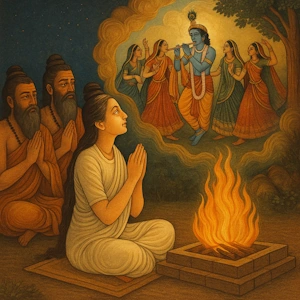
There is a beautiful story in Padma Purana. Once some rishis found a woman doing tapasya. They asked her, who are you? She said, I am Brahma Vidya. What do you do? I help people to come out of ignorance. What are you doing now? I am doing tapasya. What for?
Brahma Vidya wanted to say – to become like Radha, to attain Radha bhava. But she did not have the courage. She said, to become like gopikas, to attain gopi bhava. Gopis are facilitators of rasa leela. Their position is below that of Radha. They are not equal to Radha. Brahma Vidya wants to attain gopi bhava first. That is what she is doing tapasya for. Thousands of years of tapasya so that she can attain the state of mind of a gopika. She does not consider herself to be qualified enough to even aspire for Radha bhava, even think about attaining Radha bhava.
-
Why would even divine knowledge want to lower itself into simple love?
Because knowledge alone can stay cold. Chanting Vishnu Sahasranama warms it into affection. Names like ‘Madhusudana’ melt pride and turn sharp intellect into tender devotion. -
Is there a reason discipline sometimes feels dry, while chanting feels alive?
Discipline shapes effort but names spark presence. One round of nama japa with steady breath nourishes the heart in a way bare effort cannot. The balance of both creates depth. -
Why does the image of fighting inner impurities feel relatable today?
Because anger, greed, and fear behave like inner asuras. Repeating ‘Keshava’ or ‘Govinda’ each time they rise makes the mind see them as foreign elements that can be expelled. -
Can names really shape emotions into devotion?
Yes. Every time ‘Achyuta’ is whispered during sadness, it draws the emotion upward instead of letting it rot inside. Over time, emotions turn into offerings. -
Why do sages respect even the desire for smaller spiritual states?
Because wanting any step toward Bhagavan is valid. Chanting 12 names daily allows the small desire to stretch into bigger love without force. The names themselves do the lifting. -
How can a seeker remain humble when aspiring for the highest?
By declaring before japa: ‘Let this count not be for my gain but for your grace.’ The repetition of this resolve makes ambition bow to devotion. -
Why do scriptures say even merging into the Lord is not the end?
Because bhakti is richer than absorption. Sahasranama chanting lets you enjoy relationship, sweetness, and dialogue with Bhagavan — not just disappearance into silence. -
What lesson does the image of Brahma Vidya seeking gopi-bhava carry?
It shows that even great wisdom bows to love. A simple villager chanting ‘Om Namo Narayanaya’ with faith can stand above an ocean of book knowledge. -
Why does chanting sometimes feel like a burden before it feels like bliss?
Because the mind resists quiet. Push through with fixed counts. After about 40 days, resistance fades and the same practice becomes a refuge. -
Is there a way to turn daily struggles into offerings through names?
Yes. Choose one name every morning and dedicate all tasks under it. For example, work under ‘Madhava’, family care under ‘Ananta’. The day becomes one long japa. -
Why does bhakti often look greater than power or siddhi?
Power isolates. Bhakti connects. Chanting together — even 5 minutes as a family — heals more wounds than any show of strength. -
What role does sound itself play in this path?
Sound is the bridge between thought and form. Every uttered name sends vibration through nerves, breath, and heart. That is why even whispered Sahasranama carries force. -
How do I know if chanting is softening me inwardly?
Notice if grudges shorten, if tone softens with family, if recovery from irritation is faster. These are the first footprints of bhakti. -
Why are small, consistent offerings valued more than rare intensity?
Because names work like water drops hollowing a rock. One mala daily for a year transforms more deeply than ten malas done on a whim. -
Why do scriptures weave both philosophy and emotion?
To show they belong together. Sahasranama bridges them: each name is a teaching, each repetition is love. Head and heart walk side by side.





English
Vishnu Sahasranama
Click on any topic to open
7
30
Astrology
Bhagavad Gita
Bhagavatam
Bharat Matha
Devi
Devi Mahatmyam
Ganapathy
Garuda Puranam
Glory of Venkatesha
Hanuman
Kathopanishad
Mahabharatam
Mantra Shastra
Mystique
Practical Wisdom
Purana Stories
Radhe Radhe
Ramayana
Rare Topics
Rigveda Explained
Rituals
Sages and Saints
Shiva
Spiritual books
Sri Suktam
Story of Sri Yantra
Temples
Vedas
Vishnu Sahasranama
Yoga Vasishta
26
17
10
0


