What Is Above And Below Kalachakra
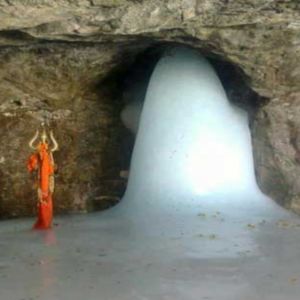
In the earlier episodes of Shiva Purana, we have been seeing the structure of the universe; seven worlds below us, then our Bhuloka, then six worlds above us up to Brahma's Satyaloka, then above that Vishnuloka, then Rudraloka, then Maheshwaraloka, then Kalachakra, and above Kalachakra Ishwaraloka or Shivaloka.
Even though we use the terms Rudra, Maheshwara, and Shiva as synonyms, they are not the same.
Rudra is that aspect of Shiva who is responsible for the elimination of the universe.
Maheshwara shrinks the eliminated universe into a microform and takes care of it till the time of the next creation.
Ishwara or Shiva is the ultimate supreme, supreme reality, Parabrahma, Paramatma.
The rest are all small parts of him.
Kalachakra is the border between the world that is influenced by maya and the world beyond.
Up to Maheshwaraloka, maya is there.
Once you go to the other side of Kalachakra, there is no maya.
By the way, what is maya?
Maya is not illusion.
मा लक्ष्मीः कर्मभोगो वै याति मायेति कथ्यते।
मा लक्ष्मीः ज्ञानभोगो वै याति मायेति कथ्यत्ते॥
Maa means Lakshmi Devi.
That's why her husband is called Madhava.
There are two types of experiences, physical, and intellectual; karma bhoga, and jnana bhoga.
Both are given by her, Lakshmi Devi.
कर्मभोगो वै याति
ज्ञानभोगो वै याति
मा याति
From that, maya.
So Kalachakra is very very important.
It is the boundary between the transient world and the eternal world.
It is the boundary between the destructible world and the non-destructible world.
It is the border between the finite world and the infinite world.
It is on this Kalachakra that Yama sits on his buffalo.
Yama has no access to the world above Kalachakra.
How to attain Ishwaraloka also we have seen.
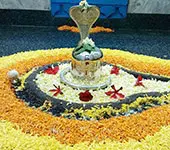
By doing nishkama puja of Siva linga.
Sakama puja of Siva linga will give you pleasures and comforts in all the worlds below Kalachakra.
Sakama puja will give you health, wealth, power, position, enjoyments, knowledge, higher worlds like Swarga, Satyaloka.
But still you will keep on taking birth and dying.
Some of the higher worlds, once you attain them you can be there till the end of the kalpa.
But at the time of kalpanta pralaya, you will die and take birth again in the next kalpa.
The only way to get out of all these is nishkama puja of Shiva linga.
By doing that you can reach Ishwaraloka or Shivaloka where there is no death, there is no time.
The worlds below Kalachakra are for the mortals.
Ishwaraloka is for the immortals.
Ishwaraloka is also called Jnanaloka.
The world below Kalachakra is called Karmaloka.
As soon as you enter Ishwarloka, you can see a white bull.
The four legs of that bull are honesty, purity, non-violence, and kindness.
Its horns are tolerance.
Its ears are self-control.
From its mouth comes the sound of the Veda.
This bull is dharma embodied.
Its ears are piety, belief in God.
Its mind and intelligence are faith.
The beginningless, endless Lord Shiva is sitting on top of this bull.
In this world, there is no day, there is no night.
If this is the ultimate goal, then why should you do the routine pujas, and vratas?
Only by doing routine pujas, and vratas, observing dharma you develop interest in Shiva.
It is a step by step progress.
If you are a devotee of Shiva, if Shiva is allowing you to worship him, that means you have already progressed in the spiritual path.
If his eyes are on you, it is also certain that you will reach Ishwaraloka some day or the other.
But you have to work hard and demonstrate your eagerness.
It is pure bliss in Ishwaraloka.
There is nothing else.
It is his grace that is going to take you to Ishwaraloka.
You see a queue.
So many people are waiting in the queue.
You learn that they are waiting to get into a beautiful garden.
You can either join the queue or simply walk away.
That is up to you.
That much earnestness you have to show.
That eagerness you have to show
That commitment you have to show.
Then he will lift you up.
- Why is Kalachakra described as the most critical boundary in the cosmic structure?
Kalachakra serves as the definitive divide between two completely different states of existence. Below it lies the Karmaloka, which is governed by Maya, time, and the cycle of birth and death. Above it lies the Jnanaloka or Ishwaraloka, which is eternal and infinite. It is the border where the influence of Yama ends and the realm of immortality begins. - How does the definition of Maya provided here challenge the common perception of it being just an illusion?
Usually, Maya is dismissed as a simple hallucination or falsehood. However, this teaching explains Maya through the etymology of Maa, representing Lakshmi Devi. It defines Maya as the provider of both physical experiences (Karma Bhoga) and intellectual experiences (Jnana Bhoga). Maya is the functional reality that allows a soul to experience the world, making it a bridge of experience rather than just a trick of the mind. - What is the functional difference between Rudra, Maheshwara, and Shiva in the process of cosmic maintenance?
While often used interchangeably, they represent distinct stages of the divine cycle. Rudra is the active force of elimination that dissolves the universe. Maheshwara is the preservative aspect who holds the dissolved universe in a micro-form during the Great Sleep until the next creation. Shiva, or Ishwara, is the absolute Supreme Reality (Parabrahma) who remains untouched by these cycles. - Why is Yama, the Lord of Death, stationed specifically on the Kalachakra?
Yama sits on the Kalachakra because his jurisdiction is limited to the worlds of time and transition. By sitting on this boundary, he marks the limit of mortality. He has no access to the realms above because those realms are beyond the reach of time (Kala) and the physical laws of cause and effect (Karma). - What distinguishes the results of Sakama puja from Nishkama puja of the Shiva Linga?
Sakama puja is performed with worldly desires and leads to rewards within the realms of Maya, such as health, wealth, and even residence in higher heavens like Satyaloka. However, these are temporary. Nishkama puja is performed without selfish desire and is the only key to crossing Kalachakra to reach Ishwaraloka, ensuring liberation from the cycle of rebirth. - What happens to a soul in the higher worlds like Satyaloka during the Kalpanta Pralaya?
Even though these worlds offer immense longevity and bliss, they are still below the Ishwaraloka. When the cycle of the Kalpa ends (Kalpanta Pralaya), the inhabitants of these worlds must undergo death and be reborn in the next cycle. They are high-level mortals, but they are not yet immortals. - What is the symbolic significance of the white bull at the entrance of Ishwaraloka?
The white bull is Dharma embodied. Its four legs represent the pillars of a righteous life: honesty, purity, non-violence, and kindness. Its horns represent tolerance, and its ears signify self-control and piety. This imagery suggests that one cannot enter the presence of the Supreme Shiva without first becoming a perfect vessel of Dharma. - If Ishwaraloka is the ultimate goal, why are routine rituals and vratas considered necessary?
Spiritual evolution is a step-by-step process. Routine pujas and vratas act as the elementary schooling for the soul. They discipline the mind, exhaust lower karmas, and gradually cultivate the genuine interest and devotion required to eventually perform Nishkama puja. They are the foundation upon which the desire for liberation is built. - Why is Ishwaraloka referred to as Jnanaloka?
It is called Jnanaloka because it is the realm of pure consciousness and supreme knowledge. Below Kalachakra is Karmaloka, the world of action and consequence. In Ishwaraloka, the soul has moved beyond the need for action and resides in the pure bliss of knowing the Self and the Supreme, where there is no distinction of day or night. - What is the hidden meaning behind the analogy of the queue at the garden?
The queue represents the massive number of souls in the cycle of evolution. Joining the queue represents the conscious decision to pursue spiritual liberation. The teaching emphasizes that while Shiva’s grace is the ultimate lift, the individual must first demonstrate "earnestness" and "eagerness." God’s grace responds to the soul's commitment to walk away from the transient and toward the eternal.





English
Shiva
Click on any topic to open
7
30
Astrology
Bhagavad Gita
Bhagavatam
Bharat Matha
Devi
Devi Mahatmyam
Ganapathy
Garuda Puranam
Glory of Venkatesha
Hanuman
Kathopanishad
Mahabharatam
Mantra Shastra
Mystique
Practical Wisdom
Purana Stories
Radhe Radhe
Ramayana
Rare Topics
Rigveda Explained
Rituals
Sages and Saints
Shiva
Spiritual books
Sri Suktam
Story of Sri Yantra
Temples
Vedas
Vishnu Sahasranama
Yoga Vasishta
26
17
10
0


