Wherever Veda Mantras Are Chanted, Bhagavan Is There
विक्रमः –
गमनं पक्षिराजेन यस्य विक्रम उच्यते - due to his movement with Garuda as his vehicle.
It has another totally opposite meaning.
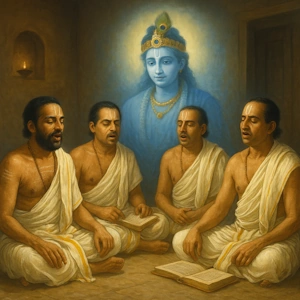
विना पतगपतिना त्रयीमयेन सुपर्णेन क्रमः – he doesn’t always need Garuda as his vehicle. Trayi, the three forms of Veda mantras Rig, Yaju, Sama mantras act as his vehicle.
That means there are two kinds of travel for him – one, the physical travel of his body, his body that has the colour of rain clouds, wearing peetambaras, holding shankha, Sudarshana, that form travels by Garuda, his vehicle.
Wherever Veda mantras go, he also goes. He doesn’t need Garuda to go there. Veda mantras talk about him only. Wherever they are heard, his presence is there. He travels using the mantras as his vehicle. When you hear a Veda mantra, be sure that he is near you. He is with you.
That’s why you got the opportunity to hear the mantra. That’s why you should listen to these mantras. You should make effort to listen to. When you hear Veda mantras, don’t walk away. It is a rare blessing that you are given the opportunity to hear them. Don’t ignore, don’t walk away. Because there you have the Lord by your side. To bless you, to protect you. Recognize this fact. Recognize his presence.
I am not saying freeze yourself there itself. But recognize his presence, acknowledge it. Be grateful that you got this opportunity. He has come to you. He has come near you.
There is one more meaning, his krama, his stride is special. With three steps he could cover the three worlds, Swarga, Bhumi and Patala. Idam Vishnur…
There are some differences in the way you pray across religions. Some religion would say – God is in heaven, you pray to him and he would listen to you. Some other religion would say – divinity is at a certain place on earth, so from wherever you are you turn towards that place, turn in that direction and pray.
If you see, there is a physical separation between you and the divinity, in terms of distance. But we are not satisfied with this. I am not saying that the other systems are inferior or anything. We think differently. Our methods are such that we want the divinity to come to us, be with us, inside us, inside our heart, filling our mind.
That’s why we use so much of imagery, so much of description of what a God or Goddess looks like. As you go on understanding these descriptions, the image, the form of the God or Goddess becomes clearer in your mind, like how sculpture is made from a lump of clay.
This is what happens when you hear divine stories also. Through the ears, the divinity enters and occupies your heart. The Lord is inside. When the Lord is inside you, throughout, he will ensure your well-being. He will ensure your prosperity. He will ensure your health. He will ensure your growth.
Like how you take care of your vehicle, car or two-wheeler. This is important for you. The condition of your vehicle will reflect your status and nature. So you always maintain it well.
When Bhagawan occupies you, your mind, mind is in the body only, you will see these changes happening in you. The stronger you feel his presence inside you, more prominent will be these changes. It is not magic. Bhagawan occupying your body is nothing strange.
When you have thoughts about him in your mind, he is there inside you. When you visualize him, he is there inside you. He will not come and stand in front of you in physical form. He does that also. When his presence inside you is complete, you will see him outside also, giving you darshana. This is what happens to great devotees, great saints. But he need not do that. His presence inside you, inside your mind is sufficient.
This is why people get great benefits by nama japa, stotra chanting. Here his names as Shabda Brahma occupy your body. What can touch you when he is riding using your body as a vehicle? You become another Garuda, as powerful as a Garuda.
And wherever he is, aiswarya is natural. Pandavas were smart. They just asked for his presence with them. Just be by our side. You don’t have to fight for us. Just be with us.
Nothing they had. Everything they lost. Pushed into the forest. But while being there, seven akshauhinis of sena assembled around them, on its own. You know how much it means? Seven kshauhinis means nearly a million soldiers and corresponding numbers of horses, chariots and elephants. Help came on its own. Because he was with them. The Lord was with them, by their side.
That is sufficient. You don’t have to go out and seek help. It comes on its own. Success comes on its own. Victory comes on its own. This is when he is by your side. What we are talking about is make him live inside you, in your mind, in your heart.
Scriptures often use the word heart. What they mean by heart is your mind and emotions together. The middle of the chest is the seat of these. That’s why it is called heart. Make your heart his abode. Invite him there. Make him stay there forever. This is what you should strive for. Whenever you look, he should be there in your mind, crystal clear. His form should be crystal clear in your mind. That means he has occupied your body.
How do you do that? By hearing about his glory, his form. The more you hear, the clearer it becomes. By chanting his name, the more you chant, the stronger will be his presence. After that you don’t have to go anywhere. He has already built a temple inside you and occupied it, in all his supreme glory.
And your life will become as brilliant as his holy shrine. Your life will be full of aiswarya like his holy shrine. Because it is not your body anymore. It is his abode, the safest and most prosperous place of all. Nothing you have to do. It is natural. You don’t have to submit your list of requirements to him individually. This change is natural. Because your body becomes his abode, as prosperous as Vaikuntha or Bhuloka Vaikuntha.
Don’t waste your time watching useless stuff, listening to useless stuff, reading useless stuff. What is it that they give you? Nothing. Instead, spend time to bring him inside you, occupy your mind, your body. If you want your life to change, in a sustainable way. If you want your life to be brilliant, forever.
-
Why does Vedic sound seem to change the mood of a room instantly?
-
Sacred sound resets mental noise. Chanting Vishnu sahasranama synchronizes breath and attention, lowering stress markers. Calm mind, softer voice, fewer conflicts at home.
-
-
If Bhagavan is near, why do I still feel anxious?
-
Nearness becomes felt through practice. Start with 11 names daily, grow to 108. Anxiety fades as attention learns a new anchor: nama before narrative.
-
-
How can nama japa help a strained family relationship without preaching?
-
Do soft, steady chanting while doing chores. The tone you carry changes first; others respond to the new steadiness. Peace spreads before opinions do.
-
-
What do I do when mind wanders during sahasranama?
-
Do not fight it. Park the mind on one name like 'Narayana'. Repeat it for one minute, then resume the flow. Short anchors beat long battles.
-
-
Is there a simple daily structure that actually sticks?
-
Morning: 5 minutes slow sahasranama. Commute/errands: whisper nama under breath. Night: 8 names of personal resonance, then silence for 60 seconds.
-
-
How does chanting support physical health in a practical way?
-
Rhythm equals regulation. Regular cadence improves breathing depth and heart rate variability. Better sleep, steadier appetite, fewer stress spikes.
-
-
What should I do on days when devotion feels dry?
-
Switch to call-and-response with a recording; keep the body moving slightly. Let posture carry faith until feeling returns.
-
-
Can sahasranama guide decisions about money, work, or studies?
-
Yes, by clearing inner turbulence first. Chant 3 mala of one chosen name, then write the decision in one line. If the chest tightens, pause; if breath stays free, proceed.
-
-
How do I bring children into this without forcing them?
-
Make it playful. One name per day on fridge notes. Let them choose a melody. Celebrate consistency, not volume.
-
-
What name should I pick when life feels uncertain?
-
Choose the name that calms your breath within three repeats. That name is your current medicine. Stay with it for 21 days.
-
-
How do I use chanting when anger flares in the middle of a conversation?
-
Drop the jaw, inhale, say one name mentally while exhaling. Delay the next sentence by one breath. Most fires die in that gap.
-
-
Can I combine walking with chanting?
-
Perfect combo. Four steps per name. Left-right-left-right becomes a moving rosary. Body settles, mind follows.
-
-
What is the minimum viable practice on an overloaded day?
-
Three names on waking, three names before sleep. If even that fails, one heartfelt 'Govinda' slowly, with full exhale.
-
-
How do I keep sahasranama from becoming mechanical?
-
Before starting, dedicate the round to one person or situation. After finishing, sit for 30 seconds of quiet. Intention at entry, silence at exit.
-
-
How do I know it is working if life is still messy?
-
Track inner metrics, not headlines: quicker recovery from irritation, kinder words under pressure, steadier sleep. These are the first fruits; outcomes follow.
-
-
What if a family member is unwell? How to align prayer and care?
-
Do nama japa at bedside softly, match their breathing, then act on medical advice calmly. Prayer steadies the hands that serve.
-
-
Is group chanting more powerful than solo?
-
Groups add momentum; solo builds intimacy. Alternate weekly. Let community lift you; let solitude refine you.
-
-
How do I begin if pronunciation scares me?
-
Start with a short list of names you can say clearly. Clarity beats speed. Meaning grows with repetition.
-
-
How do I guard this practice from burnout?
-
Fix a small daily floor you never break, and a flexible ceiling you enjoy. Non-negotiable minimum; expandable maximum.
-
-
What is a gentle way to end a session?
-
Last five names in a whisper, palms on heart, one silent thank you. Close the door softly so you want to open it again tomorrow.
-





English
Vishnu Sahasranama
Click on any topic to open
7
30
Astrology
Bhagavad Gita
Bhagavatam
Bharat Matha
Devi
Devi Mahatmyam
Ganapathy
Garuda Puranam
Glory of Venkatesha
Hanuman
Kathopanishad
Mahabharatam
Mantra Shastra
Mystique
Practical Wisdom
Purana Stories
Radhe Radhe
Ramayana
Rare Topics
Rigveda Explained
Rituals
Sages and Saints
Shiva
Spiritual books
Sri Suktam
Story of Sri Yantra
Temples
Vedas
Vishnu Sahasranama
Yoga Vasishta
26
17
10
0


