Significance Of Astika's Story In Mahabharata
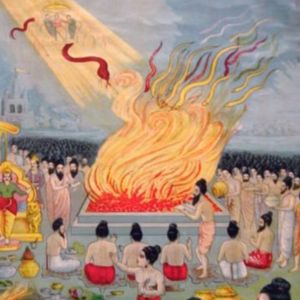
The fire blazed, the mantras soared, and Takshaka — serpent king, killer of kings — was now mid-air, dragged from the palace of Indra himself by the force of the Vedic yajna. The Sarpa-yajna had reached its fiercest moment.
Indra, invoked by mantra, appeared high in the sky in full divine radiance. But Janamejaya’s command was clear:
‘If Indra protects Takshaka, then let Indra too be offered into the Agni!’
Startled, the king of devas — who thought the invitation was to honor him — abandoned Takshaka in panic and fled. The heavens rumbled as Takshaka fell, screaming, twisted in horror, into the blazing homa-kunda, his fate sealed.
And then… it happened.
Astika, the boy-sage, the one born for this moment, raised his hand.
‘तिष्ठ तिष्ठ तिष्ठ — Stop there. Stop there. Stop there.’
And just like that, the mantras were overpowered.
Takshaka froze, suspended mid-air. Neither flying, nor falling. The mantra-shakti of the purohitas, powered by countless ahutis, was silenced by the sheer authority of a young boy’s tapobalam.
The yajna stalled. The fire paused. Silence ruled.
Janamejaya, stunned, furious, shaken, turned to Astika once again:
‘O great one… ask now. I had promised. I shall grant you anything — gold, gems, elephants, horses, lands, palaces — anything! But don’t ask for this! Don’t ask to stop the yajna!’
But Astika stood unmoved, like a pillar of dharma clad in brahmatejas.
‘I seek none of that. I ask only this — stop this yajna. Let no more serpents die. Let my mother’s vamsha live. This is the reason I was born. I have no other desire.’
The yajna had nearly achieved its purpose.
Takshaka was on the brink.
But dharma, not vengeance, must decide the end.
The purohitas and scholars rose together.
‘O King, you have given your word. You must not step back now.
To promise and not fulfill — this will taint the yajna.
Dharma is not just fire and ritual. It is vow and honor too.’
And so, Janamejaya, torn between rage and righteousness, did what few kings in his place would have done.
He bowed to truth.
He called off the Sarpa-yajna.
This is where the king’s character truly shone.
Though the yajna failed to kill Takshaka — its primary target — Janamejaya did not sulk or rage.
He honored every purohita and scholar present.
He gave abundant dakshina.
He even rewarded the vastu expert who had predicted that the yajna would be interrupted!
And what of Astika?
Janamejaya, with full heart, turned to him:
‘You are a true scholar. I hold no grudge.
I shall soon conduct an Ashwamedha yajna. You must attend it.
You are always welcome.’
Such was the king’s maturity — not ruled by mind, but guided by intelligence.
This was not emotion. This was refined dharma in action.
And what of the serpents?
They rejoiced.
They owed their survival to Astika — the one who stood between them and extinction.
They came forward and said:
‘Ask, O Astika. What can we do to honor you?’
Astika asked for something timeless:
‘Let no one who remembers this story — the Astika Upakhyana — ever be harmed by a serpent. Let them be protected.’
And the serpents agreed.
They gave a protective mantra, a promise encoded in verse:
असितं चार्तिमन्तं च सुनीथं चापि यः स्मरेत्।
दिवा वा यदि वा रात्रौ नास्य सर्पभयं भवेत्॥
Whoever remembers the names Asita, Artiman, and Suneetha — by day or by night — shall never fear serpents.
But as those mantras are not known now, they gave three verses of equal power, which anyone can chant daily:
१.
यो जरत्कारुणा जातो जरत्कारौ महायशाः ।
आस्तीकः सर्पसत्रे वः पन्नगान् योऽभ्यरक्षत ।
तं स्मरन्तं महाभागा न मां हिंसितुमर्हथ ॥
O Nagas, I remember Astika — son of Jaratkaru and the savior of your vamsha.
Because I remember him, you should not harm me.
२.
सर्पापसर्प भद्रं ते गच्छा सर्प महाविष ।
जनमेजयस्य यज्ञान्ते आस्तिकस्य वचनं स्मर ॥
O venomous serpent, depart peacefully.
Remember what Astika said at the end of Janamejaya’s yajna —
Those who remember him shall not be harmed by you.
३.
आस्तिकस्य वचः श्रुत्वा यः सर्पो न निवर्तते।
शतधा भिद्यते मूर्ध्नि शिंशवृक्षफलं यथा॥
The serpent who disobeys Astika’s command —
his head shall shatter into a hundred pieces, like the bursting fruit of the Shimsapa tree.
These three verses can be chanted daily for protection from serpents.
Their power is not symbolic — it is rooted in an ancient pact between man and Naga, sealed in the fire of dharma.
And what happened to Astika?
He lived a complete life — married, had children, fulfilled his grihastha dharma, and eventually attained moksha.
And thus, the Astika Parva ends — not in fire, but in peace.
Remember where it all began.
Shaunaka Maharshi’s guru, who used to kill every snake he saw, was stopped by a serpent who spoke of Ahimsa and Astika. That led to Ruru asking his father Pramati, and this divine tale flowed from there.
To know Astika is to know restraint.
To remember Astika is to be protected.
To tell his story is to bathe in punya.
Astika Parva — Complete.
Next begins the Aṃshāvatāra Parva, where the avatars of divinity descend to shape the Mahabharata war.
- How does the text contrast the ritualistic power of the yajna with Astika's spiritual power, and what does this reveal about ancient Vedic concepts of strength?
The text contrasts the massive, cumulative ritualistic power of the purohitas, powered by countless offerings in the fire, with Astika's individual spiritual power, known as tapobalam. While the yajna was strong enough to drag the king of gods, Indra, from the sky, Astika froze Takshaka mid-air with just three words. This reveals the hidden principle that individual spiritual purity and absolute clarity of purpose can overpower even the most elaborate, aggressive, and collective cosmic rituals. - In what way does King Janamejaya demonstrate the superiority of refined dharma over emotional vengeance at the climax of the sacrifice?
Despite dedicating immense resources to avenge his father and having his primary target, Takshaka, moments away from death, Janamejaya chooses to honor his promise to Astika. By calling off the sacrifice and rewarding the scholars instead of sulking in rage, he proves that true kingship and dharma are guided by intelligence, maturity, and honor, rather than being blinded by raw emotional vengeance. - What is the significance of Janamejaya rewarding the vastu expert after the sacrifice failed, and what overlooked aspect of his character does this highlight?
The vastu expert had accurately predicted that the sacrifice would be interrupted. By rewarding him even when that prediction meant the failure of his life's mission, Janamejaya shows profound objectivity and respect for truth and scholarly foresight. It highlights a hidden maturity where the king values reality, wisdom, and competence over the gratification of his own ego and desires. - Why did Astika refuse all material wealth offered by the king, and what principle of duty does his singular demand represent?
Astika refused gold, lands, and elephants because he recognized he was born for a specific cosmic purpose, which was to save his mother's lineage from extinction. His singular demand represents the principle of selfless duty and familial dharma, showing that true greatness lies in fulfilling one's life purpose rather than accumulating worldly wealth or power. - What is the mysterious mechanism behind the protective verses given by the serpents, and why is their power described as more than just symbolic?
The protective verses operate on a cosmic pact made between humanity and the Nagas, sealed in the fire of dharma. It is not merely a symbolic chant but a literal invocation of a historical promise. By invoking Astika's name, the chanter reminds the serpents of their ancestral debt to him, triggering a binding oath that overrides their natural predatory instincts and prevents them from causing harm. - What hidden law is enforced by the third verse, which threatens to shatter a serpent's head like a Shimsapa fruit if they disobey Astika's command?
The third verse enforces the cosmic law of gratitude and the unbreakable nature of a vow made to a savior. It implies that the natural order itself will violently punish any serpent that violates the sacred pact. The imagery of the shattering Shimsapa fruit represents the absolute, inescapable destruction that befalls those who betray the dharma of gratitude and the spoken word. - How does the origin story involving Shaunaka Maharshi's guru connect the theme of the Astika Upakhyana to the broader concept of Ahimsa?
The narrative begins with a sage blindly killing snakes out of hatred, who is then stopped by a serpent speaking of Ahimsa, or non-violence, and reminding him of Astika. This frames the entire Astika Parva not just as a historical event, but as a timeless lesson in restraint. It shows that the true legacy of Astika is the transformation of mindless vengeance and generational trauma into compassionate non-violence. - What does Indra's sudden flight reveal about the limits of divine protection when confronted by the uncompromising force of a Vedic yajna?
Indra's panicked flight reveals that even the king of the gods is subject to the absolute, mechanical power of a flawlessly executed Vedic mantra. When Janamejaya commanded that Indra be offered into the fire alongside Takshaka, it highlighted the hidden reality that cosmic rituals hold authority over the devas themselves, forcing Indra to prioritize his own survival over his protection of Takshaka. - Why is it significant to the principles of the text that Astika went on to fulfill his grihastha dharma before attaining moksha, rather than renouncing the world immediately?
Astika's choice to marry, have children, and live a complete life validates the importance of the householder stage in Vedic philosophy. It demonstrates the overlooked principle that spiritual supremacy, immense tapobalam, and the attainment of moksha do not require immediate asceticism or world-rejection; fulfilling earthly duties and continuing one's lineage is an integral part of ultimate liberation. - How does the peaceful conclusion of the Astika Parva set the stage for the Amshavatara Parva and the larger Mahabharata epic?
The Astika Parva resolves a massive conflict of vengeance through restraint, truth, and dharma, ending in peace rather than fire. This acts as a philosophical foundation and a moment of cosmic balance before the Amshavatara Parva, where divine avatars descend to earth. It contrasts the peaceful resolution achieved by a boy sage with the inevitable, destructive war of the Mahabharata, highlighting the delicate balance between human choice, honor, and divine will.





English
Mahabharatam
Click on any topic to open
7
30
Astrology
Bhagavad Gita
Bhagavatam
Bharat Matha
Devi
Devi Mahatmyam
Ganapathy
Garuda Puranam
Glory of Venkatesha
Hanuman
Kathopanishad
Mahabharatam
Mantra Shastra
Mystique
Practical Wisdom
Purana Stories
Radhe Radhe
Ramayana
Rare Topics
Rigveda Explained
Rituals
Sages and Saints
Shiva
Spiritual books
Sri Suktam
Story of Sri Yantra
Temples
Vedas
Vishnu Sahasranama
Yoga Vasishta
26
17
10
0


