Give up an Individual IF....
Sacrifices are the milestones on the path of Dharma.
If the family must be protected, forsake the individual.
If the community must be saved, forsake the family.
If the nation must survive, forsake the community.
And if the Self — the Atma — must be realized,
then forsake the entire world.
This was not just a statement — it was a sacred warning whispered by wisdom itself.
It came from Vidura, the dharma-bearer, the voice of truth,
and from the elder sages, guardians of the Kuru legacy.
They told it to Dhritarashtra —
not when the war began,
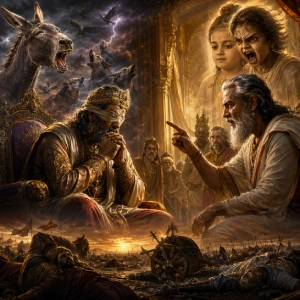
but the day his firstborn cried like a beast.
Yes. The omens had already screamed their prophecy.
The moment Duryodhana was born,
he let out a cry that was not human — it was like a braying donkey.
And then, the donkeys outside picked up the call.
Soon the entire animal world trembled in resonance —
foxes howled, dogs barked without pause,
crows cawed as if the skies had torn open.
A storm swept the land,
and the very air turned to fire.
Even the sun seemed to flinch behind the clouds.
In that same royal court, hope had already bloomed.
Yudhishthira, born earlier,
stood as a bright lamp of dharma for the Kuru throne.
But blinded by attachment, Dhritarashtra faltered.
He called his ministers and asked with a tremble in his voice:
I know... Yudhishthira is the eldest. He will rule first.
But surely, after him... my son Duryodhana will take the throne?
Silence fell. Then Vidura, like a thunderbolt cloaked in calm, spoke:
The omens do not lie, O King.
This child will bring ruin. The Kuru lineage will fall like a tree struck at its root.
If the nation must live, this one must be sacrificed.
But Dhritarashtra’s heart, soaked in moha, refused to obey.
His love for his son choked out the voice of Dharma.
He chose blood over kingdom, emotion over justice, attachment over wisdom.
And thus, Rajadharma was broken.
The dice were cast that very day —
not in the hall of Hastinapura,
but in the womb of weakness where duty was denied.
And the cost?
The ashes of lakhs of warriors,
the fall of mighty Bhishma, noble Drona, valiant Karna,
and the end of an era that once stood as the spine of Bharata.
All because a father could not let go of a son —
when Dharma itself begged him to.
- What profound hierarchy of sacrifice does Vidura present, and what is its ultimate, highest goal?
Vidura outlines a progressive scale of detachment for the greater good: sacrificing an individual to protect a family, a family for a community, and a community for a nation. However, the ultimate and most profound sacrifice is forsaking the entire world for the realization of the Self, or Atma. This reveals that while social duty demands material sacrifices, spiritual liberation requires letting go of all worldly attachments completely. - How does the text define Dhritarashtras fatal flaw, and why is it considered more destructive than the actual war itself?
Dhritarashtras fatal flaw is moha, which translates to blind emotional attachment or delusion. This inner weakness is considered more destructive than the physical war because it was the actual root cause of the Kurukshetra carnage. By choosing blood over the kingdom and emotion over justice, he broke the sacred code of Rajadharma. The physical war was merely the inevitable consequence of his internal moral failure. - According to the passage, when were the dice of the Mahabharata war truly cast, and what overlooked aspect of human choice does this reveal?
The dice were not cast during the infamous gambling match in Hastinapura, but decades earlier on the day Duryodhana was born. This reveals the hidden truth that the seeds of massive historical tragedies are often sown in private moments of weakness. A failure to act on moral warnings in the present creates irreversible ripples that shape the future. - What is the mysterious significance of the animal kingdoms reaction to Duryodhanas birth, specifically his donkey-like cry?
Duryodhanas bizarre cry and the subsequent resonance from wild animals foxes howling, dogs barking, and crows cawing symbolize a severe disruption of the cosmic and natural order. The natural world instinctively recognized the arrival of an entity aligned with chaos and adharma. These omens acted as a mystical, environmental alarm system that human leadership chose to ignore. - How does Yudhishthiras prior birth serve as a psychological trigger for Dhritarashtras faltering logic?
Yudhishthira, born earlier as a bright lamp of dharma, threatened Dhritarashtras hidden ambition for his own lineage. Instead of gracefully accepting the righteous path of succession, Dhritarashtra anxiously sought validation that Duryodhana would eventually rule. This unmasks his deep-seated insecurity and his desperate desire to manipulate destiny to favor his son over the established law of the land. - What is the harsh paradox of Rajadharma as demanded by the elder sages, and why is it so incredibly difficult to execute?
The paradox of Rajadharma is that a true king must sometimes act with extreme ruthlessness toward his own flesh and blood to ensure the survival and prosperity of the nation. It demands stripping away all personal identity as a loving father and acting solely as an impartial protector of the realm. This represents an emotional amputation that Dhritarashtras worldly attachments simply could not endure. - Why is Vidura described as a thunderbolt cloaked in calm, and what role does he play in the dynamic of the Kuru court?
Vidura is described this way because his insights are devastatingly powerful, striking at the core of the truth, yet they are delivered without anger, malice, or emotional turbulence. He serves as the uncompromising, objective conscience of the Kuru dynasty. He cuts through the kings delusions with pure dharma, even when his counsel is terrifying to hear. - What is the deeply tragic irony regarding the elder sages and their warning to the king?
The tragic irony is that supreme wisdom was entirely present in the court. The elders possessed absolute clarity and foresaw the exact destruction of the Kuru lineage, warning that it would fall like a tree struck at its root. The hidden tragedy of human history is that profound truth and clear warnings are often rendered entirely powerless when confronted with the stubbornness of human delusion. - How does the text connect a single fathers emotional inability to let go to the broader fate of an entire civilization?
The text establishes a terrifying causal link between a private failure and public annihilation. It illustrates that a leaders personal moral compromise cannot be contained. Dhritarashtras inability to sacrifice his son eventually demanded the lives of hundreds of thousands of warriors, including noble figures like Bhishma, Drona, and Karna, ultimately breaking the spine of the entire Bharata civilization. - What philosophical truth about the nature of Dharma is revealed by the final statement that Dharma itself begged him to let go?
It reveals that Dharma is not merely a rigid set of mechanical rules, but a living, vital force that seeks cosmic balance and preservation. It pleads for difficult, preemptive sacrifices to prevent unimaginable suffering later. It shows that true Dharma requires us to sever our most toxic attachments to save the very world we are supposed to protect.





English
Mahabharatam
Click on any topic to open
7
30
Astrology
Bhagavad Gita
Bhagavatam
Bharat Matha
Devi
Devi Mahatmyam
Ganapathy
Garuda Puranam
Glory of Venkatesha
Hanuman
Kathopanishad
Mahabharatam
Mantra Shastra
Mystique
Practical Wisdom
Purana Stories
Radhe Radhe
Ramayana
Rare Topics
Rigveda Explained
Rituals
Sages and Saints
Shiva
Spiritual books
Sri Suktam
Story of Sri Yantra
Temples
Vedas
Vishnu Sahasranama
Yoga Vasishta
26
17
10
0


