You Are My Disciple, You Have My Permission, Ekalavya
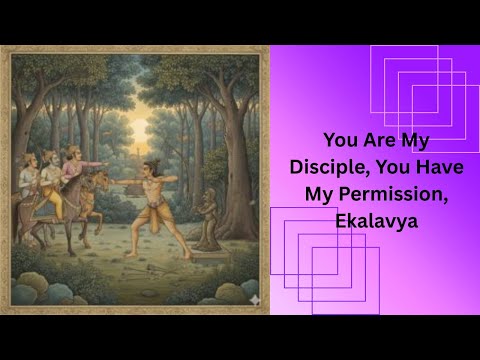
ततो निषादराजस्य हिरण्यधनुषः सुतः।
एकलव्यो महाराज द्रोणमभ्याजगाम ह।।
Tato nishadarajasya hiranyadhanushah sutah.
Ekalavyo maharaj dronamabhyajagama ha.
From the forest's heart, a son of the Nishada king, Hiranyadhanus,
Ekalavya, with a spirit aflame, approached the great Drona.
His heart, a vessel of pure aspiration, sought the fount of knowledge.
A humble seeker, standing before the master of divine arms.
This was the first stir of a profound dharma-katha, a tale of devotion's fire.
न स तं प्रतिजग्राह नैषादिरिति चिन्तयन्।
शिष्यं धनुषि धर्मज्ञस्तेषामेवान्ववेक्षया।।
Na sa tam pratijagraha naishadiriti chintayan.
Shishyam dhanushi dharmajnyastesham evanvavekshaya.
But Drona, bound by the world's intricate threads, did not accept him.
'A Nishada,' he mused, his mind caught in the currents of societal dharma.
His gaze was fixed on the Kuru princes, their future, their lineage.
Ah, the paradox of the guru! Bound by external forms, yet holding the key to inner liberation.
A moment of cosmic irony, where the path of a true seeker is tested by worldly walls.
शिष्योऽसि मम नैषादे प्रयोगे बलत्तरः।
निवर्तस्व गृहानेव अनुज्ञातोऽसि नित्यशः।।
Shishyo'si mama naishade prayoge balattarah.
Nivartasva grihaneva anujnato'si nityashah.
'You are my disciple, O Nishada, in the strength of your practice,' Drona's words echo,
A subtle acknowledgment, a seed of truth planted in the heart of refusal.
'Return to your home, you have my constant permission.'
A strange blessing, a veiled command, pushing the soul towards its own inner guru.
The divine plan unfolds, not always through acceptance, but sometimes through sacred denial.
स तु द्रोणस्य शिरसा पादौ गृह्य परन्तपः।
अरण्यमनुसंप्राप्य कृत्वा द्रोणं महीमयम्।।
Sa tu dronasya shirasa padau grihya parantapah.
Aranyamanusampraya kritva dronam mahimayam.
With head bowed, touching the feet of the guru, Ekalavya accepted his fate.
He retreated into the deep silence of the forest, his spirit undimmed.
There, with hands of devotion, he sculpted Drona from the earth itself.
A clay image, yes, but infused with the living chaitanya of his guru-bhakti.
The outer form dissolved, revealing the inner truth of his unwavering shraddha.
तस्मिन्नाचार्यवृत्तिं च परमामास्थितस्तदा।
इष्वस्त्रे योगमातस्थे परं नियममास्थितः।।
Tasminnacharyavrittim cha paramamasthitastada.
Ishvastre yogamatasthe param niyamamasthitah.
Before that earthen form, he established the highest guru-vritti, the sacred conduct of a disciple.
His every breath, every thought, a puja to his silent master.
In the art of archery, he immersed himself in supreme yoga, a profound meditation.
With unyielding discipline, he practiced, his spirit burning bright.
This was not mere practice; it was tapasya, a fiery offering of self.
परया श्रद्धयोपेतो योगेन परमेण च।
विमोक्षादानसन्धाने लघुत्वं परमाप सः।।
Paraya shraddhayopeto yogena paramena cha.
Vimokshadanasanthane laghutvam paramapa sah.
Endowed with supreme faith, united with the highest yoga,
He attained ultimate lightness in releasing, drawing, and aiming arrows.
His movements became a dance of divine precision, swift as thought.
Shraddha, the true guru, unlocked the secrets of the cosmos within him.
The ananta shakti of devotion made the impossible, effortlessly real.
लाघवं चास्त्रयोगं च नचिरात्प्रत्यपद्यत।
Laghavam chastrayogam cha nachiratpratyapadyata.
Swiftly, without delay, he mastered the lightness and the profound yoga of arms.
Time itself bent to his will, witnessing his accelerated ascent.
His skill blossomed, a lotus opening to the sun of his inner guru.
This was the mahima of self-effort, guided by the unseen hand of karuna.
A testament to the truth: where there is pure intent, the path reveals itself.
अथ द्रोणाभ्यनुज्ञाताः कदाचित्कुरुपाण्डवाः।
रथैर्विनिर्ययुः सर्वे मृगयामरिमर्दनाः।।
Atha dronabhyanujnatah kadachitkurupandavah.
Rathairviniryayuh sarve mrigayamarimardanah.
Then, with Drona's permission, the Kuru and Pandava princes,
Mounted on their chariots, set forth for the hunt, destroyers of foes.
A royal procession, vibrant with youthful energy, seeking adventure in the wild.
Little did they know, the forest held a mirror to their own aspirations.
The stage was set for a revelation, a clash of destinies.
तत्रोपकरणं गृह्य नरः कश्चिद्यदृच्छया।
राजन्ननुजगामैकः श्वानमादाय पाण्डवान्।।
Tatropakaranam grihya narah kashchidyadricchaya.
Rajannanujagamaikah shvanamadaya pandavan.
A man, by chance, carrying his hunting gear,
Followed the Pandavas, leading a dog by his side.
A small detail, seemingly insignificant, yet woven into the grand tapestry of fate.
The universe orchestrates its moments, even through the casual steps of a common man.
Every thread has its purpose in the divine design.
तेषां विचरतां तत्र तत्तत्कर्मचिकीर्षया।
श्वाचरन्स पथा क्रीडन्नैषादिं प्रति जग्मिवान्।।
Tesham vicharatam tatra tattatkarmachikirshaya.
Shvacharansa patha kridannaishadim prati jagmivan.
As they roamed, intent on their hunting pursuits,
The dog, playful and free, wandered off the path.
Its innocent steps led it directly to the Nishada, Ekalavya.
A simple creature, unknowingly bridging two worlds, two narratives.
The unseen hand of destiny guides even the smallest paw.
स कृष्णमलदिग्धाङ्गं कृष्णाजिनजटाघरम्।
नैषादिं श्वा समालक्ष्य भषंस्तस्थौ तदन्तिके।।
Sa krishnamaladigdhangam krishnajinajatadharam.
Naishadim shva samalakshya bhashamstasthau tadantike.
The dog, seeing Ekalavya, his body smeared with dark mud,
Adorned with deer skin and matted locks, stood barking near him.
A wild, untamed figure, a child of the forest, a vision of raw tapasya.
The dog's barks, sharp and piercing, broke the forest's sacred silence.
A challenge, perhaps, to the profound concentration of the solitary archer.
तदा तस्याथ भषतः शुनः सप्त शरान्मुखे।
लाघवं दर्शन्नस्त्रे मुमोच युगपद्यथा।।
Tada tasyatha bhashatah shunah sapta sharanmukhe.
Laghavam darshannastre mumocha yugapadyatha.
Then, as the dog barked, Ekalavya, with astonishing lightness in his art,
Released seven arrows simultaneously into its mouth.
Not a drop of blood, not a cry of pain, only silence.
A breathtaking display of precision, speed, and profound control.
The arrows, like a divine seal, closed the mouth of disturbance.
स तु श्वा शरपूर्णास्यः पाण्डवानाजगाम ह।
तं दृष्ट्वा पाण्डवा वीराः परं विस्मयमागताः।।
Sa tu shva sharapurnasyah pandavanajagama ha.
Tam drishtva pandava virah param vismayamagatah.
The dog, its mouth filled with arrows, returned to the Pandavas.
Seeing it, the heroic Pandavas were struck with supreme wonder.
Their eyes widened, their minds reeled at the impossible sight.
Who possessed such skill? Who could perform such a feat?
A silent question hung in the air, challenging their very understanding of archery.
लाघवं शब्धवेधित्वं दृष्ट्वा तत्परमं तदा।
प्रेक्ष्य तं व्रीडिताश्चासन्प्रशशंसुश्च सर्वशः।।
Laghavam shabdhavedhitvam drishtva tatparamam tada.
Prekshya tam vriditashchasamprashashamsushcha sarvashah.
Witnessing that supreme lightness and skill in sound-piercing,
They felt a blush of shame, yet praised him universally.
Shame, for their own perceived inadequacy; praise, for the sheer brilliance.
The heart acknowledges true greatness, even when it challenges one's own pride.
A moment of humility, a recognition of a higher, unexpected truth.
तं ततोऽन्वेषमाणास्ते वने वननिवासिनम्।
ददृशुः पाण्डवा राजन्नस्यन्तमनिशं शरान्।।
Tam tato'nveshamanaste vane vanivasinam.
Dadrishuh pandava rajannasyantamanisham sharan.
Searching for the forest dweller, the Pandavas, O King,
Found him continuously shooting arrows, ceaselessly practicing.
A figure of intense dedication, lost in his sacred art.
They saw not just a man, but a living embodiment of tapasya.
The forest bore witness to his silent, powerful devotion.
न चैनमभ्यजानंस्ते तदा विकृतदर्शनम्।
तथैनं परिपप्रच्छ्रुः को भवान्कasy वेत्युत।।
Na chainamabhyajananste tada vikritadarshanam.
Tathainam paripaprachchhruh ko bhavankasya vetyuta.
They did not recognize him then, with his wild, transformed appearance.
So they asked him, 'Who are you? Whose son are you?'
The outer form obscured the inner truth, the identity of the devoted one.
A question born of curiosity, leading to a revelation that would shake their world.
The veil of Maya often hides the most profound realities.
निषादाधिपतेर्वीरा हिरण्यधनुषः सुतम्।
द्रोणशिष्यं च मां वित्त धुर्वेदकृतश्रमम्।।
Nishadadhipaterveera hiranyadhanushah sutam.
Dronashishyam cha mam vitta dhurvedakritashramam.
'Know me, O heroes, as the son of the Nishada king, Hiranyadhanus,' he declared.
'And know me as Drona's disciple, one who has toiled in the science of archery.'
His words, simple yet profound, carried the weight of his unwavering faith.
'Drona's disciple' – a claim that resonated with cosmic irony and deep spiritual truth.
The guru's name, a mantra, had empowered him beyond measure.
ते तमाज्ञाय तत्त्वेन पुनरागम्य पाण्डवाः।
यथा वृत्तं वने सर्वं द्रोणायाचख्युरद्भुतम्।।
Te tamajnyaya tattvena punaragamya pandavah.
Yatha vrittam vane sarvam dronayachakhyuradbhutam.
Knowing him truly, the Pandavas returned,
And recounted to Drona all the wondrous events in the forest.
Their words, a torrent of awe and disbelief, painted a vivid picture.
The truth, like a sudden lightning flash, illuminated the guru's mind.
The seeds of his own actions, now bearing unexpected fruit.
कौन्तेयस्त्वर्जुनो राजन्नेकलव्यमनुस्मरन्।
रहो द्रोणं समासाद्य प्रणयादिदमब्रवीत्।।
Kaunteyastvarjuno rajann ekalavyamanusmaran.
Raho dronam samasadya pranayadidamabravit.
Arjuna, the son of Kunti, O King, remembering Ekalavya,
Approached Drona in private, and with deep affection, spoke these words.
His heart, a mix of admiration and a subtle tremor of concern.
The promise of the guru, now challenged by an unforeseen brilliance.
A moment of profound introspection for both disciple and master.
नन्वहं परिरभ्यैकः प्रीतिपूर्वमिदं वचः।
भवतोक्तो न मे शिष्यस्त्वद्विशिष्टो भविष्यति।।
Nanvaham parirabhyaikah pritipurvamidam vachah.
Bhavatokto na me shishyastvadvishishto bhavishyati.
'Was it not I alone whom you embraced, and with love, spoke these words?'
'No disciple of mine shall ever be superior to you.'
Arjuna's voice, a gentle reminder of a sacred vow, a divine assurance.
The weight of that promise, now pressing upon Drona's conscience.
The guru's word, a cosmic law, must find its ultimate fulfillment.
अथ कस्मान्मद्विशिष्टो लोकादपि च वीर्यवान्।
अन्योऽस्ति भवतः शिष्यो निषादाधिपतेः सुतः।
Atha kasmanmadvishishto lokadapi cha viryavan.
Anyo'sti bhavatah shishyo nishadadhipateh sutah.
'Then why is there another disciple of yours, the son of the Nishada king,'
'Superior to me, and mighty even in the eyes of the world?'
Arjuna's question, a poignant plea for clarity, for the truth of the guru's word.
The cosmic tension between promise and reality, now demanding resolution.
The dharma of the guru, tested by the unwavering devotion of a rejected seeker.
मुहूर्तमिव तं द्रोणश्चिन्तयित्वा विनिश्चयम्।
सव्यसाचिनमादाय नैषादिं प्रति जग्मिवान्।।
Muhurtamiva tam dronashchintayitva vinishchayam.
Savyasachinamadaya naishadim prati jagmivan.
For a moment, Drona pondered, contemplating the profound decision.
Then, taking Arjuna, the ambidextrous archer, he went towards the Nishada.
His mind, a battlefield of dharma, seeking the path of ultimate truth.
The guru's karuna, now manifesting in a form that would reshape destinies.
The journey to Ekalavya was a journey into the heart of dharma itself.
ददर्श मलदिग्धाङ्गं जटिलं चीरवाससम्।
एकलव्यं धनुष्पाणिमस्यन्तमनिशं शरान्।।
Dadarsha maladigdhagam jatilam chiravasasam.
Ekalavyam dhanushpanimasyantamanisham sharan.
He saw Ekalavya, his body smeared with mud, matted hair, clad in bark.
Holding his bow, ceaselessly shooting arrows, a vision of pure dedication.
The guru beheld the fruit of his own unspoken teaching, his own divine influence.
A profound realization dawned: this was no ordinary disciple, but a living yajna.
The forest echoed with the silent mahima of Ekalavya's tapasya.
एकलव्यस्तु तं दृष्ट्वा द्रोणमायान्तमन्तिकात्।
अभिगम्योपसंगृह्य जगाम शिरसा महीम्।।
Ekalavyastu tam drishtva dronamayantamantikat.
Abhigamyopasangrihya jagama shirasa mahim.
Ekalavya, seeing Drona approaching,
Went forward, embraced his feet, and bowed his head to the earth.
His heart overflowed with pure joy, his devotion a river flowing to its ocean.
The guru's presence, a divine anugraha, a blessing beyond measure.
This was the sacred moment of reunion, of guru and shishya in their purest form.
पूजयित्वा ततो द्रोणं विधिवत्स निषादजः।
निवेद्य शिष्यमात्मानं तस्थौ प्राञ्जलिरग्रतः।।
Pujayitva tato dronam vidhivatsa nishadajah.
Nivedya shishyamatmanam tasthau pranjaliragratah.
Then, the Nishada's son worshipped Drona according to sacred rites.
Presenting himself as a disciple, he stood before him with folded hands.
His posture, a testament to his humility, his reverence, his complete surrender.
'I am yours, Bhagavan,' his silent prayer resonated through the forest.
The guru's gaze, now holding the weight of a cosmic decision.
ततो द्रोणोऽब्रवीद्राजन्नेकलव्यमिदं वचः।
यदि शिष्योऽसि मे वीर वेतनं दीयतां मम।।
Tato dronobravidrajann ekalavyamidam vachah.
Yadi shishyo'si me vira vetanam diyatam mama.
Then Drona, O King, spoke these words to Ekalavya:
'If you are truly my disciple, O hero, then give me my fee.'
A demand, sharp as an arrow, cutting through the air of devotion.
The guru's voice, a test of ultimate surrender, a call to profound sacrifice.
The dharma of guru-dakshina, now poised to reveal a deeper truth.
एकलव्यस्तु तच्छ्रुत्वा प्रीयमाणोऽब्रवीदिदम्।
किं प्रयच्छामि भगवन्नाज्ञापयतु मां गुरुः।।
Ekalavyastu tachchhrutva priyamanobravididam.
Kim prayachchhami bhagavannajnyapayatu mam guruh.
Ekalavya, hearing this, spoke with a joyful heart:
'What shall I give, O Bhagavan? Command me, O Guru!'
No hesitation, no fear, only pure, unadulterated bliss in his voice.
His spirit, ready to offer anything, for the guru's word was supreme.
This was the essence of true discipleship, a boundless ocean of giving.
न हि किंचिददेयं मे गुरवे ब्रह्मवित्तम।
तमब्रवीत्त्वयाङ्गुष्ठो दक्षिणो दीयतामिति।।
Na hi kinchidadeyam me gurave brahmavittama.
Tamabravittvayangushtho dakshino diyatamiti.
'Indeed, nothing is undeclared by me to my guru, O best of Brahman-knowers.'
To him, Drona then said, 'Let your right thumb be given.'
A thunderbolt from the heavens, a demand that would shatter a world.
The guru's voice, a cosmic decree, asking for the very instrument of his skill.
The ultimate test of satya, of unwavering commitment to the guru's command.
एकलव्यस्तु तच्छ्रुत्वा वचो द्रोणस्य दारुणम्।
प्रतिज्ञामात्मनो रक्षन्सत्ये च नियतः सदा।।
Ekalavyastu tachchhrutva vacho dronasya darunam.
Pratijnyamatmano rakshansatye cha niyatah sada.
Ekalavya, hearing Drona's harsh words,
Protecting his own vow, ever steadfast in truth,
His heart, a crucible of dharma, faced the ultimate choice.
The inner battle raged, yet his spirit remained unyielding.
For a true seeker, the guru's word is the highest truth, the ultimate path.
तथैव हृष्टवदनस्तथैवादीनमानसः।
छित्त्वाऽविचार्य तं प्रादाद्द्रोणायाङ्गुष्ठमात्मनः।।
Tathaiva hrishtavadana stathaivadinamanasah.
Chhittva'vicharya tam pradaddronayangushtham atmanah.
With a joyful face, with an undiminished spirit,
He cut off his own right thumb without a second thought, and gave it to Drona.
No lament, no regret, only the pure offering of a devoted heart.
The blood flowed, a sacred libation, sealing his guru-bhakti forever.
This was the pinnacle of sacrifice, a testament to the power of shraddha.
ततः शरं तु नैषादिरङ्गुलीभिर्व्यकर्षत।
न तथा च स शीघ्रोऽभूद्यथा पूर्वं नराधिप।।
Tatah sharam tu naishadirangulibhirvyakarshata.
Na tatha cha sa shighro'bhudyatha purvam naradhipa.
Then, the Nishada's son drew the arrow with his fingers.
But he was no longer as swift as before, O King.
The instrument of his unparalleled skill, now diminished, altered.
The outer form of his prowess was broken, yet his inner spirit shone brighter.
A profound lesson: true strength lies not in external skill, but in the heart's purity.
ततोऽर्जुनः प्रीतमना बभूव विगतज्वरः।
द्रोणश्च सत्यवागासीन्नान्योऽभिभविताऽर्जुनं।।
Tato'rjunah pritamana babhuva vigatajvarah.
Dronashcha satyavagasin nanyo'bhibhavita'rjunam.
Then Arjuna's heart was filled with joy, his fever of anxiety gone.
And Drona's word became true: no one would surpass Arjuna.
The cosmic balance was restored, the guru's promise fulfilled.
But at what cost? The sacrifice of a pure, devoted soul.
A tale of dharma's intricate dance, where truth is upheld, yet hearts are tested.
-
Why was Ekalavya initially rejected by Drona as a student?
Ekalavya was initially rejected by Drona because he was a Nishada, belonging to a tribal community. Drona, bound by the societal norms and his commitment to the royal Kuru and Pandava princes, felt he could not formally accept a non-royal, tribal student, especially given his promise to Arjuna. -
How did Ekalavya manage to learn archery despite Drona's refusal?
Ekalavya learned archery through intense self-practice and unwavering devotion. He sculpted a clay idol of Drona and treated it as his living guru, practicing before it with supreme dedication and discipline. This profound faith and self-effort enabled him to master the art. -
Was Ekalavya's self-taught method truly effective without a living guru?
Yes, Ekalavya's self-taught method was profoundly effective. His unwavering faith in the clay idol as his guru, combined with his intense discipline and singular focus, allowed him to achieve mastery. This demonstrates that true learning can transcend formal instruction when fueled by immense devotion and self-effort. -
What extraordinary feat did Ekalavya perform that revealed his skill?
Ekalavya performed an extraordinary feat by silencing a barking dog with seven arrows. He shot the arrows so swiftly and precisely that they filled the dog's mouth without causing any injury, effectively stopping its barking. This demonstrated his incredible speed, accuracy, and control. -
How did the Pandavas react to Ekalavya's display of archery?
The Pandavas were filled with immense wonder and a sense of shame upon witnessing Ekalavya's skill. They were astonished by his precision and speed, recognizing that his abilities rivaled or even surpassed their own, despite their formal training. -
Did Ekalavya intend to challenge the Pandavas with his display of skill?
Ekalavya did not intend to challenge the Pandavas. His action was a spontaneous response to the dog's barking, which disturbed his practice. His focus was on his own discipline and devotion, not on demonstrating superiority to others. -
Why did Arjuna confront Drona about Ekalavya?
Arjuna confronted Drona because he remembered Drona's promise that no other archer would ever be superior to him. Ekalavya's extraordinary skill directly challenged this promise, causing Arjuna distress and prompting him to seek clarification from his guru. -
What did Drona demand from Ekalavya as guru-dakshina?
Drona demanded Ekalavya's right thumb as guru-dakshina. This was a severe demand, as the right thumb is crucial for drawing a bowstring effectively, and its loss would significantly impair an archer's skill. -
Was Drona's demand for Ekalavya's thumb a just request?
From a worldly perspective, Drona's demand was harsh and seemingly unjust, as it crippled Ekalavya's skill. However, from the perspective of upholding his promise to Arjuna and the dharma of a guru, Drona acted to ensure his word remained true and to protect the future of his royal disciples. -
How did Ekalavya respond to Drona's demand for his thumb?
Ekalavya responded with unwavering devotion and a joyful heart. Without a moment's hesitation or regret, he severed his own right thumb and offered it to Drona. His spirit remained undiminished, demonstrating his supreme dedication to his guru. -
What was the immediate consequence of Ekalavya's sacrifice?
The immediate consequence was that Ekalavya's archery skill was significantly diminished. He could no longer draw the bowstring with the same speed and precision as before, as the right thumb is essential for proper technique. -
Did Ekalavya regret his sacrifice after losing his skill?
The passage indicates that Ekalavya made the sacrifice with a 'joyful face' and an 'undiminished spirit.' There is no mention of regret, suggesting his devotion to his guru superseded any personal loss of skill. His act was one of complete surrender and faith.





English
Mahabharatam
Click on any topic to open
7
30
Astrology
Bhagavad Gita
Bhagavatam
Bharat Matha
Devi
Devi Mahatmyam
Ganapathy
Garuda Puranam
Glory of Venkatesha
Hanuman
Kathopanishad
Mahabharatam
Mantra Shastra
Mystique
Practical Wisdom
Purana Stories
Radhe Radhe
Ramayana
Rare Topics
Rigveda Explained
Rituals
Sages and Saints
Shiva
Spiritual books
Sri Suktam
Story of Sri Yantra
Temples
Vedas
Vishnu Sahasranama
Yoga Vasishta
26
17
10
0


