Yaska and Sayana: The Two Pillars Who Preserved Vedic Knowledge
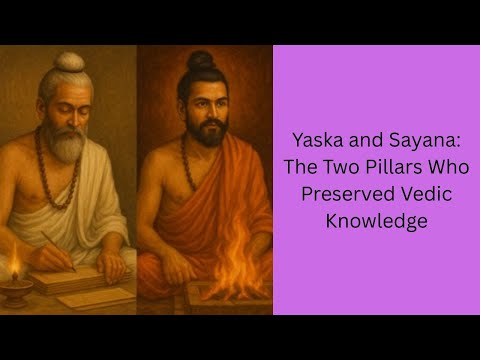
When we talk about the Vedas—the oldest scriptures in the world—it’s easy to forget how fragile their survival really was. For thousands of years, they were passed down orally, word by word, sound by sound. No printing press. No backups. Just memory, discipline, and tradition.
But how do we still understand the Vedas today?
It’s thanks to two incredible minds—Yaska, the ancient word-master, and Sayana, the medieval Vedic commentator. One gave us the tools to decode Vedic language. The other gave us explanations that preserved rituals, meanings, and wisdom.
Let’s get to know them.
Yaska: The Ancient Word-Scientist
Yaska lived around 2500 years ago, long before most grammar books existed. At a time when the Vedas were still very mysterious, full of tough words and tricky phrases, Yaska stepped in to make sense of it all.
What did Yaska do?
- He wrote two key texts: Nighantu (a list of Vedic words and synonyms) and Nirukta (a kind of dictionary that explains those words).
- He didn’t just guess meanings—he broke down words into roots, explained their origins, and showed how different parts of speech work.
- His approach was logical and systematic, not mystical. He saw that language had structure and pattern, and that even Vedic verses followed rules.
Why is he important?
Without Yaska, we wouldn’t have any roadmap for interpreting the older parts of the Rigveda. Scholars, both in India and the West, still use his methods to figure out what ancient hymns meant. He brought clarity to a world of complicated sounds.
Sayana: The Great Vedic Commentator
Jump forward about 2000 years, and we meet Sayana, a minister and scholar in the Vijayanagara Empire in South India (14th century CE). While Yaska focused on individual words, Sayana focused on entire Vedic texts.
What did Sayana do?
- He wrote or supervised detailed commentaries on all four Vedas—Rig, Yajur, Sama, and Atharva—as well as on the Brahmanas and Upanishads.
- His most famous work is called Vedartha Prakasha (meaning: 'revealing the meaning of the Vedas').
- He explained the ritual meaning, the sound, and the practical use of every mantra—not just the grammar.
Why is he important?
- Sayana’s writings preserved centuries of oral teachings, traditional interpretations, and ritual knowledge.
- Many Western translators like Max Müller and Griffith relied heavily on Sayana when they tried to bring the Vedas to the world.
- His work was massive in scope and remains a goldmine for Vedic scholars even today.
Why Do They Still Matter?
In today's world, we want to reconnect with our roots, but the Vedas are not easy to read or understand. That’s where Yaska and Sayana become priceless. They bridged the gap between the ancient chants and the modern mind.
- Yaska helps us see the logic in the Vedas.
- Sayana helps us see their ritual depth and spiritual richness.
Together, they kept the flame of Vedic knowledge burning bright.
Final Thought
If the Vedas are the soul of Sanatana Dharma, then Yaska and Sayana are the ones who protected that soul across the centuries. Their work reminds us that even divine wisdom needs human effort to survive.
And thanks to them, we can still sit down today, open the Rigveda, and find light in those ancient verses.





English
Sages and Saints
Click on any topic to open
7
30
Astrology
Bhagavad Gita
Bhagavatam
Bharat Matha
Devi
Devi Mahatmyam
Ganapathy
Garuda Puranam
Glory of Venkatesha
Hanuman
Kathopanishad
Mahabharatam
Mantra Shastra
Mystique
Practical Wisdom
Purana Stories
Radhe Radhe
Ramayana
Rare Topics
Rigveda Explained
Rituals
Sages and Saints
Shiva
Spiritual books
Sri Suktam
Story of Sri Yantra
Temples
Vedas
Vishnu Sahasranama
Yoga Vasishta
26
17
10
0


