Adi Shankaracharya: The Great Reviver of Advaita Vedanta
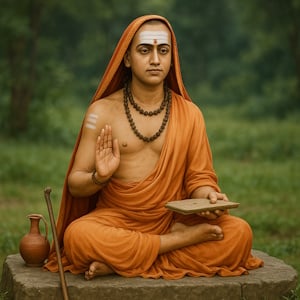
Adi Shankaracharya (8th Century CE) was a philosopher and theologian from India who consolidated the doctrine of Advaita Vedanta. He is credited with unifying and establishing the main currents of thought in Hinduism.
Early Life and Renunciation:
- Birth: He was born in Kalady, Kerala, to a Nambudiri Brahmin couple, Shivaguru and Aryamba.
- Prodigy: By the age of eight, he had mastered all four Vedas.
- Sanyasa: Legend says that while bathing in the Purna River, a crocodile caught his leg. He asked his mother for permission to take Sanyasa as his 'last wish.' Upon her consent, the crocodile released him, and he set out to find his Guru.
Finding His Guru:
He traveled to the banks of the Narmada River where he met Govinda Bhagavatpada. Under his guidance, Shankara mastered Yoga, Vedanta, and other Vedic disciplines. He was then instructed to go to Kashi (Varanasi) to write commentaries on the major scriptures.
Key Philosophies and Works:
1.Advaita Vedanta: His core teaching is 'Brahman is the only reality, the world is an appearance, and the individual soul (Atman) is none other than Brahman' (Brahma Satyam Jagan Mithya, Jivo Brahmaiva Naparah).
2.Prasthana Trayi: He wrote profound commentaries (Bhashyas) on the three pillars of Hindu philosophy:
- The Upanishads
- The Bhagavad Gita
- The Brahma Sutras
3.Stotras: He composed beautiful devotional hymns like Bhaja Govindam, Soundarya Lahari, and Kanakadhara Stotram.
The Shanmata System:
Shankaracharya is known as Shanmata Sthapanacharya (The founder of the six-fold system). He organized the chaotic various sects of his time into six main categories of worship, emphasizing that all lead to the same Supreme Truth:
- Saivam (Shiva)
- Vaishnavam (Vishnu)
- Shaktam (Devi/Shakti)
- Sauram (Surya/Sun)
- Ganapatyam (Ganesha)
- Kaumaram (Skanda/Murugan)
Establishing the Amnaya Peethams:
To ensure the continuity of Dharma, he established four main monasteries (Mathas) in the four corners of India:
- Sringeri Sharada Peetham (South - Karnataka)
- Dwaraka Kalika Peetham (West - Gujarat)
- Govardhana Matha (East - Odisha)
- Jyotirmath (North - Uttarakhand)
- Kanchi Kamatoti Peetham (Where he stayed - Tamil Nadu)
Conclusion:
Adi Shankaracharya’s life was short (he is said to have lived only 32 years), but his impact was monumental. He traveled the length and breadth of India on foot, engaging in debates with other scholars and reviving the Vedic tradition through the path of Knowledge (Jnana) and Devotion (Bhakti).





English
Sages and Saints
Click on any topic to open
7
30
Astrology
Bhagavad Gita
Bhagavatam
Bharat Matha
Devi
Devi Mahatmyam
Ganapathy
Garuda Puranam
Glory of Venkatesha
Hanuman
Kathopanishad
Mahabharatam
Mantra Shastra
Mystique
Practical Wisdom
Purana Stories
Radhe Radhe
Ramayana
Rare Topics
Rigveda Explained
Rituals
Sages and Saints
Shiva
Spiritual books
Sri Suktam
Story of Sri Yantra
Temples
Vedas
Vishnu Sahasranama
Yoga Vasishta
26
17
10
0


