Yajna Is Sri Hari Himself
Listening to his glories and singing – singing means not singing songs, singing means telling his glories to others. Both are purifying.
This purity is not something that is theoretical. This purity is something that an outsider also can feel and sense. Like what happened with Vyasa.
Shuka was Vyasa’s son. A real yogi, tapasvi, pure, equanimous, always engrossed in Paramatma. He left for sanyasa towards the forest. He was walking by a pond in which women were taking bath. They did not bother as he walked past.
Vyasa went after him pleading with him to return home. When the women saw Vyasa coming, they suddenly rushed for their garments and started wearing them. Vyasa was surprised. He asked them, why?
The women said – your son’s mind is pure, he doesn’t differentiate between man and woman. We didn’t feel embarrassed about being nude before him. But you still have that distinction in your mind, your mind is not as pure as your son’s. We have to cover our bodies before you.
Some people say that bhakti is not there in the Vedas and Upanishads. The bhakti cult started somewhere in the 11th century or later. This is not correct. The upasana that is referred to in the Shruti is nothing but bhakti. The term bhakti itself is there in Shwetashwataropanishad –
मुमुक्षुर्वै शरणमहं प्रपद्ये
यस्य देवे परा भक्तिर्यथा देवे तथा गुरौ
वषट्कारः – यदुद्देशेन अध्वरे वषट्क्रियते सः वषट्कारः
Vashat is similar to svaha. This is said at the end of the mantra while offering ahuti in yajna.
स्वाहा श्रौषट् वौषट् वषट् स्वधा एते पञ्चशब्दा देवहविर्द्दाने वह्निमुखहुतौ वर्त्तन्ते देवाय हविषो दानं देवहविर्द्दानं तत्र देवा इन्द्रादयः
Like svaha, श्रौषट्, वौषट्, वषट्, स्वधा are used while making offerings in agni. Svadha is used while making offerings to pitrus.
Vashatkara means the one for whom vashat is intended, for whom the ahuti is meant.
येन वषट्कारादि मन्त्रात्मना वा देवान् प्रीणयति स वषट्कारः
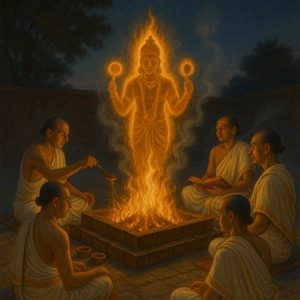
He pleases the devas being mantras such as vashatkara. The mantras accompany offerings made in yajna. Being of the form of those mantras, he pleases devas. He is himself yajna – यज्ञो वै विष्णुः. And yajna being the means for devas to receive offerings, he only pleases the devas – देवान् प्रीणयति.
सर्वं वषट् स्वेच्छानुवर्ति करोतीति वषट्कारः – he makes everything function as he desires.
सर्वस्य वशी – सर्वस्येशानः – Lord of everything.
Veda says यज्ञो वै विष्णुः – yajna is Vishnu, not in one place, in eighteen places. Not only Veda –
यज्ञो हि भगवान् विष्णुः – Vishnu Dharmottara Purana
यज्ञरूपो हि भगवान – Devi Bhagavatam
भगवान् सर्वयज्ञभुक् – he alone consumes all that is offered in yajnas – Srimad Bhagavatam
देशः कालः पृथग्द्रव्यं मन्त्रतन्त्रर्त्विजोऽग्नयः
देवता यजमानश्च क्रतुधर्मश्च यन्मयः
स एष भगवान् साक्षात् विष्णुर्योगेश्वरेश्वरः
A lot of things are important, taken into consideration while conducting a yajna.
Desha – place is important. The yajna-bhumi, to yield result, should be worthy of conducting yajna. There are clear injunctions with respect to this. If the yajna-bhumi is not good, it will not yield any result.
Someone wanted to conduct a mass Ganapathy homa – 500 people performing homa in 500 homa kundas simultaneously with the acharya in the middle. To conduct such a massive homa, you can do it only in a public ground in the city of Mumbai. The place that was identified and where it was performed, that ground is also a public toilet whenever it is vacant. This is where the so-called yajna was conducted. You can imagine what could have been the outcome.
Why do you have to do such things and make a mockery out of spirituality? Spirituality is highly personal. Yajnas are definitely a team effort, but there are a lot of things you have to be careful about. Yajna is Vishnu himself, don’t soil it, don’t spoil it.
Kala is important – appropriate timing is specified, like on amavasya, on purnima.
Dravya – materials to be used are specific. To the extent that if an offering is made to Pusha, it cannot be full grains, it has to be flour, because Pusha doesn’t have teeth. Every aspect of divinity is carefully considered in yajnas.
The mantras used.
Tantra – the techniques, the physical action. Tantra means whatever is physically done.
The qualifications of the priests – there are specific roles that are assigned based on the Veda they have learned.
Agnayah – yajna involves installation of a number of agnis.
Devata – yajnas are offered to specific devatas.
Before the commencement of the yajna itself it is declared – this yajna is going to be for so and so, so that the other devatas need not be present. While measuring out materials required for cooking the offerings, while cooking, while purifying the offerings, while actually making the offering in agni – at every stage it is specified, this is meant for so and so devata.
Yajamana – the sponsorer of the yajna. The yajamana has only a limited specific role to play in the yajna. The actual tasks of the yajna are performed by the various priests.
But isn’t spirituality personal and individual? Someone else is chanting the mantra, then the result should also go to him. Someone else is making the offering in agni, the result should go to him. When the yajamana is mostly sitting there and watching, and 90% of the tasks are performed by the priests, how is it possible that he gets any benefit out of it?
-
How can inner purity be sensed by others?
It shows up as steadiness, lack of grasping, and non-reactivity. People around feel safe, unjudged, and calm. -
Why does mental state matter more than outward action?
Intention drives the subtle effect. A precise act with a scattered mind leaks power; a centered mind focuses it. -
What gives sacred sounds their force?
Rhythm, meaning, and long practice align breath, attention, and will. That alignment changes the doer first, then the act. -
Why do different deities receive different offerings?
Each form represents a distinct quality. Matching substances and mantras tunes your mind to that exact quality. -
What makes a place suitable for ceremony?
Cleanliness, quiet, and sanctity. If past use is defiling or noisy, the space pulls the mind outward and drains the rite. -
How does time affect spiritual work?
Certain phases amplify attention and restitution. Aligning with lunar tithis and sunrise or sunset multiplies effect. -
Who actually benefits more: the priest or the sponsor?
Both. Skill channels the act; sankalpa claims the fruit. Without either, the circuit is incomplete. -
Why insist on tradition and precision?
Tradition is accumulated signal. It removes guesswork and preserves combinations that reliably work. -
What happens if rules are ignored or the event becomes a spectacle?
Attention scatters, ego rises, and results thin out. At worst, it turns into noise that teaches indifference. -
How can one verify a ceremony is being done well?
Look for clarity of purpose, clean space, qualified roles, measured pace, and unforced silence between actions. -
Is devotion present in the oldest teachings or a later add-on?
It is present from the start. Upasana is devotion in disciplined form, not a modern invention. -
What is the point of mantras like svaha or vashat?
They seal intention at the moment of offering, synchronize breath and act, and close each step cleanly. -
Why is collaboration needed if spirituality is personal?
Some works demand many skills at once. Collaboration lets each role stay focused while the whole stays coherent. -
If I cannot perform a full rite, is there a meaningful alternative?
Yes. Do fewer steps with full attention: clean space, clear resolve, a short mantra, and a simple offering. -
How does listening or speaking glories help at all?
It crowds out petty narratives, reorients desire, and steadily cleans the lens through which you act. -
What qualities make someone fit to lead a rite?
Competence, restraint, steadiness of mind, and loyalty to lineage instructions. Without these, finesse becomes show.





English
Vishnu Sahasranama
Click on any topic to open
7
30
Astrology
Bhagavad Gita
Bhagavatam
Bharat Matha
Devi
Devi Mahatmyam
Ganapathy
Garuda Puranam
Glory of Venkatesha
Hanuman
Kathopanishad
Mahabharatam
Mantra Shastra
Mystique
Practical Wisdom
Purana Stories
Radhe Radhe
Ramayana
Rare Topics
Rigveda Explained
Rituals
Sages and Saints
Shiva
Spiritual books
Sri Suktam
Story of Sri Yantra
Temples
Vedas
Vishnu Sahasranama
Yoga Vasishta
26
17
10
0


