Sponsor Of Yajna Gets The Result
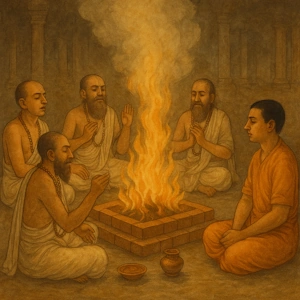
This doubt arises because you have seen only some sides of spirituality. Spirituality that you have exposure to is not all. It is a vast ocean; there are a number of ways and means to grow, to achieve.
There is a whole branch of philosophy, Darshana, called Meemamsa, Purva Meemamsa to be more specific, which talks about how yajnas work. It says:
शास्त्रफलं प्रयोक्तरि – the result of the yajna goes to the sponsorer.
क्रियाकर्तुराचार्यस्य दक्षिणया क्रीतत्वात् तदतिरिक्तफलसंबन्धानुपपत्तेः फलभाक्त्वं यजमानस्यैव — says Meemamsa Shastra.
There is so much false propaganda about spirituality. Everyone says only my system is correct, my system is perfect, everything else is a waste of time, only my method can take you ahead. Our sages never used to say this.
It is only a tendency to monopolise — the tendency to look at disciples and the spiritual territories as markets and increase one’s own market share.
But see the real commerce in spirituality — क्रियाकर्तुराचार्यस्य दक्षिणया क्रीतत्वात् तदतिरिक्तफलसंबन्धानुपपत्तेः फलभाक्त्वं यजमानस्यैव — since the sponsorer, kriyakarta, has purchased (kreetatvat — purchased) the acharya, the priest — purchased means hired his services for that particular time, dakshinaya, by paying dakshina, and this contract is exclusive — तदतिरिक्तफलसंबन्धानुपपत्तेः — there is no third party in this contract. Hence the benefit of the yajna will go to the yajamana.
Pure commercial contract. This is what is yajna. It is noble. It works. And it is Vishnu.
So let us not say whatever we know with our limited exposure, mostly through the internet and affiliation to certain school of thought, is what is Sanatana Dharma. Sanatana Dharma is an ocean.
Kratudharma — all the principles, rules and injunctions of yajna — all that — स एष भगवान् साक्षात् विष्णुर्योगेश्वरेश्वरः — all that is sakshat Vishnu, who is Yogeshwareshwara, Ishvara of Yogeshwaras.
विष्णुस्वरूपमखिलेष्टिमयं विवस्वन् — ishti means yajna, all yajna like Darsha Purna Masa, Chaturmasya, Jyotishtoma, Vajapeya, Ashwamedha — they are all His forms.
We saw that as soon as Brahma was born, he performed yajna.
Yajna is said to be the primary driving force behind rains. Rains are under the control of devas. Rains happen as and when devas want. Yajna is the means to propitiate devas. Once they are pleased, they cause timely rains.
Do not think that such worships can be carried out by anyone as and when they want. Such worships are possible only for those who are righteous, noble, and straightforward.
It is not that you have money and you can flaunt how much soever you want. Only the genuine will be permitted to perform worships such as yajnas.
The power of yajna is so much that man can achieve swarga and moksha in his own body by performing yajna. He can go wherever he wants.
In the Satya Yuga, also called Kruta Yuga, every human being was noble-hearted. Their thoughts were pure, their deeds were pure, their intentions were pure. They could virtually see Bhagawan residing in their hearts.
People of Satya Yuga never felt hunger. They had a siddhi called Rasollasa. They were all satisfied. They were ever satisfied. They never deviated from dharma. They all had equal longevity, they all had equal pleasure. They were all physically very powerful. They were all focused on Paramatma, constantly engaged in japa and tapa. They could go wherever they wanted, as and when they wanted. They could be comfortable wherever they were. These were called ashta siddhis.
Then, at the beginning of Treta Yuga, sin started creeping in. These siddhis started weakening. The feeling of ‘you’ and ‘me’ started becoming stronger. Comparisons started developing. Unhappiness, sadness, misery started developing. Heat and cold became unbearable to people.
They started building houses. They developed hunger. Earlier, due to the siddhi called Rasollasa, the body was taking care of itself. Now there was hunger, they had to eat. They started cultivation, agriculture.
When sin increases in the mind, people move away from yajnas. These sinful people talk against Vedas, Vedic principles, and yajnas.
-
Who actually gets the result of a yajna?
The named sponsor in the sankalpa gets the defined result. Priests enable the rite; the fruit goes to the yajamana. -
Why is dakshina essential?
Dakshina formally hires the priest’s service for that rite. It seals the contract and authorizes the performance. -
Do priests gain the same result as the sponsor?
No. The ritual’s promised result goes to the sponsor. Priests receive merit for right action and their pay as compensation. -
What makes someone eligible to sponsor a yajna?
Righteous conduct, honesty, and readiness to follow rules. Money alone does not grant eligibility. -
Can results be shared among many people?
Only if they are named as joint sponsors in the sankalpa. Otherwise, the fruit is exclusive to the yajamana. -
How can yajna influence rain and prosperity?
Yajna is a way to honor devas and uphold order. When order is upheld, timely rain and growth follow. -
What is Kratudharma?
It is the set of rules and principles that govern sacrifices. It covers procedure, roles, timings, and offerings. -
Why is yajna linked to Vishnu?
Tradition holds that yajna is a form of Vishnu. Serving yajna is serving Vishnu’s sustaining order. -
Which rites are examples of ishti (sacrifices)?
Darsha Purnamasa, Chaturmasya, Jyotishtoma, Vajapeya, and Ashvamedha are classic examples. -
Does simply watching a yajna give the same result?
No. Viewers receive general blessing, but the specified fruit belongs to the sponsor named in the sankalpa. -
Can a yajna lead to swarga or moksha?
Yes. Shastra states that properly performed yajna purifies deeply and grants high results, up to liberation. -
What blocks the result of a yajna?
Wrong intent, lack of eligibility, and serious procedural faults. Proper guidance and adherence fix this. -
What was special about life in Satya Yuga?
People were pure, content, and powerful in virtue. They enjoyed siddhis, constant focus on Paramatma, and effortless well-being. -
What changed in Treta Yuga?
Sin rose, contentment fell, and hunger appeared. People built houses, took to farming, and drifted from yajna. -
What is Rasollasa?
A siddhi described as effortless inner nourishment. With it, hunger is absent and contentment is steady. -
What are the ashta siddhis often spoken of?
Anima (ability to become minute), Mahima (ability to become vast), Garima (ability to become immensely heavy), Laghima (ability to become extremely light), Prapti (ability to obtain or reach anything anywhere), Prakamya (ability to make any will instantly effective), Ishitva (supreme lordship and mastery), Vashitva (power to subdue and control). They express mastery over body and environment.





English
Vishnu Sahasranama
Click on any topic to open
7
30
Astrology
Bhagavad Gita
Bhagavatam
Bharat Matha
Devi
Devi Mahatmyam
Ganapathy
Garuda Puranam
Glory of Venkatesha
Hanuman
Kathopanishad
Mahabharatam
Mantra Shastra
Mystique
Practical Wisdom
Purana Stories
Radhe Radhe
Ramayana
Rare Topics
Rigveda Explained
Rituals
Sages and Saints
Shiva
Spiritual books
Sri Suktam
Story of Sri Yantra
Temples
Vedas
Vishnu Sahasranama
Yoga Vasishta
26
17
10
0


