How to Develop Bhakti
This knowledge is not to impress people, to make them think that you are spiritually evolved.
This is not to get respect or position as a guru or spiritual mentor.
This knowledge is not to develop siddhis so that you can read minds or predict the future.
This knowledge removes impurities of the mind.
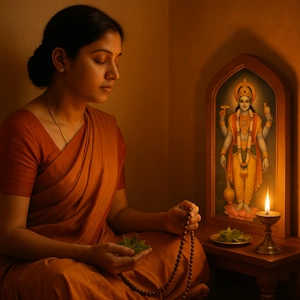
To plant this seed of bhakti within you and to grow it, make it flower and yield fruits, there is only one way — keep on listening to the greatness of Sri Hari, keep on singing His glories, keep on meditating upon His lotus feet, keep on physically worshiping Him by visiting temples and doing His puja at home. Bhakti will develop.
Your mind may be callous because of its conditioning. You may have grown up in an environment where everything was rational, logical, where God is considered weakness of the mind. God, you must have been told, is a creation of man — man is the creator of God. Doesn’t matter. Listening to His greatness itself will transform you. That is the power.
Because this state of devotion is natural. Sri Hari Paramatma resides inside everyone. He need not be brought in. This garb of rationalism, logic, and scientism is like a garb children wear in fancy dress competitions. You don’t wear it for a lifetime. Once the competition is over, they go back to their normal dress. Devotion, bhakti, is natural to you.
Keep on listening to His glory — you will start feeling His presence in your heart. He was always there, but now you start feeling His presence. And He will start working from inside. He will remove your vasanas — vices. As these impurities start reducing, bhakti starts strengthening, bhakti starts firming up.
The rajoguna and tamo guna inside you subside. Satva guna takes hold. You start seeing peace within you. The agitation will no more be there. Desires start vanishing and ananda starts taking their place.
When there is a desire, there can’t be ananda. Desire for something is when you lack something, you don’t have something. You don’t have a house — now your mind becomes obsessed with this. The desire to have a house is always coupled with the pain and dissatisfaction that you don’t have one. This pain will be there with you till the time you get a house. Then that particular desire and the pain associated with it go, and another one starts — this is a small house, I want a bigger one.
This desire, which is associated with rajoguna, is part of the plan of Maya Shakti which creates and runs the world. It is natural. Need not even look at it as something bad, something that you alone have. To have a desire is not a crime. Just understand that there are also other states — states where desires are replaced by ananda. There are people who live in that state. Whether you want it or not is up to you.
Brihadaranyaka Upanishad says:
यत्क्रतुर्भवति तत्कर्म कुरुते
यत्कर्म कुरुते तदभि – सम्पद्यते
You become whatever you think about. Your experience of the world depends on your perspective.
Great sages like Narada, Shuka, Vasishta, and Vyasa — they also come and live in this samsara only, but they enjoy. Because what they see everywhere is the leela of Bhagawan, what they see everywhere is the glory of His Maya Shakti.
When your ears are engrossed in hearing His praises, when your feet are engaged in doing pilgrimage to holy places and temples of His, when your hands are always engaged in doing service to Him, when your nose always smells the fragrance of tulasi offered at His lotus feet, when people around you are all Sri Hari’s devotees, then the world around you changes. It becomes different from how you experience it now. It becomes full of ananda, it becomes enjoyable.
The same world which today is unbearable, which gives you only sorrow, disappointment, and a feeling of defeat, becomes enjoyable. Because what you do in this world matters a lot, and you have a lot of control over what you choose to do.
यत्कर्म कुरुते तदभि – सम्पद्यते
This ananda that we are talking about is quite different. This is not the pleasure that you get when your tongue is gratified by your favorite dish. This is not the pleasure that you get when your ears are gratified by your favorite music. This is not the pleasure that you get when your eyes are gratified by watching your favorite actor or actress. This is not the pleasure that you get when your skin is gratified with the cool breeze from an air conditioner in hot summer. This is not the pleasure that you get when your nose is gratified with the smell of your favorite fragrance.
This ananda is internal. It is not the result of a stimulation of the sensory organs.
-
'Do I need a living guru or is listening enough?' — A living guide accelerates everything, but lack of a guru is not a blocker. Start with steady shravanam, keep practice honest, pray for guidance. A true guru points you back to Bhagavan.
-
'What if I feel nothing even after trying?' — Fix a daily slot. One nama, one kirtan, one short reading. Cut noise. Track subtleties: fewer anger spikes, quicker recovery, a quiet pull toward nama. Feeling follows fidelity.
-
'How do I measure progress without fooling myself?' — Less agitation and craving, cleaner speech, more compassion, steadier focus, and love for nama when no one is watching. Showmanship down, sincerity up.
-
'Will bhakti make me drop duties and ambition?' — No. Bhakti purifies ambition. Work stays; anxiety and vanity drain out.
-
'Is it wrong to ask Sri Hari for worldly things?' — Not a crime. Offer desires honestly. As rajas and tamas reduce, the grip loosens. Do not fake detachment; grow into it.
-
'Can a rational person be a devotee?' — Yes. Keep rigor. Test by practice. Rationalism becomes a tool, not armor.
-
'Is bhakti only for Vishnu or Krishna?' — Bhakti is to Bhagavan. The piece centers Sri Hari; follow that if it resonates. Honor other forms without contempt.
-
'No temple access. What is a simple home routine?' — Clean space, small image of Sri Hari, light a lamp, offer water and a leaf or flower, chant names, sit in remembrance. Consistency beats complexity.
-
'How do I strengthen sattva practically?' — Sleep on time, eat satvik, earn honestly, speak truth, give in charity, choose clean company, daily japa and kirtan, periodic tirtha yatra, avoid tamasic media.
-
'What exactly are vasanas, and how are they reduced?' — Deep habit-tendencies. Replace loops: when urges rise, pivot to nama, prayer, seva. Be honest with Bhagavan, keep satsang, repeat till rewired.
-
'Is bhakti escapism?' — No. Escapism freezes; bhakti gives courage. Tamas is lethargy, not devotion. Real bhakti makes you more reliable.
-
'Grace or effort — which works?' — You give steady effort; grace lifts the heavy part. Both together; neither excuses quitting.
-
'I keep slipping. How do I restart?' — Restart today. Skip guilt drama. Return to basics: listen, sing, remember, worship. Never miss two days in a row.
-
'Is Sanskrit required? What about music style?' — Use the language your heart understands. Bhava beats grammar. Keep tunes devotional, not performative.
-
'How long till ananda shows up?' — No fixed clock. With steady shravanam, kirtanam, smaranam, archana, real change shows within weeks; depth keeps widening.
-
'Where does professional mental help fit in?' — If depression, anxiety, or intrusive thoughts affect functioning, see a qualified professional. Bhakti supports good therapy.
-
'What does ananda actually feel like?' — Quiet contentment without a trigger. A background okayness that persists even in rough weather.
-
'Common pitfalls to avoid' — Collecting concepts without practice, showing off, guru-hopping, bingeing spiritual content, guilt spirals, using spirituality to dodge hard talks.
-
'A simple starter plan that works' — 20 mins Hari katha, 20 mins nama-japa, 20 mins puja or scripture daily; weekly satsang; monthly temple visit or short yatra; some seva. Keep it small, steady, sincere.





English
Vishnu Sahasranama
Click on any topic to open
7
30
Astrology
Bhagavad Gita
Bhagavatam
Bharat Matha
Devi
Devi Mahatmyam
Ganapathy
Garuda Puranam
Glory of Venkatesha
Hanuman
Kathopanishad
Mahabharatam
Mantra Shastra
Mystique
Practical Wisdom
Purana Stories
Radhe Radhe
Ramayana
Rare Topics
Rigveda Explained
Rituals
Sages and Saints
Shiva
Spiritual books
Sri Suktam
Story of Sri Yantra
Temples
Vedas
Vishnu Sahasranama
Yoga Vasishta
26
17
10
0


