Why Both Monsoon And Year Are Called Varsha In Sanskrit
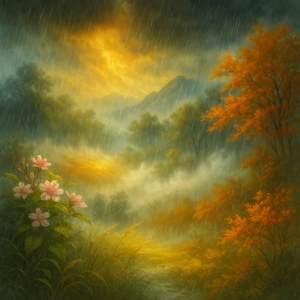
We have the six seasons of the year — 12 months, six seasons.
The exact beginning and end of a particular season depends on the calendar — whether you are following the lunar calendar or the solar calendar — and also your geographical location.
India has a latitudinal extent of nearly 30 degrees, and the seasons occur due to the north–south movement of the sun. Naturally, there is bound to be regional variation.
The six seasons are:
Vasanta – spring
Greeshma – summer
Varshaha – rainy season
Sharad – autumn
Hemanta – pre-winter
Shishira – winter
Among them, Varsha is very interesting.
In Sanskrit, the term Varsha stands for both rain and year.
Why is this so?
There is no dearth of words in Sanskrit. Of course, there are also other terms for both rain and year — Vrishti for rain, Samvatsara for year. But there is something special about Varsha.
The Varsha Ritu contains all the other five Ritus in it.
Have you noticed?
On a cloudy day in the rainy season or when the humidity is high, you will feel heat — you can experience Greeshma during Varsha Ritu itself.
If it rains heavily, you will feel cold. Depending on the intensity of the rain, you can experience either Hemanta or Shishira — pre-winter or winter — during Varsha Ritu.
When it rains moderately, you can feel the pleasantness of both Vasanta and Sharad Ritu.
Varsha Ritu stands for all the six seasons spread over the entire year. That’s why the year itself came to be known as Varsha — or the other way round.
All the six seasons of the year — the Varsha — can be experienced during the rainy season itself. So the rainy season came to be known as Varsha.
Do you see the connection?
Sanskrit nomenclature is not casual or arbitrary.
Deep principles are involved in each Sanskrit name and term.
What about the other seasons?
Take Vasanta, Greeshma, and Varsha Ritus.
The weather starts warming up during Vasanta.
यस्मिन् काले अग्निकणाः पदार्थेषु वसन्तो भवन्ति इति वसन्तः
Agni comes to reside in everything.
Vasantaha — Nivasantaha — that in which Agni takes residence.
यस्मिन् काले अग्निकणाः पदार्थान् गृह्णन्ति इति ग्रीष्मः
Agni takes over everything during Greeshma.
Summer — this is the period when Agni’s presence is at its peak.
यस्मिन् काले अग्निकणाः शीर्णाः भवन्ति इति शरत्
Agni starts receding.
यस्मिन् काले अग्निकणाः हीनतां गताः भवन्ति इति हेमन्तः
Very little presence of Agni.
यस्मिन् काले अग्निकणाः पुनः पुनरतिशयेन शीर्णाः भवन्ति इति शिशिरः
Agni is almost nil. Almost gone.
It is because of Agni’s presence on Earth during these three Ritus — Vasanta, Greeshma, and Varsha — that they make up Uttarayana.
Uttarayana is considered as the period of the Devas.





English
Rare Topics
Click on any topic to open
7
30
Astrology
Bhagavad Gita
Bhagavatam
Bharat Matha
Devi
Devi Mahatmyam
Ganapathy
Garuda Puranam
Glory of Venkatesha
Hanuman
Kathopanishad
Mahabharatam
Mantra Shastra
Mystique
Practical Wisdom
Purana Stories
Radhe Radhe
Ramayana
Rare Topics
Rigveda Explained
Rituals
Sages and Saints
Shiva
Spiritual books
Sri Suktam
Story of Sri Yantra
Temples
Vedas
Vishnu Sahasranama
Yoga Vasishta
26
17
10
0


