Why and How to Offer Padya, Arghya, and Achamaneeya in Puja
We are seeing the principles behind the Shodasha Upachara Puja.
In this context, we have seen that in Kali Yuga, there is not one method of worship.
Many options are available, all of them equally good and equally effective.
From the simplest – which you can do in less than two minutes.
The point is that – you get connected to divinity, stay connected to divinity.
That is why we have so many options.
The standard puja has sixteen steps – it is called the Shodasha Upachara Puja.
It is like how you serve an important guest who has come to your home.
In this, we have seen the first two – Avahana and providing Asana.
We have also seen that visualization is very, very important in the puja.
Visualization is the essence of puja.
Without visualization, puja is just a mechanical ritual. It will not help you in any way.
It is a blank shot, an engine without fuel.
The third, fourth, and fifth steps are providing Arghya and Padya or Padya and Arghya, and Achamaneeya.
All three involve providing water.
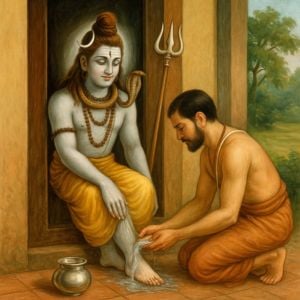
Padya for washing the feet.
Arghya for other purposes – like washing hands and face or anything like that, to refresh oneself.
The guest has arrived after a long travel.
The Lord has come from Kailasa to your home after a long travel – mounted on His bull.
He has to refresh Himself.
In traditional homes, you might have seen, always a pot of water is kept near the entrance.
Anyone who goes out, before getting back into the house, washes their feet.
This used to be normal practice in our culture – obviously for hygienic reasons.
Your feet come into contact with so many things, even if you are wearing footwear – so many dirty things, disease-causing microorganisms.
It is hygienic to wash your feet whenever you come home from outside.
Even if you are living in an apartment and cannot afford the luxury of keeping a pot of water at the entrance and washing your feet there,
even then you can go to the bathroom and wash your feet first thing whenever you come back home from outside.
This is a very hygienic practice.
As an extension of this, don’t bring footwear that you wear outside into your home – for the same reason.
It is not hygienic.
Just because you are wearing a 5000-rupees shoe, it does not mean that it will not catch dirt.
For the welfare and health of your family, don’t bring footwear inside home.
Don’t walk around inside home with the same footwear that you have worn outside.
If for health or any other reason you have to wear footwear inside the house, then keep a separate pair.
Don’t use the same ones you wear outside.
Avoid touching your footwear with your hands.
If you touch, then wash your hands thoroughly.
This is stuff that any health and hygiene professional can tell you.
What I am trying to point out is that hygiene was built into our spirituality.
Our sages were concerned about every single aspect of human life.
That’s why water is very important in our pujas.
So, the guest comes in, then you offer him water to wash his feet and for other purposes.
Now this has another important point here.
This Padyam is not the washing of the feet for hygiene.
That is implied – anyone would do that because you have already offered the Simhasana to the Lord.
The primary washing is already offered – don’t get confused.
This Padyam – you are washing His feet – it is ceremonial washing,
to show your humility, that your position is at His feet.
The water after you wash His feet is called Padodakam or Charanamritam.
The water that has washed the Lord’s feet is nectar for us.
You drink it, you sprinkle it over your head.
So this water used as Padyam is prepared by putting chandan, akshata, durva, and flowers in it.
So here the visualization is that the Lord has already occupied the Simhasana offered by you,
and you have kept a vessel under His feet for collecting the water,
and then you are pouring water on His feet with your left hand and washing it with your right hand.
Or if you are doing the puja as a couple, then the wife is pouring water and the husband is washing the feet with both his hands.
Then the Arghya – water for other purposes – for washing hands or wiping the face.
This you have to offer to the Lord.
This is the visualization you have to do.
There is one more step involved in this – Achamanam – the three times sipping of water to purify the Lord’s body.
This is Sagunopasana – the Lord has a body.
If there is body, then there can be impurities also.
So the Lord Himself performs Achamana with the water provided for the purpose by you.
One point to be noted here –
The sequence can be Arghya first, then Padya, or Padya first, then Arghya.
This depends on the particular text that you are following.
In Shiva Purana, it is Arghya first and then Padya.
So after Avahana, it will be:
Asanam Samarpayami
Arghyam Samarpayami
Padyam Samarpayami
Achamaneeyam Samarpayami
Achamaneeyam means – whatever is meant for Achamanam, water meant for Achamanam.
Normally we do:
Asanam Samarpayami
Padyam Samarpayami
Arghyam Samarpayami
Achamaneeyam Samarpayami
Just pointing it out.
Both are correct.
If you are following a particular system, stick to it. Don’t mix different systems.




English
Shiva
Click on any topic to open
7
30
Astrology
Bhagavad Gita
Bhagavatam
Bharat Matha
Devi
Devi Mahatmyam
Ganapathy
Garuda Puranam
Glory of Venkatesha
Hanuman
Kathopanishad
Mahabharatam
Mantra Shastra
Mystique
Practical Wisdom
Purana Stories
Radhe Radhe
Ramayana
Rare Topics
Rigveda Explained
Rituals
Sages and Saints
Shiva
Spiritual books
Sri Suktam
Story of Sri Yantra
Temples
Vedas
Vishnu Sahasranama
Yoga Vasishta
26
17
10
0


