Offering Pancha Bhutas to the Lord
We are examining in depth, in detail, every single step in a puja – right now the Shodasha Upachara Puja.
We have already covered Avahana, Assana Samarpna, Padya, Arghya and Achamaneeya.
Now we will look into Snana, the next step.
We have seen that the Shodashopachara is designed in exactly the same way how you would treat a VIP guest who has come home after a long travel.
We have invited him inside through Avahana, offered him a royal seat which is Asana Samarpana, washed his feet as mark of respect – which is Padya,
given him water for cleansing of his body, basically hands, face, which is more of freshening up – this is Arghya Pradana.
Then Achamaneeya – which is for internal purity.
Now the next step that Shiva Purana talks about is Abhyangapurvakam Snanam.
In other puja vidhis, sometimes another step called Madhuparka Samarpanam is there.
Madhuparka is a ceremonious drink – like how we offer a fruit juice.
Madhuparka can be a combination of curd and honey, or curd, ghee and honey, or honey, sugar, curd, ghee and water.
However, here in Shiva Purana this is not included.
Snana is regular bath.
The guest takes bath before proceeding for Bhojana, which is natural.
Abhyanga means applying oil all over the body.
Abhyanga from a health perspective also has great benefits.
Ayurveda considers a bath to be a complete bath only if you massage the body with oil prior to that.
This helps in deep cleaning also.
When you apply oil, then you definitely use something to remove that oil, which ensures deep cleaning.
So these are the two steps – Abhyanga and Snana.
After that, you provide a new set of clothes to the guest, which is Vastra Samarpanam.
Olden days, it always used to be a Vastra and Uttareeya – which is common size for everyone.
Only the modern dress code has different sizes and customisation.
It is always a pair of clothes.
The only ritual which you can do with a single cloth – meaning without Uttareeya – is the death rite.
Otherwise, always a pair of clothes should be used.
Never do a puja without Uttareeya.
Veda says that it is only Asuras who do not follow this rule and do puja whichever way they want.
And that’s why they are not able to secure their place in Swarga.
It is very important that you understand these principles.
Even when you are going to a temple, make sure that you are wearing traditional dress.
It helps a lot. Your worship will be 1000 times more powerful.
When you are doing puja at home, make sure that you are 100 percent wearing traditional dress.
Dharma provides relaxation wherever there is no harm.
For example, for Nama Japa – there is no rule, you can do whenever you want, wherever you want, wearing whichever dress you want.
But don’t think that this is common for everything.
If you cannot stick to rules, do Nama Japa only. No harm. It is equally effective.
If your interest is in doing puja, then follow the rules of puja.
That too, don’t mix different systems.
Like here in Shiva Purana, Madhuparka is not there.
That doesn’t mean you need not do it in other systems where it is mentioned.
Then it becomes faulty.
If you are following Shiva Purana and doing Shiva Puja, then Madhuparka is not there.
After this comes the Pachopachara.
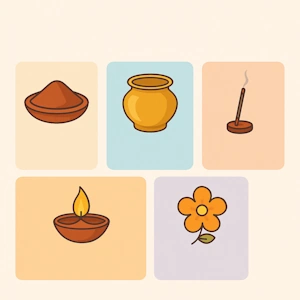
Everything in this universe is made up of five elements – the Pancha Bhutas:
Prithivi, Jala, Agni, Vayu and Akasha – Earth, Water, Fire, Air and Ether.
Ether means space – the space that is occupied by any object.
If you offer these five, that means you have offered everything, because there is nothing other than these in the world.
By offering these five, you are showing that you have offered everything that you have to the Lord.
Out of these, we have offered Jala already as Padya, Arghya, Achamaneeya and Snana.
The other four are left now.
Gandha or Chandana stands for Prithvi – because smell is associated with earth.
Chandana is well known for its fragrance.
So when you offer Chandana, that means we are offering the entire Prithvi Bhuta or Prithvi Tattva to the Lord.
Flowers stand for Akasha Tattva.
Mantras can travel through space. Mantras don’t need air to travel as a medium like the ordinary sound.
So when you hold a flower in your hand and say a mantra, then the vibrations of that mantra get absorbed in that flower,
since it is similar to Akash Bhuta or Ether.
And when you offer that flower at the feet of the Lord, then those entire vibrations of the mantra reach Him.
When you chant a mantra, only the audible sound is reaching the Lord, which in Mantra Shastra is called Vaikhari Shabda.
But when you hold a flower in your hand and chant a mantra, then the other parts of the mantra vibrations, called Para, Pashyanti and Madhyama, also get absorbed in it.
And when you offer it to the Lord, then the whole mantra reaches Him.
This is why we use flowers in puja.
Then two more bhutas – Air and Fire – Vayu and Agni.
The Dhoopa or Agarbathi stands for Vayu Bhuta – as smoke.
And Deepa is Pratyaksha Agni.
So by offering these five to the Lord, we have virtually offered Him everything in our possession.
The next step is Naivedya, which we will see later.





English
Shiva
Click on any topic to open
7
30
Astrology
Bhagavad Gita
Bhagavatam
Bharat Matha
Devi
Devi Mahatmyam
Ganapathy
Garuda Puranam
Glory of Venkatesha
Hanuman
Kathopanishad
Mahabharatam
Mantra Shastra
Mystique
Practical Wisdom
Purana Stories
Radhe Radhe
Ramayana
Rare Topics
Rigveda Explained
Rituals
Sages and Saints
Shiva
Spiritual books
Sri Suktam
Story of Sri Yantra
Temples
Vedas
Vishnu Sahasranama
Yoga Vasishta
26
17
10
0


