Mount Gowardhana Was Originally Not in Mathura
भर्ता – प्रपञ्चस्य अधिष्ठानत्वेन भरणात् भर्ता
He is the ruler of the universe, hence Bharta.
यस्तान् पुष्णात्यात्मदानात् स भर्ता परिकीर्तितः
He nourishes his creation. He submits himself as all the nourishment his creation requires.
Food nourishes. What is food?
अन्नं ब्रह्मेति व्यजानात्
That food is him — Brahma, Sri Hari.
He protects. He nourishes.
In the last episode we saw how the Lord lifted Gowardhana on the little finger of his left hand and protected the inhabitants of Vraja from the wrath of Indra.
There is an interesting story about how Gowardhana came to Vraja Desha.
In fact, Vraja Desha, Vrindavana, Gokula — they are all just replicas of Goloka. Lord Krishna’s permanent dwelling abode is Goloka — which is even above Kailasa and Vaikuntha. There he lives with Radha Rani, Gopas, Gopikas and cows. Vrindavana is originally in Goloka only.
When the Lord decided to take avatara on earth, he told Radha Rani. She said she would feel lonely in Goloka once he goes. Lord said, then you also come along. Then it was decided that everything — Vrindavana, Yamuna, Gopas, Gopikas — everything would be recreated on earth, so that Radha Rani can feel at home.
This is how he rewards bhakti.
This is how he rewards commitment towards him.
This is how he rewards love and affection towards him.
He decided to recreate Goloka on earth. Have that kind of devotion towards him, have the kind of devotion Radha Rani had towards him — he will do the same for you also.
Gowardhana was originally at Goloka.
On earth, Gowardhana took birth from the womb of the wife of Dronachala. Dronachala is situated in Shalmali Dwipa — one of the seven islands described in the scriptures. This is where Gowardhana took birth as the son of Dronachala.
When Gowardhana was born, all the other great mountains — Himalaya, Vindhya — they all came to visit. They were all excited to see Gowardhana, who had come down from the Lord’s own Goloka. They praised him with the name Giri Raja.
Once, Sage Pulastya came to Dronachala. He saw Gowardhana there. Madhavi lata — plants whose flowers called Madhavi are famous — they were seen blossomed all over Gowardhana. A mountain full of streams and trees stooping down due to the weight of fruits on them.
परोपकाराय फलन्ति वृक्षाः
Trees bear fruits not for themselves.
We go to the market, buy fruits, choose tasty juicy fruits all for ourselves — to enjoy ourselves. But why do trees bear fruits? They don’t get to eat a single one. It is all for others — it is for all those birds, and squirrels, and monkeys, and flies, and of course, man.
And being Bhagawan’s own special mountain, the fruit-bearing trees had so much fruit on them that their branches were bending down, unable to bear their weight.
All kinds of gems and precious minerals were there on that mountain. Beautiful birds singing all over — peacocks, cuckoos. Deer and monkeys and all other animals. Very peaceful. Ideal for observing tapas.
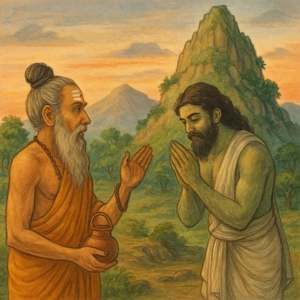
Pulastya approached Dronachala, Gowardhana’s father. Dronachala offered respects to the sage.
Pulastya said, I am coming from Kashi, the great land of Mahadeva. But we don’t have mountains in Kashi. Can I take your son with me?
Tears came to Dronachala’s eyes. But what to do? He can’t say no. Pulastya is a very powerful rishi. What if he curses? And it is for a noble purpose. So he told Gowardhana to go to Bharata Varsha with the sage.
Gowardhana tried to resist — I am 8 yojanas in length, 5 yojanas in width and 2 yojanas in height. How will I come with you?
Yojana is an ancient unit of measurement of length or distance. One yojana is about eight miles. Today, the parikrama of Gowardhana is about 38 km. If you walk around Gowardhana once, you would have walked 38 km.
So how will I go with you, Gowardhana asked.
Rishi said, I will keep you on my palm and take you. You don’t have to worry.
Gowardhana put a condition — then you should not put me down till we reach the destination. If you put me down, I will not move from there.
So Pulastya kept Gowardhana on his palm and proceeded towards Kashi.
On the way was Vraja, Mathura, Vrindavan.
When they reached Mathura, Gowardhana suddenly remembered who he was. He suddenly realized that his Lord was going to take avatara here. All his companions of Goloka were here. The Gopas, Gopikas, cows — they were all here. In all probability, Radha Rani will also come here.
I don’t want to go from here. Let me stay here only.
Gowardhana suddenly started increasing his own weight. The sage’s hand became tired. He could not bear Gowardhana’s weight. For a moment he forgot the condition that Gowardhana had put — not to keep him down.
The sage put him down and took rest for some time.
After some time, when Pulastya again tried to lift him up, Gowardhana refused to budge.
I told you not to put me down. Now I will not move from here.
Pulastya was disappointed. He gave a curse to Giriraj Gowardhana — a small curse, of course — every day you will go on reducing by the size of a sesame seed.
That’s why we have Gowardhana with a circumference of 38 km today.
And this is how the great Gowardhana came to Mathura — to be part of the Lord’s leela. Gowardhana who was part of Goloka.
No wonder Sri Hari told to worship Gowardhana.
-
What does it practically mean that Sri Hari is ‘Bharta’, the nourisher and supporter?
-
He is the source of outcomes and the sustainer of life; duties done with this awareness become lighter.
-
You work, but you stop clutching; anxiety drops because support is already secured.
-
-
If ‘anna is Brahman’, how should I treat food at home?
-
Cook and eat as worship: clean kitchen, steady mind, gratitude before the first bite.
-
Choose sattvic, simple meals most days; your gut calms, sleep improves, anger dips.
-
-
Why would the Lord recreate a sacred realm on earth instead of keeping it far away?
-
To prove that divine closeness is not a myth; it is livable here and now.
-
Your home can be a small Vrindavan when speech is gentle and routines are pure.
-
-
Why is a mountain worthy of worship? Isn’t it just rock and soil?
-
When the Lord marks something as his vibhuti, it becomes a doorway to him.
-
Respecting such places trains the mind to see the sacred in the ordinary.
-
-
What is the lesson in trees bearing fruit for others?
-
Real value is measured by usefulness, not display.
-
In family life, ask daily: what relief did I give? Generosity keeps the house peaceful.
-
-
Why did the sage’s ‘do not put me down’ condition matter so much?
-
Dharma includes honoring boundaries and promises.
-
Relationships shrink when we drop our word; they grow when we carry it to the end.
-
-
What do we learn from the mountain shrinking by a sesame seed each day?
-
Neglect erodes strength quietly.
-
Skip prayer, walk, or honest talk for many days and character thins the same way.
-
-
Is devotion only emotion, or does it change outcomes?
-
It changes outcomes; devotion rearranges circumstances around the devotee’s good.
-
The heart’s alignment often succeeds where raw force fails.
-
-
How should a family ‘worship Govardhana’ in spirit without traveling?
-
Protect cows and nature, keep food pure, avoid waste, keep promises.
-
Do parikrama-style walks together in your neighborhood; talk softly and remember the Lord.
-
-
Why did the Lord choose simple means rather than a grand spectacle?
-
Divine power is precise and restrained; it protects without noise.
-
Imitate that at home: fewer speeches, more steady actions.
-
-
What is the mental health takeaway from running to the Lord instead of panicking?
-
One clear refuge reduces cognitive overload and panic loops.
-
Breath, name of the Lord, and one next step — this triad steadies the nervous system.
-
-
How does this guide disagreements about tradition inside the family?
-
Keep reverence, but point the goal back to the Highest; remove ego from the debate.
-
Decide together: what practice brings us closer to truth, kindness, and self-control?
-
-
Why is gratitude for food a spiritual practice and a health practice?
-
Gratitude shifts the body to rest-and-digest; absorption improves.
-
You eat slower, portions settle, and irritability after meals declines.
-
-
What daily habit mirrors the mountain’s steadfastness?
-
Fixed times for prayer, work, movement, and sleep.
-
Predictable rhythms make children secure and adults calmer.
-
-
How should I respond when devotion asks for courage against convenience?
-
Choose the higher truth even if it strains comfort.
-
Families respect the one who quietly carries duty without drama.
-
-
What exactly should I pray for after reading this story?
-
A clean tongue, steady routines, and a servant’s heart.
-
The strength to keep promises and the eyes to see the sacred in everyday life.
-





English
Vishnu Sahasranama
Click on any topic to open
7
30
Astrology
Bhagavad Gita
Bhagavatam
Bharat Matha
Devi
Devi Mahatmyam
Ganapathy
Garuda Puranam
Glory of Venkatesha
Hanuman
Kathopanishad
Mahabharatam
Mantra Shastra
Mystique
Practical Wisdom
Purana Stories
Radhe Radhe
Ramayana
Rare Topics
Rigveda Explained
Rituals
Sages and Saints
Shiva
Spiritual books
Sri Suktam
Story of Sri Yantra
Temples
Vedas
Vishnu Sahasranama
Yoga Vasishta
26
17
10
0


