When the Self Says: Not Yet
Kathopanishad, 1.2.24 -
नाविरतो दुश्चरितान्नाशान्तो नासमाहितः ।
नाशान्तमानसो वाऽपि प्रज्ञानेनैनमाप्नुयात् ॥ २४॥
You want to know the Self?
Not in theory, not as an idea — but as a living, blazing truth within you?
Then this verse is your gatekeeper.
And that gate is not unlocked with cleverness.
It opens only when you’ve purified the way you live, the way you feel, and the way you think.
Let’s walk line by line.
नाविरतः दुश्चरितात् — 'Not withdrawn from wrong conduct.'
Start here.
This isn’t about being a saint. This is about being honest.
If your actions are selfish, harmful, dishonest — if you’re still chasing petty pleasures at the cost of your own dharma — then the door is shut.
No matter how much scripture you chant, how many mantras you memorize —
you won’t reach Him.
The Upanishad doesn’t say you’re evil.
It says: You’re not ready.
Because Atma isn’t an object you get by technique.
It’s a truth you become aligned with.
And that alignment begins when your life stops moving in the opposite direction.
नाशान्तः — 'Not peaceful.'
Now comes the next block.
Let’s say you’ve cleaned up your outer actions.
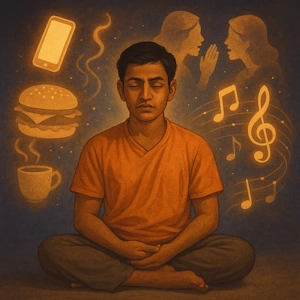
But inside, your senses are still hungry.
Your eyes still dart from thrill to thrill.
Your tongue still craves ten tastes in one day.
Your ears itch for gossip.
You’re addicted to movement, noise, distraction.
Then again — the Atma remains veiled.
Why?
Because the Self is not found through outer excitement.
It’s found in inner silence.
If you can’t be still for even a few minutes without itching for stimulation —
how will you ever hear the soft hum of your own being?
नासमाहितः — 'Not concentrated.'
Now look deeper.
Even if you’re peaceful in the senses, are you mentally anchored?
Or does your mind behave like a monkey on sugar — jumping from memory to fear, plan to fantasy, pain to past?
That kind of distracted mind cannot hold the Self.
Because the Self is subtle.
It doesn’t crash in like a wave —
It arises like fragrance — only in inner stillness.
The samahita chitta — the gathered, focused, one-pointed mind — becomes a clear mirror.
And in that mirror, the Atma reflects.
But if the mirror is cracked by restlessness, no reflection can appear.
नाशान्तमानसो वापि प्रज्ञानेनैनमाप्नुयात् — 'Even if one has great knowledge, he cannot attain the Self if the mind is not at peace.'
This is the final blow.
You might be a genius.
You might know every shloka, every commentary.
People may gather to listen to your words.
But if your inner climate is stormy, your heart is tight, your thoughts are turbulent —
then all that knowledge is just noise.
It’s like reading about silence while sitting in a rock concert.
You may know the definitions, but you’ll never experience the quiet.
The Self doesn’t come to those who collect ideas.
It comes to the one who drops everything and becomes empty enough to receive it.
So if your mind is always busy, always planning, always worrying — the Self will wait.
Not out of cruelty.
But out of compassion — because if He revealed Himself to a restless mind, you wouldn’t recognize Him.
So what does this mantra really ask of us?
It says:
- Clean up your conduct.
- Tame your senses.
- Gather your attention.
- And quiet your mind.
Only then can true knowledge — prajnana — shine.
Not borrowed wisdom. Not hearsay. But knowing that transforms your being.
This verse is not just a warning.
It’s a roadmap — from chaos to clarity, from noise to knowing.
It tells you where you are — and what needs to fall away for you to arrive.





English
Kathopanishad
Click on any topic to open
7
30
Astrology
Bhagavad Gita
Bhagavatam
Bharat Matha
Devi
Devi Mahatmyam
Ganapathy
Garuda Puranam
Glory of Venkatesha
Hanuman
Kathopanishad
Mahabharatam
Mantra Shastra
Mystique
Practical Wisdom
Purana Stories
Radhe Radhe
Ramayana
Rare Topics
Rigveda Explained
Rituals
Sages and Saints
Shiva
Spiritual books
Sri Suktam
Story of Sri Yantra
Temples
Vedas
Vishnu Sahasranama
Yoga Vasishta
26
17
10
0


