Nothing left to fear, nothing left to prove
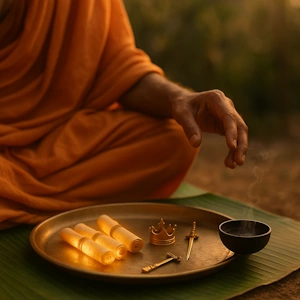
Kathopanishad 1.2.25
यस्य ब्रह्म च क्षत्रं च उभे भवत ओदनः ।
मृत्युर्यस्योपसेचनं क इत्था वेद यत्र सः ॥ २५॥
What’s food for you? Rice? Roti? A hearty meal?
But for the knower of the Self, even the highest — Brahma (the Vedas, knowledge, wisdom) and Kshatra (kingship, rule, might, warrior strength) — become just food on the plate of awareness.
Yes — knowledge and power, the two pillars the world worships, are described here as nothing more than odanah — cooked rice. Just a simple dish.
And what’s the side dish?
Mrityu — Death itself. उपसेचनम् — a mere accompaniment. Like a spoonful of chutney.
Let that sink in.
This is the vision of the liberated one — of the Atma-jnani.
To such a being, Brahma and Kshatra hold no more pride.
He doesn’t chase Vedic titles or royal status.
He doesn't flinch at Death. He has eaten it.
Everything that terrifies the world — power, pride, death — he sees as small, digestible, nothing.
And then comes the final thunderclap:
क इत्था वेद यत्र सः —
Who truly knows that state?
Who can even understand what it's like to become that?
Not the scholar.
Not the philosopher.
Only one who has walked through fire, emptied their ego, and become nothing — and in becoming nothing, became That.
This verse doesn’t explain the Self.
It laughs at all human attempts to measure it.
You can't study your way there.
You can't fight your way there.
You can't even die your way there.
Because the Self is beyond all three.
In Essence
- To the one who has known the Self —
Vedas become food. Kingship becomes garnish. Death becomes a side dish. - And this state?
Rare. Mysterious. Unimaginable.
Only the truly fearless, truly detached, truly quiet — know it.
What the words literally say
- Brahma and Kshatra – the twin ideals of sacred knowledge (the priestly, scholarly function) and political-military power (the ruling, warrior function)
- become odanah – plain cooked rice, the basic staple food.
- Mrityu – death itself – is upasechanam – a side dish or condiment.
- The verse ends: ‘Who really understands the one for whom it is so?’
In other words: For the realized person, knowledge, power, and even death are nothing more than items on the dinner plate.
2. Why use the ‘food’ metaphor?
- Eating is the most fundamental act of assimilation.
When you eat something, you digest it, break it down, and it loses its independent status. - By calling Brahma, Kshatra, and Death ‘food’, the Upanishad claims the liberated Self assimilates them. They no longer dominate him; he digests them and remains untouched.
3. Interpreting Brahma and Kshatra rationally
- Brahma (knowledge, ritual, doctrine)
- Represents the cognitive, intellectual drive.
- Even the highest scriptural wisdom is still object-knowledge – something you hold.
- The Self that knows itself no longer depends on second-hand concepts.
- Kshatra (political or physical power)
- Represents the volitional, executive drive – control over external events.
- From an awakened stance, worldly control is just another transient phenomenon, useful but not ultimate.
The verse lumps both together as rice: important for ordinary life, but trivial once you experience consciousness as its own self-existent fact.
4. Why downgrade Death to a ‘side dish’?
- In everyday valuation death is the ultimate threat.
- For the knower of the Self, death is merely one more event in the play of appearances, processed, absorbed, and left behind like any other sensation.
- Logically consistent with Advaita: If consciousness is not generated by the body, the body’s dissolution cannot end it. Hence death slides to condiment status.
5. Psychological reading
- Knowledge addiction and power addiction are two strong ego-hooks.
- Freedom arrives when both are relativised – you use them when needed, but they no longer define you.
- Fear of death is the master-hook. When that fear drops, the mind rests in unshakable composure.
6. Epistemic implication
- Anything that can be grasped (conceptualised or controlled) becomes food to the ungraspable subject.
- Therefore the Self is not another item in the inventory of the world; it is the ground in which the inventory appears.
7. The final challenge – ‘Who truly knows this?’
- The verse admits that such a perspective is rare and not easily conceived from the ordinary standpoint.
- It is a call to test one’s own priorities: Are knowledge, status, and fear still ruling me?
- Until they lose their charge, the claim ‘I am the Self’ remains intellectual, not existential.





English
Kathopanishad
Click on any topic to open
7
30
Astrology
Bhagavad Gita
Bhagavatam
Bharat Matha
Devi
Devi Mahatmyam
Ganapathy
Garuda Puranam
Glory of Venkatesha
Hanuman
Kathopanishad
Mahabharatam
Mantra Shastra
Mystique
Practical Wisdom
Purana Stories
Radhe Radhe
Ramayana
Rare Topics
Rigveda Explained
Rituals
Sages and Saints
Shiva
Spiritual books
Sri Suktam
Story of Sri Yantra
Temples
Vedas
Vishnu Sahasranama
Yoga Vasishta
26
17
10
0


