When the Horses Control the Rider
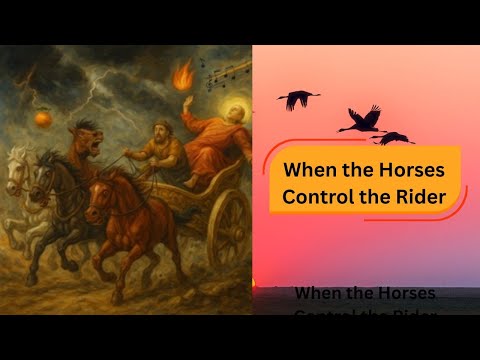
One of the most powerful metaphors in the Kathopanishad is verses 1.3.3–1.3.9 — it maps the whole human condition and spiritual journey onto the image of a chariot.
Verse 3
आत्मानं रथिनं विद्धि शरीरं रथमेव तु ।
बुद्धिं तु सारथिं विद्धि मनः प्रग्रहमेव च ॥ ३ ॥
Know the Self as the rider of the chariot,
the body as the chariot itself,
the intellect (buddhi) as the charioteer,
and the mind (manas) as the reins.
This is the setup. The Atman is not the body, not the senses, not even the mind. It is the master, the one seated within. The body is just the vehicle — it doesn't decide where to go. The intellect is the driver — ideally making decisions based on dharma. And the mind? It’s like the reins, connecting the driver to the horses (senses). If the mind is shaky, the reins go loose — the chariot veers off track.
Verse 4
इन्द्रियाणि हयानाहुर्विषयांस्तेषु गोचरान् ।
आत्मेन्द्रियमनोयुक्तं भोक्तेत्याहुर्मनीषिणः ॥ ४ ॥
The senses are called the horses,
and the sense-objects are their paths.
He who is united with the body, mind, and senses —
the wise call him the enjoyer (bhokta), the experiencer.
The senses are like horses — they pull towards their desired objects: sound, taste, touch, sight, and smell. If they’re wild, they drag you wherever they want. The one who is experiencing all this, riding along with this setup — is the Jivatma, bound to this whole apparatus of body and mind.
Verse 5
यस्त्वविज्ञानवान्भवत्ययुक्तेन मनसा सदा ।
तस्येन्द्रियाण्यवश्यानि दुष्टाश्वा इव सारथेः ॥ ५ ॥
But he who lacks discrimination,
whose mind is unrestrained,
his senses become uncontrollable —
like bad horses for a charioteer.
If your buddhi (intellect) is weak and your mind is undisciplined, the horses (senses) will run wild. The rider is helpless. You’re dragged into indulgence, error, suffering. Life becomes a wreck — your chariot is out of control.
Verse 6
यस्तु विज्ञानवान्भवति युक्तेन मनसा सदा ।
तस्येन्द्रियाणि वश्यानि सदश्वा इव सारथेः ॥ ६ ॥
But he who has wisdom,
and whose mind is always restrained —
his senses obey him well,
like noble horses with a skilled charioteer.
This is the ideal. When your intellect is sharp and your mind is under control, the senses follow your direction. You don’t become emotionless, but you're in charge — not dragged around by impulses. Now your chariot moves toward the right goal.
Verse 7
यस्त्वविज्ञानवान्भवत्यमनस्कः सदा अशुचिः ।
न स तत्पदमाप्नोति संसारं चाधिगच्छति ॥ ७ ॥
He who lacks wisdom,
whose mind is always unrestrained and impure —
he does not reach that supreme goal.
Instead, he enters the cycle of birth and death.
No control, no progress. The undisciplined one doesn’t reach the ultimate — the tad padam (supreme state). Instead, he gets thrown back again and again into samsara — suffering, rebirth, confusion.
Verse 8
यस्तु विज्ञानवान्भवति समनस्कः सदा शुचिः ।
स तु तत्पदमाप्नोति यस्माद्भूयो न जायते ॥ ८ ॥
But he who has wisdom,
whose mind is calm and pure —
he reaches that supreme state,
from which there is no more return.
This is Moksha. The one who uses the intellect as a guide, who keeps the mind steady and pure, reaches the eternal, the Vishnoh Paramam Padam — no more rebirth, no more bondage.
Verse 9
विज्ञानसारथिर्यस्तु मनःप्रग्रहवान्नरः ।
सोऽध्वनः पारमाप्नोति तद्विष्णोः परमं पदम् ॥ ९ ॥
He who has the intellect as charioteer
and the mind as firm reins —
he reaches the end of the road,
that supreme state of Vishnu.
This seals it. Vishnu's Paramam Padam here is the metaphor for the final goal — not a location, but spiritual completion. The adhvanah param — the other shore, beyond suffering, time, and identity. It's not a matter of worship alone, but of self-mastery, clarity, and balance.
So what’s the takeaway?
You're not the chariot. You're the one riding in it.
And your journey depends entirely on who’s driving,
how firm the reins are,
and whether the horses are well-trained.
A weak driver + loose reins = disaster.
A wise driver + steady reins = liberation.
What is the core idea behind the chariot metaphor?
The body, mind, and senses are tools — the true self is the inner rider. Liberation depends on how well these tools are managed by the intellect and mind. If the senses dominate, the self gets pulled into suffering.
Why does the Upanishad compare life to a chariot journey?
It's a vivid way to explain that our progress depends on who is in control. Just like a journey goes wrong if the driver is drunk or the horses are wild, life goes astray if the intellect and mind aren't disciplined.
Isn't the body enough to know the self — why complicate it with metaphors?
Without metaphor, the inner hierarchy gets missed. People often mistake the body or emotions for the self. This layered model forces clarity — the self is none of these; it uses them.
What happens if the mind is restless or distracted?
A restless mind makes the reins loose, allowing senses to drag the person toward distractions and indulgences. The intellect becomes powerless. This leads to errors in judgment and constant emotional chaos.
How can someone train their mind to be steady?
Through regular practices like meditation, discipline, and thoughtful living, the mind learns to respond calmly rather than react wildly. Over time, it becomes more like a firm rein than a tangled rope.
Why blame the mind? Isn't it natural to have emotions?
Emotions are natural, but letting them drive you is dangerous. The mind's job is to translate the intellect's guidance into action. When it's not trained, it obeys the senses instead, which leads to suffering.
What role does the intellect (buddhi) play in this model?
The intellect is the decision-maker, like a charioteer choosing which way to go. It evaluates, judges, and sets direction. Without a sharp intellect, the entire setup becomes unstable.
Can someone rely only on emotions and still live rightly?
Not reliably. Emotions may feel truthful, but they shift quickly. Intellect brings stable reasoning and alignment to long-term goals. Without it, one gets lost in momentary highs and lows.
Isn't intellect also biased or confused at times?
Yes, but only if it's neglected. A well-nourished intellect, fed by inquiry and reflection, becomes strong. It’s like sharpening a knife — dull if ignored, but precise when maintained.
Why are the senses compared to wild horses?
Because they are naturally impulsive — drawn to pleasures, reacting to stimuli, and hard to restrain. Without control, they overpower the rider. Like wild horses, they need training and direction.
Can the senses be completely silenced?
Not silenced, but mastered. The goal isn’t to destroy them but to use them wisely. You train the horses to listen to the reins, not run off by instinct.
Is sensory desire the root of all suffering then?
Not desire itself, but uncontrolled desire. When the senses command instead of serve, the self loses freedom. That lack of inner authority causes suffering.
What is meant by reaching the supreme state?
It's the state beyond rebirth — stable, peaceful, untouched by change. Once reached, there's no return to worldly bondage. It's the highest human fulfillment.
Is that state something external or internal?
It's deeply internal. Nothing outside grants it. It emerges when the self realizes its own nature and is no longer bound by body or mind.
How can one be sure this state exists?
Because every moment of silence, clarity, or deep insight points to something more lasting. The Upanishads are based on inner seeing, not belief. Those who’ve mastered themselves report the same destination.
What determines whether someone remains in samsara or attains liberation?
The key is discrimination (viveka) and disciplined mind. Without these, the soul keeps returning to worldly life. With them, it breaks free from the cycle.
What signs show someone is nearing liberation?
Calmness in conflict, detachment from pleasure-seeking, and clear inner direction. Such a person isn't tossed about by praise or blame. They act with stability.
Isn't rebirth just a belief, not a fact?
Belief or not, patterns repeat — in habits, emotions, and lives. Samsara explains the inertia behind it. Even without memory, people carry forward tendencies, which only self-realization can end.




English
Kathopanishad
Click on any topic to open
7
30
Astrology
Bhagavad Gita
Bhagavatam
Bharat Matha
Devi
Devi Mahatmyam
Ganapathy
Garuda Puranam
Glory of Venkatesha
Hanuman
Kathopanishad
Mahabharatam
Mantra Shastra
Mystique
Practical Wisdom
Purana Stories
Radhe Radhe
Ramayana
Rare Topics
Rigveda Explained
Rituals
Sages and Saints
Shiva
Spiritual books
Sri Suktam
Story of Sri Yantra
Temples
Vedas
Vishnu Sahasranama
Yoga Vasishta
26
17
10
0


