Beyond the mind lies...
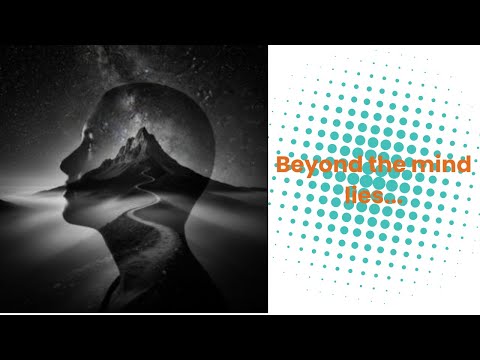
We often ask ourselves the big questions: Who am I, really? What is the nature of reality? Where am I going? We look for answers in science, in psychology, in the world around us. But thousands of years ago, ancient seers in India created a map—not a map of the world, but a map of consciousness itself. A map that leads from the surface of our awareness to the very core of our being.
Today, we're looking at two verses from this map. It's a dialogue between a young, fearless boy named Nachiketa and Yama, the Lord of Death himself. And Death is revealing the ultimate secret: the hierarchy of reality.
The first verse, verse 10 of the third valli of the first chapter of Kathopanishad, begins the ascent. It lays out the layers of our own experience, moving from the gross to the subtle. Yama says:
इन्द्रियेभ्यः परा ह्यर्था अर्थेभ्यश्च परं मनः ।
मनसस्तु परा बुद्धिर्बुद्धेरात्मा महान्परः ॥
Which translates to:
'Beyond the senses are the objects of the senses, beyond the objects is the mind, beyond the mind is the intellect, and beyond the intellect is the Great Self.'
It’s like climbing a ladder.
At the very bottom, the most external layer, are the senses—the Indriyas. Sight, sound, touch, taste, smell. These are our windows to the world. They are the tools we use to perceive.
One step higher, or subtler, are the sense objects—the Arthas. The things the senses perceive. The beautiful sunset, the melody of a song, the texture of a stone. The verse says the objects are 'beyond' the senses because the senses are just instruments; the world they perceive is the field they operate in.
But what processes all this data? That's the next rung: the mind, or Manas. The mind is like the central processing unit. It takes the feed from all five senses and weaves it into a single, coherent experience. It’s a constant stream of thoughts, feelings, and impressions.
Higher still is the intellect, the Buddhi. This isn't just raw thinking; this is our faculty of discernment, of judgment, of decision-making. If the mind is the busy, chaotic office, the Buddhi is the CEO who analyzes the data and makes the final call.
And then, we reach a fascinating level: the Great Self, or Mahat Atman. This isn't our small, individual ego. Think of it as the universal 'I-am-ness,' the cosmic mind, the first expression of consciousness in the universe. It’s the pure, intuitive awareness that underlies even our highest intellect.
So, in just one verse, we’ve traveled from the outer world of sights and sounds, inward through our mental and intellectual faculties, to the doorstep of cosmic consciousness.
But the journey isn't over. Yama takes us even deeper. Verse 11 reveals what lies beyond the cosmic mind. He says:
महतः परमव्यक्तमव्यक्तात्पुरुषः परः ।
पुरुषान्न परं किंचित्सा काष्ठा सा परा गतिः ॥
The translation is breathtaking:
'Beyond the Great Self is the Unmanifest, and beyond the Unmanifest is the Supreme Being, the Purusha. Beyond the Purusha, there is nothing. That is the ultimate end, the supreme goal.'
Let’s climb these final two steps.
Beyond the Great Self is the Unmanifest, the Avyakta. This is the primordial, uncaused cause. It's pure potentiality. Think of it like a seed that contains the blueprint for the entire tree, but before it has sprouted. It is the silent, unexpressed source from which all of creation springs forth.
And then, we arrive at the summit. The final reality. Beyond even the Unmanifest potential is the Purusha. The Supreme Spirit, the Pure Consciousness.
The Purusha is not a thing. It is the eternal, silent Witness. It’s the screen on which the entire movie of the universe plays. It is unborn, undying, unchanging, and utterly free. It is the aware space in which everything appears and disappears.
And Yama delivers the final, definitive statement: 'Beyond the Purusha, there is nothing.' This isn't a void of nothingness; it's a fullness of Being. There's nowhere else to go. You've reached the source.
He concludes: 'That is the ultimate end, the supreme goal.'
This isn't just a philosophical diagram. It's a treasure map. The entire purpose of the spiritual journey, according to the Upanishads, is to travel this path inward—to realize that our true identity is not the body or the mind, but this silent, eternal, blissful Purusha.
So the next time you feel lost in the noise of the world, remember this map. Your true home lies beyond the senses, beyond the thoughts, beyond even cosmic intelligence. It is the silent, aware presence that is here, right now.
- What is the cosmic hierarchy described in the text?
It maps existence in layers of increasing subtlety and power, starting from the physical senses. Beyond the senses are their objects, which are governed by the mind. The discerning intellect governs the mind, and beyond that lies the Great Self or universal consciousness. This culminates in the unmanifest source of creation, and finally, the ultimate reality of pure, silent consciousness which is the supreme goal. - If the mind and intellect are just layers, who is the 'I' that is supposed to understand this?
The 'I' you normally experience is a composite identity operating across these different layers. The spiritual process involves shifting your sense of self away from the lower levels like the body, senses, and fluctuating mind. The goal is to discover that your true identity is not the vehicle of perception, but the ultimate, silent witness at the very top of the hierarchy. You are not the climber, but the destination itself realizing its own nature. - Isn't this hierarchy just an abstract philosophical model with no practical proof?
This model is presented as an experiential map for inner exploration, not a dogmatic belief system. Its proof is not based on external evidence but on direct perception through the practice of introspection and meditation. Just as science uses instruments to probe the physical world, this framework guides the use of a refined mind to probe the inner world. The validity is confirmed by systematically witnessing and transcending these layers within your own consciousness.
- How is the true Self realized according to this teaching?
The Self is described as being deeply hidden and invisible to ordinary perception. It can only be perceived through a one-pointed and extremely subtle intellect, developed by dedicated seekers. The practical technique is to systematically merge the outer faculties into the inner ones. This means quieting speech and external actions to observe the mind, then using the intellect to quiet the mind, and finally merging the intellect itself into the vast, silent Self. - Why must speech be merged into the mind first? What does that mean in practice?
Merging speech into the mind is the crucial first step in turning consciousness inward and halting its outward flow. In practical terms, it means moving from active expression to inner contemplation, which is the foundation of meditation. By ceasing to speak and act impulsively, you quiet the most external layer of your personality. This allows you to gain control over the raw material of thought and emotion, preparing the mind for the deeper work of self-inquiry. - If the Self is hidden from everyone, isn't this 'subtle perception' just a form of self-hypnosis or imagination?
The text explicitly distinguishes this perception from imagination by stating it is achieved via a sharp, discerning intellect, not a fanciful mind. The process is one of deconstruction, not fabrication; it involves systematically setting aside what is observable and transient, such as thoughts, feelings, and sensations. What remains is not a mental creation but the foundational awareness that was always present, discovered through a rigorous process of elimination, not suggestion.
- What does it mean that the spiritual path is like the sharp edge of a razor?
This powerful metaphor highlights the extreme precision, alertness, and balance required for the spiritual journey. Just as walking on a razor's edge allows for no carelessness, this path demands unwavering focus and commitment. The slightest lapse in awareness, egoic indulgence, or misinterpretation can lead one astray. It underscores that the journey is subtle, challenging, and best navigated with the guidance of a competent teacher. - Why would the path to my own true nature be so difficult?
The difficulty stems not from the Self being far away, but from our deeply ingrained habits of identifying with the non-Self—the body, mind, and external world. The challenge lies in overcoming this powerful, lifelong conditioning and dismantling the ego's defenses. It requires unwinding complex psychological patterns and attachments that obscure our true nature. The Self is inherently simple and peaceful, but the journey to uncover it is arduous. - Doesn't calling the path 'difficult' just serve to empower gurus who claim to have the secret?
The warning is a realistic assessment of the inner work required, not a tactic for control. It serves as a caution against spiritual complacency and arrogance, emphasizing the need for humility and sincerity. An authentic teacher's role is not to hoard a secret but to act as a guide through the predictable challenges of this inner terrain, much like a skilled mountain guide. The text's primary call is to 'arise and awake,' placing ultimate responsibility on the individual's effort. - What is the nature of the ultimate reality, and what is the result of knowing it?
The ultimate reality is defined by what it is not—it is beyond all sensory attributes, having no sound, form, taste, or smell. It is described as eternal, undecaying, constant, and without beginning or end. The profound result of directly realizing this changeless reality is achieving true immortality. This means complete liberation from the cycle of change, decay, and death, which only affect the transient aspects of our being. - How can something be real if it lacks all tangible qualities like form or sound?
Its reality is of a different order than that of physical objects. Consider space: it has no form, sound, or taste, yet it is the fundamental medium in which everything tangible exists. The ultimate Self is analogous to the conscious space in which all experiences, including thoughts and perceptions of form, appear and disappear. Its reality is foundational, as it is the very awareness that makes the perception of any quality possible. - Isn't the promise of 'freedom from death' just a psychological comfort to cope with our fear of mortality?
This teaching approaches the concept from a different angle. It redefines 'death' as the consequence of mistakenly identifying with what is temporary—the body, the personality, and the mind. 'Freedom from death' is therefore not physical immortality, but a radical shift in identity to the eternal, unchanging consciousness that witnesses the body's birth and decay without being affected by it. It is a liberation from the fear of ending because one has realized the part of oneself that never began.





English
Kathopanishad
Click on any topic to open
7
30
Astrology
Bhagavad Gita
Bhagavatam
Bharat Matha
Devi
Devi Mahatmyam
Ganapathy
Garuda Puranam
Glory of Venkatesha
Hanuman
Kathopanishad
Mahabharatam
Mantra Shastra
Mystique
Practical Wisdom
Purana Stories
Radhe Radhe
Ramayana
Rare Topics
Rigveda Explained
Rituals
Sages and Saints
Shiva
Spiritual books
Sri Suktam
Story of Sri Yantra
Temples
Vedas
Vishnu Sahasranama
Yoga Vasishta
26
17
10
0


