What Your Mind Does at Death Decides Everything

At the moment of death, nothing external matters.
Not your wealth.
Not your status.
Not even your body.
Only one thing matters.
The state of your mind.
Whatever fills your mind at that final moment… that is what carries forward.
This is not philosophy.
This is mechanism.
Now understand the danger.
Most people do not leave peacefully.
Their mind does not become silent.
It becomes crowded.
Faces appear.
Memories rush in.
Emotions surge.
And the strongest among them… takes control.
A father lying on his deathbed.
His mind is not thinking of truth.
Not thinking of Bhagavan.
He is thinking…
What will happen to my children?
Will they be safe?
Who will take care of them?
On the surface, this looks noble.
But look deeper.
This is attachment speaking.
Not clarity.
Because the mind is not stable.
It is pulled outward.
It is clinging.
And whatever the mind clings to… it binds itself to.
This is the danger.
Attachment at death does not express love.
It creates continuation.
Now take another case.
A person filled with unfulfilled desires.
Things he wanted but never got.
Experiences he kept postponing.
Pleasures he kept craving.
At death, all of that rises.
Not one by one.
All at once.
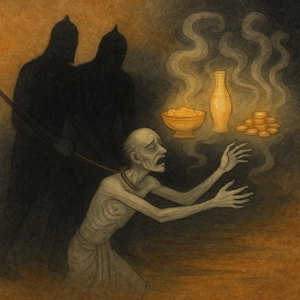
The mind starts grasping.
I still have to do this.
I did not achieve that.
I have not enjoyed enough.
This is not thinking.
This is hunger.
And hunger cannot end in peace.
It pushes the mind into movement again.
This is how the cycle continues.
Not because someone forces it.
Because the mind itself is unfinished.
Understand this clearly.
Death does not suddenly purify you.
It reveals you.
Whatever you have trained your mind to hold…
that is what comes up naturally.
You cannot pretend at that moment.
You cannot act spiritual at that moment.
Your true inner condition takes over.
That is why attachment becomes dangerous.
Because attachment is not just emotion.
It is dependence.
It is identity.
When you say my family, my wealth, my life…
You are tying your mind to them.
So at the final moment…
The mind does not know how to let go.
It only knows how to hold tighter.
And that holding… creates continuation.
Now see the contrast.
A person who has lived with awareness.
Who has done his duties fully.
Who has loved, but without clinging.
Who has enjoyed, but without addiction.
Such a person’s mind does not panic at death.
It does not run outward.
It turns inward.
There is no urgency.
No unfinished hunger.
No desperate holding.
There is acceptance.
There is clarity.
There is stillness.
And in that stillness…
The transition becomes smooth.
This is why preparation for death is not done at death.
It is done in life.
Every day you are training your mind.
What to depend on.
What to value.
What to hold.
If you train it to depend on external things…
It will struggle when they are taken away.
If you train it to remain steady…
It will remain steady even when everything is removed.
So the real question is not…
What will I think at the time of death?
The real question is…
What am I training my mind to think every single day?
Because that… decides everything.
-
Why does the state of mind at death carry so much importance
Because at that moment, the mind is stripped of distractions. What remains is its deepest conditioning. That final state is not created then, it is revealed. Whatever has been repeatedly held, feared, desired, or depended upon rises naturally. That becomes the direction in which the inner movement continues. -
Why is thinking about family at death considered dangerous
It is not the family itself, it is the clinging. When the mind says my children, my people, it is not expressing care, it is expressing dependence and incompleteness. That creates a pull outward. Instead of dissolving, the mind holds on. That holding becomes the cause for continuation. -
What role do unfulfilled desires play at the final moment
Unfulfilled desires behave like open loops. They do not disappear. They remain active in the background. At death, when control drops, these desires surge forward. They create restlessness and push the mind into seeking again. This is how the cycle continues without external force. -
Can a person change their state of mind at the last moment
No. At the last moment, there is no time or strength to change patterns. The mind falls back on its training. Just like in a crisis, you do not invent new reactions, you act from habit. Death is the ultimate test of that habit. Only what has been practiced consistently will appear. -
What is the hidden principle behind a peaceful death
Completion. A mind that has lived fully, performed its duties, and reduced its dependencies does not struggle. It does not try to grab or resist. It remains steady. That steadiness allows a smooth transition. The secret is not detachment from life, but freedom from inner compulsion.
Objection 1: There is no proof that thoughts at death matter
Reply: Not everything operates at a visible level. Even in daily life, your thoughts shape your behavior, decisions, and outcomes without direct measurement. The final moment is simply an intensified version of the same principle. The invisible does not mean non-existent.
Objection 2: Thinking about family is natural, how can it be wrong
Reply: Natural does not always mean beneficial. Attachment is natural, but so is fear and anger. The point is not to reject family, but to understand the difference between care and dependence. One supports clarity, the other creates bondage.
Objection 3: If everything depends on past conditioning, then effort is useless
Reply: Conditioning is built through repeated effort. Every thought, every reaction, every habit shapes it. What you do now is exactly what determines that conditioning. Effort is not useless, it is the only way the mind is shaped.
Objection 4: Many people die suddenly without thinking anything
Reply: Even if the outer event is sudden, the inner state is not blank. The mind is always in some condition. Whether conscious or not, that underlying state continues. Death does not create a new state, it carries forward the existing one.
Objection 5: This idea creates fear about death
Reply: It creates awareness, not fear. Fear comes from lack of clarity. When you understand how the mind works, you gain control over your preparation. The purpose is not to scare, but to make you live in a way that brings stability and peace when it matters most.





English
Garuda Puranam
Click on any topic to open
7
30
Astrology
Bhagavad Gita
Bhagavatam
Bharat Matha
Devi
Devi Mahatmyam
Ganapathy
Garuda Puranam
Glory of Venkatesha
Hanuman
Kathopanishad
Mahabharatam
Mantra Shastra
Mystique
Practical Wisdom
Purana Stories
Radhe Radhe
Ramayana
Rare Topics
Rigveda Explained
Rituals
Sages and Saints
Shiva
Spiritual books
Sri Suktam
Story of Sri Yantra
Temples
Vedas
Vishnu Sahasranama
Yoga Vasishta
26
17
10
0


