8 Signs of Preta Disturbance You Should Not Ignore

People want a clear answer.
Is there a ghost here or not.
Shastra does not answer like that.
It does not give you a checklist.
It gives you patterns.
And once you see the pattern, you cannot miss it.
Understand this first.
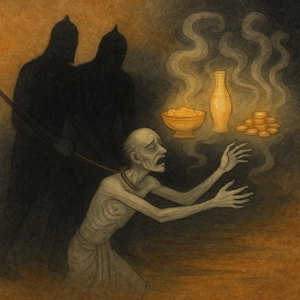
A preta is not a monster.
It is a being stuck in transition.
A state where the body is gone, but the mind is not settled.
Now see how that shows up.
First, a place starts feeling heavy.
Not visually different.
Nothing dramatic.
But you enter and something feels off.
Restlessness.
Uneasiness.
You cannot sit there for long.
There is no logical reason.
This is the first signal.
Shastra describes pretas as restless.
So wherever they linger, that restlessness spreads.
Second, the departed do not leave your mind.
Not in a normal way.
Not as memory.
They appear repeatedly.
In dreams.
In a specific form.
Sometimes asking.
Sometimes just standing there.
Sometimes distressed.
This is not random dreaming.
This is unresolved connection.
When the transition is incomplete, the link remains active.
Third, sudden emotional disturbance.
No trigger.
No clear cause.
But the mind becomes unstable.
Fear appears.
Anger rises.
Confusion sets in.
This is where people get it wrong.
They think it is only psychological.
Shastra does not deny the mind.
But it also does not limit reality to it.
It accepts that unseen influences exist.
Fourth, dharmic actions start facing obstruction.
Simple things do not go smoothly.
Puja gets delayed.
Shraddha arrangements fail.
Something or the other goes wrong.
Again and again.
This is not coincidence anymore.
When energy is invoked, disturbance becomes visible.
Fifth, the disturbance is not everywhere.
It is specific.
One room.
One corner.
One location.
You feel normal everywhere else.
But not there.
Animals avoid that space.
You feel watched there.
This matches exactly how shastra describes it.
Attachment binds a being to a place.
So the effect also stays localized.
Sixth, something strange starts happening around food.
Appetite drops suddenly.
Food feels unappealing.
Or things spoil without reason.
This looks small.
But it is not.
Shastra describes pretas as intensely hungry but unable to consume.
That imbalance reflects subtly in the environment.
Seventh, life itself starts showing patterns of obstruction.
Not one problem.
A pattern.
Marriage delays.
Financial blocks.
Repeated failures at the same stage.
And when you look deeper, it is not just you.
It runs in the family.
This is where shastra introduces ancestral imbalance.
What is not resolved continues.
Eighth, time matters.
The same place feels normal in the day.
But not at night.
Early morning.
Late evening.
Transition times.
That is when uneasiness rises.
These are not random beliefs.
These are observed patterns recorded over generations.
Now understand the most important thing.
None of this is given to scare you.
Shastra never leaves you helpless.
It shows the problem.
And it shows the correction.
Shraddha.
Tarpana.
Mantra.
Daana.
Proper rituals.
Because a preta is not your enemy.
It is a being in difficulty.
Just like a hungry person behaves differently, a restless being creates disturbance.
That is all.
So do not jump to conclusions.
Do not label everything as ghost.
But do not dismiss everything as imagination either.
Observe patterns.
Look for repetition.
And understand one simple truth.
Where there is disturbance, something is incomplete.
And what is incomplete can always be completed.
-
Why does shastra describe patterns instead of giving a fixed checklist for preta disturbance
Because reality is not mechanical. A preta is not an object you can measure directly. It is a condition of a subtle being. So shastra trains you to observe repetition, consistency, and context. When multiple patterns align, the indication becomes strong. This prevents blind belief and also prevents blind rejection. -
What is the deeper reason behind repeated dreams of the same departed person
Dreams in this context are not random mental noise. They become a medium of unresolved connection. When the transition of the departed is incomplete, or when strong attachment remains, the link continues. The mind becomes the channel through which that unfinished state expresses itself. -
Why are disturbances often limited to specific places and not everywhere
Because attachment has a location. A being that has not moved on remains connected to a particular space, object, or event. So the disturbance is not spread randomly. It is concentrated. This localization is one of the strongest indicators that the issue is not purely psychological. -
How do ancestral imbalances continue across generations
Because actions and unresolved states do not end with one body. They form a continuity. When proper closure is not done, especially through rites meant for transition, the imbalance remains active. It does not act randomly. It shows up in repeating patterns in the family line until it is addressed. -
What is the hidden principle behind all these signs
Incompletion. Every sign points to something that has not been resolved. Whether it is desire, attachment, or ritual closure, the core issue is the same. Where there is incompletion, there is disturbance. When completion is brought through correct means, the disturbance reduces or ends.
Objection 1: All these signs can be explained psychologically, there is no need to bring in spirits
Reply: Psychological explanations cover a part of human experience, not all of it. Shastra does not deny the mind, but it does not restrict reality to it. When patterns extend beyond individual behavior and show consistency across place, time, and lineage, a wider framework is needed.
Objection 2: Dreams are just brain activity, they do not have any external meaning
Reply: Many dreams are indeed internal. But not all. Shastra differentiates between random dreams and repeated, structured, meaningful appearances. When the same form appears again and again with specific signals, it is treated as communication, not noise.
Objection 3: This creates unnecessary fear and superstition
Reply: Fear comes from lack of clarity. Shastra gives clarity. It explains the cause and also provides solutions. The intent is not to scare, but to make you aware of patterns so that you can respond correctly instead of remaining confused.
Objection 4: If pretas exist, why can they not be seen directly
Reply: Not everything real is visible to the physical senses. Even in science, many forces are known through their effects, not direct perception. Shastra follows the same approach. It identifies presence through impact, not through appearance.
Objection 5: Rituals like shraddha or tarpana are symbolic, they cannot affect anything real
Reply: Symbolism is the outer layer. The inner layer is process. These rituals are structured actions involving intention, mantra, and offering, designed to create completion at a subtle level. Their effect is not emotional alone, it is functional within the framework described by shastra.





English
Garuda Puranam
Click on any topic to open
7
30
Astrology
Bhagavad Gita
Bhagavatam
Bharat Matha
Devi
Devi Mahatmyam
Ganapathy
Garuda Puranam
Glory of Venkatesha
Hanuman
Kathopanishad
Mahabharatam
Mantra Shastra
Mystique
Practical Wisdom
Purana Stories
Radhe Radhe
Ramayana
Rare Topics
Rigveda Explained
Rituals
Sages and Saints
Shiva
Spiritual books
Sri Suktam
Story of Sri Yantra
Temples
Vedas
Vishnu Sahasranama
Yoga Vasishta
26
17
10
0


