What Really Happened During Sati's Dehatyaga?
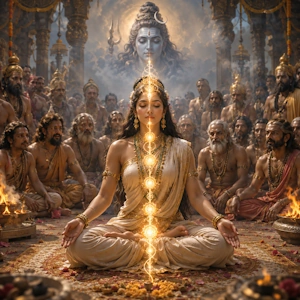
Sati entered the yajna already wounded by Daksha's hatred toward Shiva.
When Daksha openly insulted Shiva before the entire assembly, something inside her became completely detached.
The scenr then shifts from emotional pain into advanced yoga.
Sati becomes silent.
Not the silence of weakness.
The silence of withdrawal.
She stops reacting to the outer world.
The yajna.
The insults.
The assembly.
Everything fades from her awareness.
She remembers only Shiva.
Then she sits facing north.
In yogic symbolism, north represents ascent.
Movement toward higher states of consciousness.
She performs achamana.
Purifies herself.
Closes her eyes.
Steadies the mind.
Shiva Purana then describes a profound yogic process.
First, she balances prana and apana.
Normally these life-forces move in opposite directions.
One rises upward.
One moves downward.
In ordinary people, this creates instability.
Restlessness.
Emotional disturbance.
Mental fluctuation.
But Sati brings them into complete equilibrium.
This itself shows extraordinary yogic mastery.
Then she raises udana vayu.
Udana is the ascending force connected to higher consciousness and departure from the body.
Ordinary beings do not control death.
Death overtakes them.
But here, Sati consciously directs the process herself.
The Shiva Purana then describes the upward movement of awareness.
From the navel region.
To the heart.
To the chest and throat.
Then toward the bhrumadhya — the space between the eyebrows.
This is not merely physical imagery.
It represents withdrawal from bodily identification.
The senses lose importance.
The outer world disappears.
The body itself becomes secondary.
Only pure awareness remains.
And throughout this process, Sati thinks only of Shiva.
That is the spiritual center of the chapter.
Yoga here is not mechanical technique.
It is total absorption in Shiva-consciousness.
Her mind does not move toward revenge.
Not toward anger.
Not toward self-pity.
Only Shiva remains.
Then comes the climax.
The body burns through inner yogic fire.
No external flame is used.
The fire arises from within.
This is yogagni.
In ordinary existence, the body dominates the person.
Fear dominates them.
Pain dominates them.
But in higher yoga, consciousness rules even the body's elements.
Sati does not merely die.
She consciously abandons the body through yogic power.
The devas panic.
The worlds tremble.
The ganas erupt in grief and rage.
Because the assembly realizes they have witnessed something terrifyingly rare:
A Devi leaving the body through complete yogic mastery while absorbed entirely in Shiva.
Question:
Why does the Shiva Purana describe prana, apana, and udana in Sati's death?
Answer:
Because this is not ordinary death.
The Purana is showing conscious departure from the body.
Sati does not lose control.
She controls the process herself.
The text shows:
how awareness is withdrawn,
how life-force is stabilized,
and how consciousness rises upward.
Question:
Why did Sati think only about Shiva during the process?
Answer:
Because the chapter is teaching the highest yoga.
Not just posture.
Not just breathing.
Complete absorption in Shiva.
Her mind does not move toward anger.
Not toward Daksha.
Not toward revenge.
Only Shiva remains.
That one-pointedness becomes her power.
Question:
Why were devas and ganas terrified after Sati's dehatyaga?
Answer:
Because they understood the seriousness of what happened.
This was not merely a daughter dying.
A Devi had rejected the body itself.
And she did it through yogic fire,
while absorbed in Shiva-consciousness.
The entire cosmic balance was shaken.
Objection:
No one can burn their own body through inner yogic fire. This sounds mythical.
Reply:
The Purana is describing an extraordinary yogic state.
Even today,
breath,
heartbeat,
body temperature,
and pain response can be influenced through deep practice.
Yogic traditions describe much higher states beyond ordinary experience.
Sati is presented as a cosmic being,
not an ordinary human.
The deeper teaching is this:
Consciousness is far more powerful than most people realize.





English
Shiva
Click on any topic to open
7
30
Astrology
Bhagavad Gita
Bhagavatam
Bharat Matha
Devi
Devi Mahatmyam
Ganapathy
Garuda Puranam
Glory of Venkatesha
Hanuman
Kathopanishad
Mahabharatam
Mantra Shastra
Mystique
Practical Wisdom
Purana Stories
Radhe Radhe
Ramayana
Rare Topics
Rigveda Explained
Rituals
Sages and Saints
Shiva
Spiritual books
Sri Suktam
Story of Sri Yantra
Temples
Vedas
Vishnu Sahasranama
Yoga Vasishta
26
17
10
0


