How Insult of Shiva Turned a Yajna Into Chaos
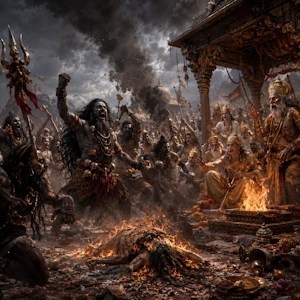
After Sati left her body, the yajna changed instantly.
Until then, it was pride.
Now it became fear.
Nobody spoke first.
The whole assembly froze.
Then cries erupted everywhere.
'Haa Haa!'
'What has happened!'
Devas became frightened.
Rishis lowered their heads.
The atmosphere became heavy.
People immediately blamed Daksha.
'This is his arrogance.'
'He insulted Mahadeva.'
'He destroyed his own daughter.'
Adharma may look successful initially.
Crowds may support it.
But the moment consequences appear, everyone steps back.
Nobody defended Daksha now.
Many sages understood another truth.
A yajna is not fire alone.
Not mantras alone.
Inner bhava matters.
Without reverence, ritual becomes empty.
With ego, even sacred acts become dangerous.
Meanwhile Shiva's ganas lost control completely.
Their grief became fury.
Some screamed loudly.
Some lifted weapons.
Some cursed Daksha openly.
A few ganas attacked themselves in sorrow.
That is another deep point.
True devotion is not casual emotion.
Shiva’s ganas were bound through loyalty.
Sati’s pain became their pain.
Others rushed toward the yajna.
'Destroy it!'
'End this hypocrisy!'
The sacred arena became violent.
Then Bhrigu intervened.
He protected the yajna through mantras.
Offerings entered the sacred fire.
From the fire emerged fierce beings.
Powerful warriors.
Blazing with Brahma-tejas.
A terrible battle began.
Weapons clashed everywhere.
Cries filled the directions.
The yajna became a battlefield.
Another takeaway emerges here.
When ego enters dharma, dharma itself becomes weaponized.
Both sides now stood inside sacred space.
But peace had disappeared completely.
Many ganas fell.
Many were pushed back.
The devas became silent.
Even those who sided with Daksha understood the danger now.
Because one mistake had triggered everything.
Disrespect toward Shiva.
That is the core warning of this episode.
Pride destroys judgment first.
Then family.
Then dharma.
Then peace.
Q: Why did the yajna collapse so quickly after Sati’s death?
A: Because rituals alone are not enough.
Fire was burning.
Mantras were continuing.
Priests were present.
But respect had died already.
Hatred toward Shiva had entered the yajna.
That poisoned everything.
Sati’s death only exposed the inner impurity openly.
Q: Why were Shiva’s ganas so fierce?
A: Because their devotion was total.
Not symbolic.
Not casual.
For them, Shiva was life itself.
Sati was sacred motherhood.
Her insult became their pain.
Her suffering became their rage.
This chapter shows real bhakti.
Not social performance.
Q: Why is Daksha still remembered negatively despite performing great yajnas?
A: Because ego destroyed his wisdom.
He had knowledge.
Authority.
Status.
Ritual power.
But no humility.
That is the warning here.
A person may appear spiritual outside.
But pride inside destroys everything slowly.
Objection:
'Why does this story contain anger and violence in a sacred setting?'
Reply:
Because actions have consequences.
Daksha insulted sacred principles publicly.
He humiliated Sati repeatedly.
He insulted Shiva openly.
The later chaos was not random.
It was the result of accumulated arrogance.
The chapter is not glorifying violence.
It is warning against ego inside dharma.





English
Shiva
Click on any topic to open
7
30
Astrology
Bhagavad Gita
Bhagavatam
Bharat Matha
Devi
Devi Mahatmyam
Ganapathy
Garuda Puranam
Glory of Venkatesha
Hanuman
Kathopanishad
Mahabharatam
Mantra Shastra
Mystique
Practical Wisdom
Purana Stories
Radhe Radhe
Ramayana
Rare Topics
Rigveda Explained
Rituals
Sages and Saints
Shiva
Spiritual books
Sri Suktam
Story of Sri Yantra
Temples
Vedas
Vishnu Sahasranama
Yoga Vasishta
26
17
10
0


