What Happens if Death Rites are not Done Properly?
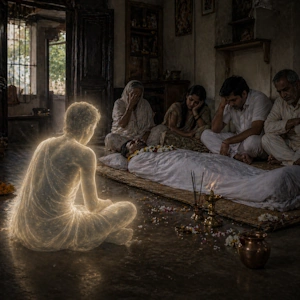
People assume death rites are optional.
They see them as cultural.
They see them as emotional.
They see them as something that can be skipped if inconvenient.
This assumption comes from a simple place.
Death is uncomfortable.
So the rituals around it get treated as formality.
Something to get through.
Something to scale down.
Something to modernize away.
That assumption is wrong.
Death rites are not decoration.
They are part of a system.
When a person dies, the body ends.
But the journey does not.
There is a transition phase.
That phase is sensitive.
It is structured.
It depends on support.
That support is what death rites provide.
Understand this clearly.
If rites are done properly, the transition is supported.
If they are done casually, support becomes weak.
If they are not done at all, the system does not stop.
It continues.
But without assistance.
That is where the problem begins.
The being that has just left the body is not stable.
It is not fully settled.
It exists in between.
It is not in the physical world.
It is not yet fully established in the next stage.
In this condition, it requires guidance.
It requires nourishment.
It requires structure.
Death rites provide all three.
Now remove them.
What happens?
First, confusion increases.
The being does not clearly understand what has happened.
It tries to relate to the old body.
It tries to connect to familiar people.
Nothing responds.
This creates disturbance.
Second, lack of nourishment begins.
After death, the being no longer has a physical body.
It exists in a subtle state.
It operates through a finer layer of existence.
It still has needs.
But it cannot meet them physically.
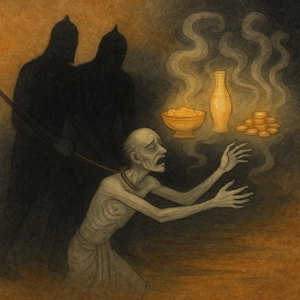
It depends on subtle support sent through proper offering.
If that offering is not made, the support does not reach.
So the being remains in a state of lack.
It remains hungry.
It remains restless.
It remains unsettled.
Third, stabilization gets delayed.
The subtle body formation process does not get proper support.
So the being remains incomplete.
It is not fully equipped for the next phase.
This creates friction in the journey.
Fourth, attachment does not reduce.
Rites are designed to create closure.
They work for the living.
They work for the departed.
If they are skipped, attachment continues without resolution.
The being keeps turning back.
It keeps trying to reconnect.
This leads to stagnation.
Understand something important here.
This is not punishment.
This is consequence of absence.
If a system requires steps and those steps are not performed, the result does not complete.
Now consider another layer.
Improper performance also affects the result.
Rituals done mechanically lack attention.
Rituals done casually lack correctness.
In such cases, partial effect happens.
Not zero.
But not full.
The process exists in precise form for a reason.
When steps are skipped or done without care, the conversion from physical offering to subtle support does not complete properly.
The being receives less than what the rite was designed to deliver.
That is why precision matters.
Now look at the larger impact.
The issue is not only about the departed.
It also affects the living.
When a transition is left incomplete, the connection does not close cleanly.
An unresolved thread remains.
That imbalance shows up in the family.
It shows up in the environment.
It shows up in daily life in subtle ways.
This is why traditions insist on completion.
Not for fear.
For stability.
Now bring this into modern thinking.
Many people say they will do something simple.
They say they will just remember the departed.
They say they will not follow full procedure.
Emotion is not the same as process.
Feeling respect is internal.
It stays within you.
Performing the rite is external.
It produces a result in a system.
One does not replace the other.
If a system exists, it must be engaged correctly.
Otherwise, outcomes change.
Understand the core point.
Death rites are not about formality.
They are about ensuring that a difficult transition is handled properly.
Skipping them does not stop the journey.
It only removes support.
When support is removed, difficulty increases.
So the real question is not whether you believe in it.
The real question is whether you understand the role it plays.
Once you see it clearly, this is not tradition.
This is responsibility.
Responsibility does not become optional because it is inconvenient.
Question: What is the biggest mistake people make after someone dies?
Answer: They assume nothing urgent is happening, when in reality the most critical transition phase has just begun.
Question: Why do rituals focus so much on the first 10 days?
Answer: Because that is when the being is most unstable and most dependent on support from the living.
Question: What is the most ignored truth about death rites?
Answer: That they are not about respect but about survival support in a different state of existence.
Question: Why does the system not wait until the family is ready?
Answer: Because the transition does not pause for emotions, it follows its own timing.
Question: What happens if rituals are delayed?
Answer: Support reaches late, which means the being has already passed through part of the journey without assistance.
Question: Why do people underestimate these rituals?
Answer: Because they judge them using visible logic, while the process operates in a subtle layer.
Question: What is the hidden cost of skipping rituals?
Answer: Not immediate punishment, but prolonged instability and unresolved transition.
Question: Why is correct method more important than intention alone?
Answer: Because intention initiates the process, but method completes the conversion into usable support.
Question: What is the most unsettling part of this system?
Answer: That it continues exactly as designed whether you participate or not.
Question: What makes this knowledge powerful?
Answer: It shifts the view of death from an ending to an active phase that requires responsibility.
Objection: This sounds outdated in modern times.
Reply: Time does not change structure, it only changes perception.
Objection: People used to believe many things that are no longer valid.
Reply: What fades is blind belief, not structured systems that continue to show consistent logic.
Objection: Why would a system depend on rituals done by others?
Reply: Because interdependence is built into existence, even in life no one functions fully in isolation.
Objection: This feels like unnecessary pressure on families.
Reply: It is not pressure, it is clarity about responsibility during a critical phase.
Objection: If something is real, it should work automatically.
Reply: Many real systems require correct input to produce results.
Objection: I have seen people skip rituals and nothing happened.
Reply: Not all effects are immediate or visible, especially when they belong to subtle processes.
Objection: This creates fear around death.
Reply: It removes confusion by showing structure, and clarity is not fear.
Objection: Why not simplify everything to just prayer?
Reply: Prayer is one component, but the system includes specific actions designed for specific outcomes.
Objection: Different families follow different practices.
Reply: Variation in form does not cancel the core requirement of structured support.
Objection: This is too complex to follow strictly.
Reply: Complexity does not remove necessity, it only demands better understanding.





English
Garuda Puranam
Click on any topic to open
7
30
Astrology
Bhagavad Gita
Bhagavatam
Bharat Matha
Devi
Devi Mahatmyam
Ganapathy
Garuda Puranam
Glory of Venkatesha
Hanuman
Kathopanishad
Mahabharatam
Mantra Shastra
Mystique
Practical Wisdom
Purana Stories
Radhe Radhe
Ramayana
Rare Topics
Rigveda Explained
Rituals
Sages and Saints
Shiva
Spiritual books
Sri Suktam
Story of Sri Yantra
Temples
Vedas
Vishnu Sahasranama
Yoga Vasishta
26
17
10
0


