First 10 Days After Death
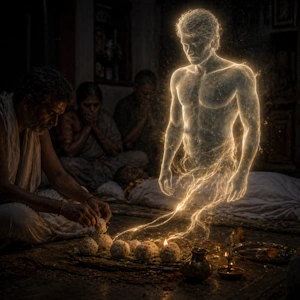
This is one of the most misunderstood parts of death.
People think the body ends and nothing replaces it.
That is not correct.
The physical body ends.
But a new form begins.
It is not a flesh body.
It is a subtle body.
This is the vehicle through which the being continues its journey.
Now understand this clearly.
This subtle body is not instantly ready.
It is formed gradually.
It is formed step by step.
This is where something very precise happens.
The texts describe that this formation is supported by Pinda Daan.
It happens day by day.
It is not random.
It is not symbolic.
It is systematic.
Each day's offering supports one stage of formation.
Now see how exact this is.
Days one through three support the upper structure.
The head forms first.
Then the neck and shoulders.
Then the heart begins to take shape.
Days four through six establish the middle.
The back is supported.
Then the navel region.
Then the lower parts.
Days seven through nine complete the foundation.
The thighs take form.
The knees are supported.
The feet are formed.
On the tenth day, something critical happens.
Hunger and thirst fully arise.
Now pause and understand this.
This is not anatomy in the physical sense.
There are no bones.
There are no muscles.
There are no organs as you know them.
This is functional formation.
It is a subtle structure that allows experience.
It is a framework through which the being can feel.
It can perceive.
It can move.
It can suffer.
Without this, the journey cannot proceed properly.
Now see the deeper logic.
While alive, your physical body was already built.
After death, that support is gone.
So a new support system must form.
That is what this process is.
Understand this carefully.
This formation is not independent.
It is assisted.
The offerings made by the living act as the raw material.
They do not act in gross form.
They act in subtle essence.
Each pinda is converted.
It is transformed.
It is used to support this gradual formation.
That is why the sequence matters.
That is why continuity matters.
If the sequence is broken, formation becomes incomplete.
Now understand the consequence.
If proper offerings are made, the subtle body stabilizes.
The being becomes capable of continuing its journey.
If offerings are weak or missing, the formation remains unstable.
The being becomes incomplete.
It is not fully formed.
It is not fully supported.
This creates difficulty in the next stages.
Now hold one more detail.
This subtle body is not permanent.
It is transitional.
It exists only for the journey phase.
Once its purpose is complete, it is no longer required.
But during this phase, it is essential.
Now understand the precision of this system.
There is day by day formation.
There is specific support.
There is defined sequence.
Nothing here is random.
This is not poetic imagination.
This is structured explanation.
Now see why this knowledge is rarely understood.
People reduce rituals to emotion.
They do not see the mechanism behind it.
They perform without understanding.
Or they reject without studying.
Both lead to the same loss.
Ignorance of process.
Now bring this into clarity.
Pinda Daan is not offering food to memory.
It is contributing to formation.
You are not feeding a past identity.
You are supporting a present transition.
This is why this knowledge matters.
It is not just information.
It is responsibility.
If you know that a being is in the middle of a journey,
and that the journey depends on what the living do,
then performing this correctly is no longer tradition.
It becomes care.
It becomes active.
It becomes precise.
Now understand the deeper point.
After death, there is construction.
There is not destruction.
A new structure is built to carry forward what already exists within.
So the real question is not whether this happens.
The real question is whether the formation is supported properly.
Because that decides how the next phase unfolds.
Simple.
Exact.
Critical.
Now you know why.
Question: What is the most hidden principle behind Shraddha and Pinda Daan?
Answer: That the living are not just remembering the departed but actively participating in their transition, making the relationship functional even after death.
Question: Why is the idea of a ‘subtle body’ so critical to understand this process?
Answer: Because without understanding that the being continues in a different functional state with real needs, the entire logic of nourishment and support appears meaningless.
Question: What is the real significance of the day-by-day body formation described in the texts?
Answer: It reveals that post-death is not a sudden shift but a structured rebuilding phase where continuity depends on precise external support.
Question: What is the mysterious part people usually overlook in these rituals?
Answer: The conversion mechanism, where physical offerings are transformed into subtle essence through mantra and process, making the unseen exchange possible.
Question: What makes this system powerful beyond belief?
Answer: Its precision, where every step, timing, and method directly influences the condition of the being in transition, showing a complete and ordered design.
Objection: This sounds like imagination without evidence.
Reply: The system is described with consistent structure and internal logic, which is a hallmark of an organized framework rather than random invention.
Objection: Why should the living affect the condition of the dead?
Reply: Because the connection does not end at death, and interdependence continues in a different form within the same system.
Objection: If this is real, everyone would experience the same thing.
Reply: The system is uniform in structure but not in experience, as each being carries its own internal state into the journey.
Objection: This feels like unnecessary ritual complexity.
Reply: Complexity exists because the process itself is precise, and simplification without understanding reduces effectiveness.
Objection: Remembering with sincerity should be enough.
Reply: Sincerity is internal, but the system operates through defined actions that produce measurable effects within its own framework.





English
Garuda Puranam
Click on any topic to open
7
30
Astrology
Bhagavad Gita
Bhagavatam
Bharat Matha
Devi
Devi Mahatmyam
Ganapathy
Garuda Puranam
Glory of Venkatesha
Hanuman
Kathopanishad
Mahabharatam
Mantra Shastra
Mystique
Practical Wisdom
Purana Stories
Radhe Radhe
Ramayana
Rare Topics
Rigveda Explained
Rituals
Sages and Saints
Shiva
Spiritual books
Sri Suktam
Story of Sri Yantra
Temples
Vedas
Vishnu Sahasranama
Yoga Vasishta
26
17
10
0


