What Happened to Amba, Ambika, and Ambalika?
King Shantanu was dead. His son Bhishma, bound by his oath of celibacy, refused to marry. But the Kuru throne needed heirs. So the burden of securing the dynasty fell on Bhishma's shoulders — not through marriage, but by arranging one for his stepbrother Vichitravirya, the young, throne-worthy but weak king.
The king of Kashi announced a swayamvara — a ceremony where his three daughters, Amba, Ambika, and Ambalika, would choose their husbands. But he didn't invite Hastinapura. Big insult.
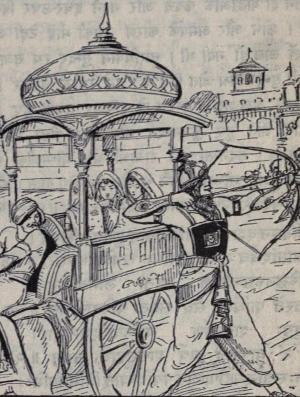
Bhishma didn’t take that lightly. He stormed into the swayamvara uninvited, in full warrior mode, defeated all assembled kings, and abducted all three princesses in a single chariot — a power move meant to secure brides for his stepbrother.
On the way back, Amba speaks up: she had already chosen King Salva, and they were in love. Bhishma, bound by dharma, immediately sent her to Salva, saying she was free to go.
But Salva — wounded in pride after being defeated by Bhishma — refused to accept her now that she had been 'won' by another man.
Rejected by both Salva and Bhishma, Amba was humiliated and furious. Her sorrow turned into rage.
Bhishma went ahead and married off Ambika and Ambalika to Vichitravirya.
But Amba? She vowed revenge on Bhishma for destroying her life. She wandered, pleaded, meditated, and finally got a boon from Lord Shiva — she would be the cause of Bhishma’s death.
She was reborn as Shikhandi, a woman raised as a man, who would one day stand on the battlefield of Kurukshetra and bring about Bhishma’s fall.
After Bhishma brought them to Hastinapura, both Ambika and Ambalika were married to Vichitravirya, the young Kuru king. The idea was simple: secure the royal lineage.
But things didn’t go as planned.
Vichitravirya was weak in health and died young, without fathering any children. This put the Kuru dynasty in a deep succession crisis. No heirs, no stability, no future.
Satyavati, the queen mother, had a solution from tradition: Niyoga — a practice where a learned sage could father children with a widow of royal blood to continue the lineage.
She summoned her own son from before her marriage — Vyasa, the great sage.
He agreed, but under one condition: the women must not recoil at his appearance, since he was unkempt from years of penance and tapas.
Ambika was sent first. But she closed her eyes in fear the moment she saw Vyasa.
As a result, her son, Dhritarashtra, was born blind.
Next came Ambalika. She didn't close her eyes, but turned pale with fright.
So her son, Pandu, was born with a pale complexion and poor health.
To try again for a healthy heir, Ambika was sent once more — but this time she secretly sent her maid instead.
The maid treated Vyasa with respect and calmness.
That son was Vidura — wise, dharmic, and sharp-minded — but since he was born to a maid, he wasn’t considered for the throne.
So in summary:
- Ambika became the mother of Dhritarashtra (blind).
- Ambalika became the mother of Pandu (pale and weak).
- A maid gave birth to Vidura (wise but disqualified).
Each of these children became crucial players in the Mahabharata — and it all began with Bhishma’s single act of abduction at the swayamvara.






English
Rare Topics
Click on any topic to open
7
30
Astrology
Bhagavad Gita
Bhagavatam
Bharat Matha
Devi
Devi Mahatmyam
Ganapathy
Garuda Puranam
Glory of Venkatesha
Hanuman
Kathopanishad
Mahabharatam
Mantra Shastra
Mystique
Practical Wisdom
Purana Stories
Radhe Radhe
Ramayana
Rare Topics
Rigveda Explained
Rituals
Sages and Saints
Shiva
Spiritual books
Sri Suktam
Story of Sri Yantra
Temples
Vedas
Vishnu Sahasranama
Yoga Vasishta
26
17
10
0


