What Are the Three Gunas?
Every now and then we talk about satva, rajas, tamo gunas. What are these?
Guna does not mean merit. It means only characteristic. Guna does not mean it is desirable or something good.
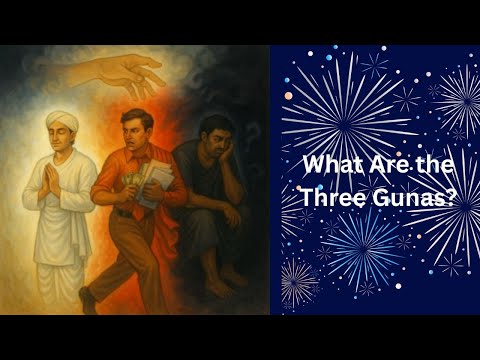
Satva guna means — wherever you find simplicity, honesty, cleanliness, faith, trust, patience, tolerance, courage, mercy, kindness, self-awareness (knowing one’s own limits), peace, righteousness — satva guna is prominent. It is symbolized by the color white.
Rajo guna means — mode of creation, to create something that is not there. It is associated with many things — competition, envy, anxiety, stress, dissatisfaction, ambition, impatience, lack of concern for others, fatigue arising out of overwork. Wherever you see these, understand that rajo guna is prominent there.
Tamo guna means — laziness, ignorance, oversleep, fear, anger, depression, skepticism, atheism. Wherever you see these, understand that tamo guna is prominent there.
Satva guna is a state of tranquility.
Rajo guna is a state of dynamism.
And tamo guna is a state of inertia.
Going back — Sri Hari wanted to multiply. For this, He created maya shakti — maya shakti comprising of satva, rajas, tamo gunas along with materials, awareness, and action.
Then He imposes upon Himself time, nature, and action.
Time agitated the three gunas.
Nature transformed them.
And action gave birth to mahat tatva.
This transformation happens in stages —
An agitation resulting in another state.
Again an agitation — another stage.
The fact of the matter is that none of these stages can be permanent.
It is like changing jobs.
You join a new job because you were not happy with your earlier job.
Now in the new job, for a few days or weeks or months, things are fine.
Then you develop a discomfort — this is not right, that is not good, he is not good, she is not good, I am underpaid, I am doing the whole work.
You are agitated and you want to change your job again.
Another job. Then after some time, the same agitation — you want to change again.
This is what is inherent in the saguna world.
It can never be permanent.
That is why we say it is not shashwata. It cannot be stable.
These agitations keep on happening, and everything keeps on changing.
The whole insentient world is born out of a series of agitations — how can it be stable?
We have reached up to creation of mahat tatva.
Now, the same tools of Sri Hari — materials, knowledge, and action — agitate mahat tatva.
Out of mahat tatva is born ahamkara.
Now, ahamkara has got three components — each one related to one of the tools that agitated mahat tatva and created ahamkara:
-
Vaikarika — associated with knowledge
-
Taijasa — associated with action
-
Tamasa — associated with materials
Now, out of tamasa is born the material worlds.
The pancha bhutas are the components of material world.
Like how cement, bricks, wood, tiles make a building —
The pancha bhutas in various combinations, in varying proportions, make the material world.
They are akasha, vayu, agni, jala, and prithivi — ether, air, fire, water, and earth.
Here, if you see — it is a process of progressive solidification, becoming denser and denser.
Air is denser than ether.
Fire is denser than air.
Water is denser than fire.
And earth is denser than water.
Earth means solid state.
Up to here, the tamasa state of ahamkara, which came from mahat tatva, which came from the satva-rajas-tamo gunas, upon being acted upon at every stage by time, nature, and action — is the source of pancha bhutas.
Tamasa ahamkara got agitated — akasha (ether) was born.
Consider this agitation and a new thing taking birth out of it similar to churning curd and butter coming out of it.
Akasha is associated with sound and hearing.
Production of sound, its transmission, its reception — they are all associated with the bhuta called akasha (ether).
Then time, nature, and action worked upon akasha — vayu was the result.





English
Vishnu Sahasranama
Click on any topic to open
7
30
Astrology
Bhagavad Gita
Bhagavatam
Bharat Matha
Devi
Devi Mahatmyam
Ganapathy
Garuda Puranam
Glory of Venkatesha
Hanuman
Kathopanishad
Mahabharatam
Mantra Shastra
Mystique
Practical Wisdom
Purana Stories
Radhe Radhe
Ramayana
Rare Topics
Rigveda Explained
Rituals
Sages and Saints
Shiva
Spiritual books
Sri Suktam
Story of Sri Yantra
Temples
Vedas
Vishnu Sahasranama
Yoga Vasishta
26
17
10
0


