Interesting Facts About Panchabhuta
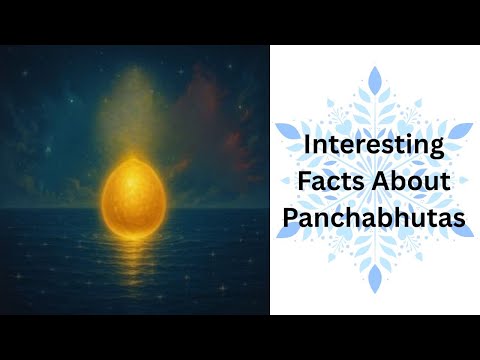
Vayu’s primary association is with touch.
Vayu is not ether (Akasha) completely transformed into something else. Vayu contains the property of Akasha also — that is, sound — and a new thing called touch. That means Vayu is associated with both sound and touch.
You can feel a wind blowing on your skin. You can also feel sound on your skin. When sound waves reach the membrane in the ear, you are able to hear. That membrane is skin. It responds to sound vibrations.
Vayu is associated with both sound and touch. Vayu can also transmit sound.
When Vayu was agitated, Agni (fire) was born.
Agni is primarily associated with vision. You are able to see because of light, brilliance — that is called Agni, not just the physical fire which burns. Anything that emanates light is Agni, fire.
Agni is connected to sound, touch, and vision.
When Agni got agitated, water (Jalam) was born.
Primary quality of water is taste. But it is also connected to sound, touch, and vision.
When water was agitated, earth (Prithvi) was born.
Quality of Prithvi is smell, and it also contains qualities of all the four elements preceding it — sound, touch, vision, and smell.
We spoke about three divisions of Ahamkara — Vaikarika, Taijasa, and Tamasa.
From Tamasa came the Panchabhutas.
From Vaikarika Ahamkara, which is related to knowledge, took birth the mind and the ten governing deities of the five Jnanendriyas and five Karmendriyas.
Jnanendriyas are — ears, skin, eyes, tongue, and nose.
Karmendriyas are — speech organs, hands, legs, excretory organs, and genitals.
The ten governing deities for these are:
The Dishas (directions), Vayu, Surya, Varuna, Ashwini Kumaras, Agni, Indra, Vishnu, Mitra, and Prajapati.
The third type of Ahamkara, called Taijasa Ahamkara, gives birth to the five Karmendriyas and the five Jnanendriyas.
Buddhi (intelligence) and the vital forces called Pranas also took birth out of the agitation of Taijasa Ahamkara.
So now we have:
-
The Panchabhutas
-
The mind
-
Five Jnanendriyas
-
Five Karmendriyas
-
Their governing deities
-
Intelligence
-
The Pranas
All these components were acting independently; they were not coming together.
Sri Hari again, with His Maya Shakti, made them mix and mingle together in varying proportions.
This is why He got the name Vaikuntha — which we will see later.
They are related with each other as cause and effect — that is their mutual relationship.
When they all came together, it took the form of an egg called Brahmanda.
And this egg remained in causal water, pralayic waters, for 1000 divine years.
Bhagawan, after 1000 years, again made time, nature, and action work upon this egg, and it broke open.
Out came Virat Purusha.
Virat Purusha had innumerable hands, legs, eyes, faces, and heads.
All the worlds — every moving and non-moving object, everything with and without life — they were all there in the Virat Purusha.
-
Bhuloka is at the feet of the Virat Purusha
-
Bhuvarloka at His nabhi (navel)
-
Svarloka at His heart, middle of His chest
-
Maholoka at His shoulders
-
Janaloka at His neck
-
Tapoloka at His chest, the two sides of the chest
-
Satyaloka at His head
These are the seven worlds above.
Then the seven worlds below — the netherworlds (Patalas):
-
Waist – Atala
-
Thighs – Vitala
-
Knees – Sutala
-
Between the knees and ankles – Talatala
-
Ankles – Mahatala
-
Toes – Rasatala
-
Under the feet – Patala
One thing that should be borne in mind is that the Virat Purusha is still within the realm of Maya and it is a saguna aspect of Sri Hari.
The 14 worlds — starting from the bottom (Patala) and ending in Satyaloka at the top — are just parts or organs of His gross body.





English
Vishnu Sahasranama
Click on any topic to open
7
30
Astrology
Bhagavad Gita
Bhagavatam
Bharat Matha
Devi
Devi Mahatmyam
Ganapathy
Garuda Puranam
Glory of Venkatesha
Hanuman
Kathopanishad
Mahabharatam
Mantra Shastra
Mystique
Practical Wisdom
Purana Stories
Radhe Radhe
Ramayana
Rare Topics
Rigveda Explained
Rituals
Sages and Saints
Shiva
Spiritual books
Sri Suktam
Story of Sri Yantra
Temples
Vedas
Vishnu Sahasranama
Yoga Vasishta
26
17
10
0


