What Are The Benefits Of Doing Puja?

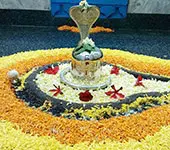
We will now see about Parthiva Moorthy Pujanam — idols made of clay.
Of course, this idol is not for long-term use. It is meant for a single puja or for a few days, like how it is done for 10 days during Vinayaka Chaturthi, from Chaturthi to Ananta Chaturdashi.
If you don’t have the wherewithal for everyday puja and want to do it on special occasions such as Shivaratri, then this is a good option. Because you don’t have to keep the idol permanently and take care of it.
In both chala and sthira forms of installation of the idol, the idol is permanent. The only difference is that in chala you can move it about; in sthira it is fixed to the peetah.
Clay idols — visarjana is performed after the puja is over. What is the meaning of visarjana?
Sarjana is making.
Visarjana is the opposite of that.
After the puja is over, you can put the idol in clean waterbodies, river or the sea. Why clay? Because clay will dissolve in water.
Shiva Purana specifically says that both men and women have got the right to perform puja on idols made of clay:
पुरुषाणां च नारीणां अधिकारोऽत्र निश्चितम्
Which are the devatas whose Parthiva Murthy can be made? Ganesha, Vishnu, Surya, Shiva and Devi. In the case of Shiva, you can make either an idol or a linga.
The clay should be collected from the bottom of a river, lake or pond. It should be well ground and purified by adding chandana powder to it. Milk should be mixed while preparing the clay.
In the case of idols, all the organs and the ayudhas also should be properly made.
The Parthiva Murthy or Linga should also be worshiped with the sixteen upacharas.
Cooked rice is the naivedyam always for Parthiva Murthy.
Now Shiva Purana talks about the quantity of naivedya.
At home, the quantity is 1.25 litres. That means your naivedya patra should measure 1.25 litres, and it should be full with naivedya.
At a temple where the linga is installed by humans, it should be 5 litres.
At a temple where installation has been done by Devas, it should be 15 litres.
At a temple where the linga is swayambhu — then it is 25 litres.
This is the volume of the vessel in which naivedya is offered.
Wherever the puja is done, if the performer of the puja does it 1000 times, then he will surely attain Satya Loka, the highest loka.
When you are doing abhisheka — say with water or any other dravya such as oil:
-
For linga installed by humans, the quantity is 50 litres.
-
For linga installed by rishis, the quantity is 500 litres.
-
It is the same for those installed by Devas also.
-
For swayambhu linga, it is 5000 litres.
All these can be two times or three times also — like naivedya at home can be 3 or 4.5 litres also.
For linga installed by rishis, abhisheka can be 1000 litres or 1500 litres.
In some Shiva temples, Sahasra Kalasha Abhisheka is done. This is the principle behind it.
Abhisheka purifies the performer.
The ill effects of all past deeds — they go.
When you do abhisheka on the idol or linga, this is what happens with you also. Abhisheka is basically bathing, right? Bathing purifies — externally and eternally.
You may not be able to take bath in punya nadis such as Ganga every day. Instead, you can do abhisheka. It will give the same result.
When you offer chandana to Bhagavan, it adds to your punya.
Removal of papa is removal of negative.
Gaining punya is gaining positive.
You have a car unused for years. It has rusted. Tyres are deflated.
Now you clean it up, get it repaired, make it fit.
This is removing the negative — like removal of papa.
It is these defects that prevent the car from moving.
Now this is not sufficient. If you want to take out the car, go somewhere, then you have to fill petrol.
This is gaining of punya.
Both are required.
By abhisheka — papa gets removed.
By applying chandana — punya is gained.
Naivedya gives long life.
Offering of dhupa gives wealth.
Offering lamp (deepa) gives knowledge.
Offering tamboola gives all kinds of enjoyments.
These six are very important in shodasha upachara puja.
If you want both worldly enjoyments and moksha — complete freedom — then do japa and namaskara at the end of puja. Japa can be mantra or stotra. It will fulfill all your desires.
But always do mental worship — the manasa puja — before you do physical worship (bahya puja).
Manasa puja means visualizing that you are offering jala, chandana, flowers, dhupa, deepa and naivedya.





English
Shiva
Click on any topic to open
7
30
Astrology
Bhagavad Gita
Bhagavatam
Bharat Matha
Devi
Devi Mahatmyam
Ganapathy
Garuda Puranam
Glory of Venkatesha
Hanuman
Kathopanishad
Mahabharatam
Mantra Shastra
Mystique
Practical Wisdom
Purana Stories
Radhe Radhe
Ramayana
Rare Topics
Rigveda Explained
Rituals
Sages and Saints
Shiva
Spiritual books
Sri Suktam
Story of Sri Yantra
Temples
Vedas
Vishnu Sahasranama
Yoga Vasishta
26
17
10
0


