Was Krishna a Historical Person, a God, or Both at Once?
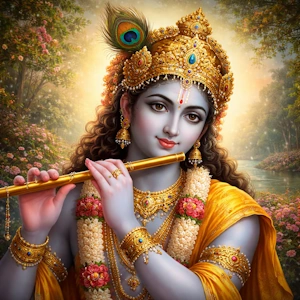
Was Krishna a historical person, a god, or both at once?
This is one of the most fascinating questions in all of Indian thought. Let us walk through it carefully.
- First, understand what the question is really asking
When we ask was Krishna historical, we mean: did a real person named Krishna walk the earth, live in Mathura and Dwarka, fight in a war, and speak the Gita?
When we ask was he a god, we mean: was he a divine being who descended from another plane of existence?
And when we ask both at once, we are asking something much deeper. Can a single being be fully human and fully divine at the same time?
This third option is actually what most serious Hindu traditions hold. And it is the most interesting one to explore.
- The historical evidence
There is real evidence that Krishna was a historical figure.
The Mahabharata is one of the longest epics ever written. It contains enormous amounts of geographical, political, and genealogical detail. Krishna's kingdom of Dwarka is mentioned with specific details about its location on the western coast of India.
In the 1980s and again in 2002, marine archaeologists discovered submerged structures off the coast of Dwarka in Gujarat. These structures show signs of a large ancient settlement. The dating is still debated, but the location matches the descriptions in the texts almost exactly.
The Greek ambassador Megasthenes, who visited India around 300 BCE, recorded that people in the region worshipped a god called Herakles, which many historians believe was a reference to Krishna or a figure closely associated with him. This is an outside record, not an Indian one.
Many scholars today, including historians like N.S. Rajaram and archaeologists working on the Saraswati River research, place Krishna's life somewhere between 3200 BCE and 1500 BCE based on astronomical references in the Mahabharata.
So there is a genuine case for a historical Krishna.
- The theological claim
Now look at the other side.
The Bhagavata Purana, one of the most important Sanskrit texts, makes an extraordinary claim. It says Krishna is not simply an avatar, a descent of Vishnu. It says Krishna is the source from which even Vishnu emerges. The exact phrase used is Svayam Bhagavan, God himself, in person.
This is a very specific and strong claim. It does not say Krishna was a great saint. It does not say he was a prophet. It says he was the original, complete, unlimited divine being who chose to appear in human form.
The Gita itself supports this. Krishna says I have taken birth in many ages. I remember all of them. You do not remember yours. He is speaking as someone outside of time, looking into it.
- The both at once position and why it matters
Here is what most Vaishnava traditions actually teach.
Krishna was simultaneously and completely both. Not half human and half divine. Not human on the outside and divine on the inside. Fully human. Fully divine. At the same time.
This is called the doctrine of Avatara. The word avatar means descent. It does not mean disguise. God did not pretend to be human. He actually entered human experience, felt hunger, friendship, love, loss, while remaining fully himself underneath.
This is why the stories show Krishna doing very human things. He plays pranks as a child. He has a favourite friend in Sudama. He feels something when he leaves Vrindavan. He sits quietly as a charioteer.
And yet in the same life, he shows Arjuna the entire universe inside his mouth as a baby. He speaks as if he created time itself. He is present in all places at once during the Rasa Leela.
The human moments make him accessible. The divine moments reveal what is actually there beneath the surface.
- What modern scholarship says
Academic historians tend to separate the layers. They say there may have been a real tribal chief or king named Krishna who lived in northwestern India thousands of years ago. Over centuries, stories, myths, and spiritual teachings were gathered around this figure until he became what we see in the texts today.
This is a reasonable scholarly position. But it does not fully satisfy the question either. Because the Gita is not the kind of text that gets assembled by accident around a minor tribal king. Its philosophy is too precise, too internally consistent, and too deep for that explanation to be complete.
- The deeper point
Here is what this question is really pointing at.
The question of whether Krishna was historical or divine assumes these two things cannot go together. That history and divinity are separate categories.
But Indian thought has always held a different view. It says that the divine does not stay separate from the world. It enters the world. It takes form. It walks in time. And when it does, it looks like a person, but it carries something that a person alone cannot carry.
Krishna is the most complete example of this idea in the entire tradition.
Takeaway
The honest answer is this. There is enough evidence to take seriously the idea that a person named Krishna existed. There is enough philosophical depth in the texts to take seriously the claim that he was divine. And the tradition itself insists you do not have to choose between the two. The mystery is not that one of these is true. The mystery is that both can be true at the same time, and that this is precisely the point his life is making.
Question 1. If Krishna was fully divine, why did he bother living a human life at all?
Because a message alone does not change anyone. A life does. Krishna lived every aspect of human experience first. He was born in a prison. He was a cowherd. He loved and lost. He navigated war and politics. He watched his own clan destroy itself. He died alone in a forest. This was not background to one central speech. This was the purpose itself. Wisdom that has not been lived is just information. Krishna demonstrated that the divine does not teach from outside human experience. It enters it completely and teaches from deep inside it.
Question 2. What does it mean that Krishna remembered all his past lives while humans forget theirs?
In the Gita, Krishna tells Arjuna that both of them have lived many lives. He remembers all of them. Arjuna does not. This points to a specific idea about consciousness. Ordinary human consciousness lives inside one body, one time, one set of memories. Krishna's consciousness does not live inside time. It observes time from outside. When you are inside a river, the current controls you. When you stand on the bank, you can see the whole river. Krishna is always standing on the bank, even when he appears to be swimming in the current. This is the secret of his unshakeable calmness. It is not that he does not feel. It is that he sees from a perspective so wide that nothing can collapse him.
Question 3. Why did Krishna choose to be born inside a prison?
Kamsa had imprisoned Krishna's parents and posted guards. He thought this made the birth of his enemy impossible. Krishna was born in that exact cell. The thing that is truly divine cannot be contained by any human structure. Not a prison. Not a political system. Not a set of rules designed to prevent it from entering the world. Kamsa represents the ego-driven mind that fears the arrival of something greater than itself. It builds walls and locks the doors. And yet the very thing it fears is born inside those walls. The thing meant to liberate people always appears first in the place where liberation seems most impossible.
Question 4. Krishna performed miracles as an infant before he could walk. What does this tell us about divine power?
Most traditions place a teacher's authority in their maturity. Authority is earned through time and discipline. But Krishna shows supernatural awareness from his very first breath. What this communicates is that divine power is not something that develops over time through practice. It is not acquired. It is simply what is already there when the covering of ordinary human limitation is thin or absent. A child's consciousness has not yet built the walls that adult thinking builds. A divine child's consciousness has no walls at all. Krishna's childhood miracles are not entertainment. They are a teaching about what is available when the mind is fully open.
Question 5. Krishna was a king, a husband to many, a warrior, a philosopher, and a cowherd. How can one being contain so many different identities?
This is the secret teaching hidden inside his biography. Identity is a costume, not a cage. Krishna plays each role fully. When he is with Sudama his poor childhood friend, he is completely present as a friend with no trace of kingship. When he is a charioteer for Arjuna, he is completely present as a servant. When he speaks the Gita, he is completely present as the absolute. A truly free being is not confined by any single identity. The ordinary human being becomes trapped in one role and forgets everything else. The fully realized being can wear any identity completely and remove it just as completely.
Question 6. What is the hidden secret in the fact that Krishna served as Arjuna's charioteer?
Krishna was the most powerful being on the field. He could have ended the war in one moment. Instead he sat in the driver's seat and held the reins of four horses. He chose the position of a servant voluntarily and without any reduction in who he actually was. True greatness has no need to display itself. The person who needs to be seen as powerful is not yet powerful. The one who is completely secure in what they are can sit in the lowest seat without feeling diminished. A true teacher does not replace the student's journey. They hold the conditions stable so the student can find their own way through. The divine in its full power chose to serve. Not because it had to. But because in that context, service was the highest expression of love available.
Question 7. Why does the tradition say that simply hearing Krishna's name has power?
In Indian thought, sound is not just vibration in the air. Sound is considered the subtlest form of matter. Before anything takes physical form, it first exists as a sound or vibration. This is why the concept of Nada Brahma exists, the idea that the universe itself emerged from primordial sound. A name is not just a label. It is a condensed form of everything that person is. When millions of people repeat a name across thousands of years with complete devotion, something accumulates around that name. A field of meaning, memory, and longing that goes beyond any individual repetition of it. This is why hearing Krishna's name in the right setting does not feel like information entering your mind. It feels like something being recognized that was already there.
Question 8. Krishna's most devoted followers were simple cowherd women, not priests or scholars. What is the secret teaching inside this fact?
The Gopis did not think about Krishna. They did not analyse him. They did not construct philosophical frameworks around him. They simply loved him completely, without condition, without expectation, without any agenda. The priest approaches the divine with ritual. The philosopher approaches it with thought. The saint approaches it with discipline. All of these involve the self managing its relationship with the divine, which means the self is still in the centre. The Gopis had no self in the centre. There was only Krishna. The divine is not impressed by your knowledge or your discipline. It is moved by the quality of your longing. A simple heart that burns completely is closer to the truth than a sophisticated mind that understands it from a distance.
Question 9. Why did Krishna leave Vrindavan and never return?
The separation was the deepest form of grace Krishna could have given them. In his physical presence, the love had a direction, an object, a destination. When he left, the love had nowhere to go except inward. It had no choice but to become absolute. Radha's love after Krishna's departure is described as purer than her love during his presence. Because it was no longer about seeing him or being with him. It became about being him. She dissolved so completely into her love that the boundary between lover and beloved disappeared. Sometimes the greatest gift a teacher can give is their absence. Because absence forces the student to find inside themselves what they were seeking outside.
Question 10. The Mahabharata says Kali Yuga began the moment Krishna left the earth. What does this tell us about what he actually was?
As long as Krishna was physically present on earth, Kali Yuga could not begin. His presence held it back. The moment he departed, the darkness entered. This is an extraordinary statement. It is not saying that Krishna was a great man whose teachings kept people morally steady. It is saying that his physical presence had a direct effect on the quality of consciousness available on earth. He was not a teacher who left behind good ideas. He was a field. A living condition. And when that field withdrew, the quality of human experience changed at its root. We are, according to this view, currently living in the experience of that absence. And this is precisely why his story continues to pull people toward it across thousands of years. Something in the human being recognizes what is missing.
Objection 1. Krishna is just a mythological character. There is no archaeological or historical proof he existed.
Reply. This objection assumes that absence of proof is proof of absence. That is a logical error. The historical records from ancient India were primarily oral. The absence of a stone inscription does not mean a person did not exist. The submerged structures found off the coast of Dwarka in Gujarat are real and documented. The Marine Archaeology Unit of India has conducted multiple expeditions and found structures that match the geographical descriptions in the Mahabharata. The astronomical references inside the Mahabharata, when calculated using modern software, point to specific dates that place the war around 3100 BCE. These include precise positions of planets, eclipses, and star alignments. The honest scholarly position is not that Krishna definitely did not exist. It is that we do not yet have complete evidence either way. That is a very different statement.
Objection 2. The miracles attributed to Krishna are physically impossible. These are fairy tales.
Reply. This objection applies the laws of ordinary matter to something the tradition explicitly says operates outside those laws. The question is not whether these events are possible within Newtonian physics. The question is whether Newtonian physics is complete enough to describe all of reality. Modern quantum physics has already demonstrated that matter behaves in ways that would have been called impossible two hundred years ago. Particles exist in multiple places simultaneously. Observation changes what is observed. The tradition does not ask you to believe these events happened the way a rock falls. It asks you to consider that a consciousness operating at a level beyond ordinary human limitation would interact with matter in ways ordinary human experience cannot predict or explain.
Objection 3. The Bhagavad Gita was used historically to justify caste oppression and social hierarchy. Why should we respect such a text?
Reply. Misuse of a text does not define the text. The same Bible that preaches love thy neighbour was used to justify slavery. The same Quran that speaks of compassion has been used to justify violence. Every profound text has been distorted by those who needed it to serve their own interests. What the Gita actually says, read carefully, is that every human being has a responsibility to act from their deepest nature without attachment to results. It does not say caste is a biological destiny. It explicitly says the fourfold division of society is based on qualities and actions, not birth. Krishna also says he dwells equally in all beings. Read without the social distortions layered on top of it, the Gita is one of the most radical egalitarian documents in human history.
Objection 4. Krishna had 16,108 wives. This makes him look like a king with unlimited appetite, not a god worth worshipping.
Reply. The 16,100 women in this story were prisoners kidnapped by a demon king named Narakasura. When Krishna freed them, these women faced complete social exclusion because in the social reality of that time, a woman held in another man's household was considered unmarriageable. No family would accept them back. Krishna married all of them not out of desire but to restore their dignity and social standing in the only way that system allowed. This is not the behaviour of a man with appetites. It is the behaviour of someone using the tools of the existing social system to protect the most vulnerable people within it.
Objection 5. Krishna encouraged deception in the war. Bhishma was killed using Shikhandi as a shield. Drona was killed by a lie. Karna was killed when unarmed. A truly moral god would not use such methods.
Reply. This objection assumes that dharma means following a fixed set of rules regardless of context. The Gita teaches that dharma is situational. The right action depends on the full reality of the situation, not just a rulebook. Bhishma was holding up an unjust war by his continued presence. Drona had become a weapon of mass destruction who could not be stopped by conventional means. Karna was killed at that specific moment because he would otherwise have used a divine weapon that would have killed Arjuna. In a war against enemies who broke the rules of war repeatedly and first, insisting that only one side maintain perfect ritual purity is not morality. It is performance. Krishna was interested in the actual outcome, not the appearance of virtue.
Objection 6. The story of Radha and Krishna glorifies extramarital relationships. Radha was married to someone else.
Reply. This objection takes a story that explicitly operates in the domain of the sacred and reads it as a social instruction manual. Every major tradition uses the language of love to describe the relationship between the human soul and the divine. Christian mystics described themselves as the bride of Christ. Sufi poets wrote of intoxicating love for God using the imagery of wine and the beloved. The Radha-Krishna story operates in the same register. Radha represents the individual soul. Krishna represents the divine. The husband she leaves behind represents social obligation and the comfort of what is familiar and safe. This story is not about adultery. It is about the soul's willingness to leave everything behind for the one thing that is real.
Objection 7. Millions of poor people in India pray to Krishna daily and remain poor. If he is all-powerful and all-loving, why does he not help them?
Reply. This objection assumes that the purpose of a divine being is to solve material problems on request. That is a transactional model of the divine and it is not what the Krishna tradition teaches. Krishna says he does not give people what they want. He gives people what they need for their evolution. He also says explicitly that he does not interfere with free will. The suffering of poverty in India is not a divine failure. It is a human failure. It is the result of centuries of political decisions, colonial extraction, caste-based exclusion, and systemic corruption. These are human actions with human consequences. The question worth asking is not why Krishna does not fix poverty. The question is why human beings with all their capacity for thought and action have not fixed it.
Objection 8. The stories of Krishna were written centuries after the events they describe. They are not reliable historical sources.
Reply. This objection applies a standard of historical reliability that we do not apply consistently. Homer's Iliad was composed centuries after the events of the Trojan War. Yet archaeologists using the Iliad as a guide discovered the actual site of Troy. The existence of poetic elaboration does not eliminate historical memory. It often preserves it in the only form that survives across centuries without written records. The Mahabharata contains extremely specific geographical details that match real locations, astronomical data that modern software can verify, and genealogical records that connect to figures mentioned in other independent texts. A text can be simultaneously a poetic elaboration and a historical memory. It does not have to be one or the other.
Objection 9. If Krishna is God, why did he die? Gods do not die. His death from a hunter's arrow is undignified and random.
Reply. The assumption here is that God must be separate from the laws of the world he created. But the Krishna tradition teaches the opposite. When the divine enters the world completely, it enters its laws completely. The body that was taken must also be released. The form that was assumed must also be dissolved. This is not weakness. It is completion. The manner of his death is also not random. The hunter Jara was the soul of Vali from the Ramayana, a figure Krishna had killed in a previous age through an indirect method. The death closes a karmic loop that had been open across two ages of the world. Even God, when operating within the laws of the world, is subject to those laws. Not because he has to be. But because he chose to be. Completely. Without exception. That is not undignified. That is the deepest possible statement of integrity.
Objection 10. Krishna is worshipped by Hindus but billions of people follow other traditions and do not accept him. How can he be the universal God if most of humanity does not know him?
Reply. Krishna himself answers this in the Gita. He says that in whatever form a person seeks the divine, their seeking reaches him. He says he is the light inside every lamp regardless of what the lamp looks like. The tradition does not claim that Krishna is only available to those who know his name. It claims that Krishna is the underlying reality that all genuine seeking eventually reaches regardless of what name or form it approaches through. A person who genuinely loves truth, who works without selfishness, who seeks to understand existence, the Gita says that person is close to what Krishna is pointing at even if they have never heard of him. The universality of Krishna is not a claim that everyone must worship a blue-skinned cowherd from ancient India. It is a claim about the nature of consciousness itself. That at its deepest level it is one, it is loving, it is aware, and every genuine human reaching toward something greater than itself is a reaching toward that. Whether you call it Krishna or not is, from that perspective, a secondary matter.






English
Rare Topics
Click on any topic to open
7
30
Astrology
Bhagavad Gita
Bhagavatam
Bharat Matha
Devi
Devi Mahatmyam
Ganapathy
Garuda Puranam
Glory of Venkatesha
Hanuman
Kathopanishad
Mahabharatam
Mantra Shastra
Mystique
Practical Wisdom
Purana Stories
Radhe Radhe
Ramayana
Rare Topics
Rigveda Explained
Rituals
Sages and Saints
Shiva
Spiritual books
Sri Suktam
Story of Sri Yantra
Temples
Vedas
Vishnu Sahasranama
Yoga Vasishta
26
17
10
0


