Vrishaahī vrishabho vishnuh ...
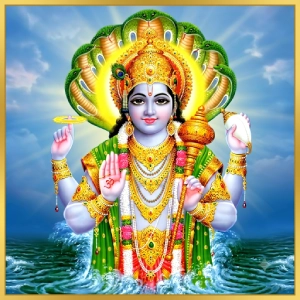
वृषाही वृषभो विष्णुर्वृषपर्वा वृषोदरः ।
वर्धनो वर्धमानश्च विविक्तः श्रुतिसागरः ॥ २८॥
vrishaahī vrishabho vishnur vrishaparvaa vrishodarah
vardhano vardhamaanashcha viviktah shrutisaagarah
1. वृषाही (Vrishaahi) – He Who Commands Dharma
He is Vrishaahi — the One who rides upon dharma, the master of righteousness.
He does not follow dharma — dharma follows Him.
He commands it, defines it, and realigns it when it falters.
He is the driver of the chariot of truth, the voice behind the law.
When confusion reigns, He becomes the lighthouse of clarity.
2. वृषभः (Vrishabhah) – The Bull of Righteousness
He is Vrishabha — the eternal bull, symbol of strength, stability, and dharma.
Not wild, but poised.
Not feral, but focused.
His presence is weight, grace, and steadiness in a world spinning too fast.
He upholds the yuga-dharma like a mighty bull holds the plough.
3. विष्णुः (Vishnuh) – The All-Pervading One
He is Vishnu — not a mere name, but a cosmic truth.
He pervades.
He spreads like fragrance, like meaning behind words, like presence behind prayer.
Every atom knows Him.
Every star is lit by Him.
He is the thread that weaves the tapestry of the universe.
4. वृषपर्वा (Vrishaparvaa) – The Ladder of Dharma
He is Vrishaparva — the steps through which dharma ascends.
From the lowest to the highest, from instinct to enlightenment —
He is the pathway through which souls climb.
Every stage of evolution, every rung of refinement,
is part of the staircase He has carved into the universe.
5. वृषोदरः (Vrishodarah) – He Who Holds Dharma in His Core
He is Vrishodara — the One whose very belly holds the essence of righteousness.
Not in His mind, not just in His actions —
but in His very being, dharma lives and breathes.
Like fire hidden in wood, like nectar in flowers,
He contains the secret source of all ethical strength.
6. वर्धनः (Vardhanah) – The Nourisher
He is Vardhana — the One who makes all things grow.
Not just plants and bodies —
He grows hope, devotion, wisdom, faith.
He is the gentle hand under the seed,
the rain on the parched earth,
the whisper that tells you,
‘You can become more’.
7. वर्धमानः (Vardhamanah) – The Ever-Expanding One
He is Vardhamana — ever increasing, ever blooming.
Unlike the things of the world that rise and fall,
He grows without decay.
His grace grows.
His names grow.
His presence in your heart — grows until there’s no room for anything else.
He is the infinite tree with no shadow, only light.
8. विविक्तः (Viviktah) – The Transcendent, the Untouched
He is Vivikta — untouched, untainted, set apart.
He walks through the mud of samsara but gathers no dust.
He dwells within the mess of minds, yet remains crystal.
He is not aloof — He is above.
A lotus blooming in murky water — untouched, majestic, divine.
9. श्रुतिसागरः (Shrutisaagarah) – The Ocean of the Vedas
He is Shrutisagara — the ocean of sacred sound,
from whom all the Vedas rise, like waves singing divine truths.
The chants, the mantras, the secrets of Brahman —
all are mere ripples on the surface of His wisdom.
Dive deep, and you will find Him —
the still, infinite depth beneath every sacred syllable.
This verse is a stairway of righteousness, a river of clarity, a call to the soul to rise.
He is not just a protector — He is the very law, path, purpose, and force behind what is right.
Vrishaahi. Vrishabha. Vishnu. Vrishaparvaa. Vrishodara. Vardhana. Vardhamana. Vivikta. Shrutisagara.
Each name is a step upward, each one a light held forward.
- Why does the verse connect the concept of Dharma specifically with the imagery of a bull and a ladder in the names Vrishabhah and Vrishaparvaa?
The bull represents the foundational weight and stability of righteousness on Earth. It is the unyielding force that carries the burden of moral order. The ladder represents the evolutionary journey of the soul. Together, they reveal a profound truth: Dharma is not a static, rigid boundary. It is both the immovable ground beneath your feet that gives you stability, and the active staircase that helps you climb from basic human instincts to supreme spiritual realization. - If the name Vrishaahi implies that He commands Dharma and defines it, does this mean moral laws are arbitrary and can change based on divine whim?
It means that true righteousness is alive and responsive, not a dead set of rules written in stone. He commands Dharma because He is the ultimate consciousness behind it. When human societies misinterpret religious laws or when the times change, He realigns the law to match its true original intent. It is a reminder that the spirit of righteousness is always superior to the literal, blind enforcement of a rule. - How can Vishnu be completely all-pervading in every atom as described in the third name, yet simultaneously remain untouched and untainted as Vivikta?
This is one of the greatest mysteries of spiritual philosophy. It operates like space or sunlight. Sunlight falls upon a pristine river and a muddy puddle alike, illuminating both completely, yet the sunlight itself never becomes dirty or wet. As Vishnu, He intimately fills and experiences everything in creation, but as Vivikta, His core essence remains completely transcendent, pure, and unaffected by the chaos of material existence. - The name Vrishodara says He holds Dharma in His core or belly. What is the hidden cosmic meaning behind storing righteousness in the abdomen?
In ancient symbolism, the belly or core is the center of assimilation, nourishment, and reproduction. Storing Dharma in His core signifies that righteousness is not an intellectual concept or a surface level behavior for Him. It is the very fuel that sustains the universe. Just as a mother nurtures life within her body, He gestates, protects, and feeds the moral order of creation from deep within His own being. - What is the subtle psychological difference between Vardhana, the Nourisher, and Vardhamana, the Ever-Expanding One?
Vardhana is an active, external blessing. It is the divine hand that builds your capacity, feeding your weak faith and helping your small virtues grow day by day. Vardhamana is an inherent cosmic trait. It represents the realization that the divine presence itself has no ceiling. When you focus on Him, your perception of His greatness expands infinitely, eventually swallowing your ego until nothing else remains but that light. - Shrutisaagarah describes Him as the Ocean of the Vedas. If all sacred texts are just ripples on His surface, what does this tell us about the limitations of human scriptures?
It reveals that scriptures, chants, and philosophies are beautiful and necessary tools, but they are finite pointers to an infinite truth. Words can only describe the surface waves of the divine ocean. To truly understand Him, a seeker must move past just reading or reciting the text, and instead dive beneath the syllables to experience the silent, vast depth of consciousness from which those words emerged. - How do these nine names function together as a practical guide for a human being trying to live a meaningful life?
The verse lays out a complete spiritual map. First, you accept His moral command (Vrishaahi) and build inner discipline and stability (Vrishabhah). Realizing that the divine is everywhere (Vishnu), you begin to climb the steps of self-improvement (Vrishaparvaa). You integrate goodness into your innermost character (Vrishodara), allowing your virtues to be nourished (Vardhana) and to grow boundlessly (Vardhamana). This process detaches you from worldly anxieties (Vivikta) and leads you to the ultimate truth of existence (Shrutisaagarah). - Is there a hidden warning in the name Vivikta for spiritual seekers who live in a chaotic world?
The hidden lesson is that true purity is not found by running away to an isolated cave, but by maintaining an inner sanctuary while living in the thick of daily life. Just as He walks through the mud of creation without gathering dust, human beings are challenged to engage with their worldly duties, relationships, and messy environments without letting the negativity stain their inner soul. - Why is the progression of growth in Vardhana and Vardhamana placed right before the quality of being untouched in Vivikta?
This sequence is deliberate. As your spiritual knowledge and devotion grow infinitely, you naturally begin to outgrow worldly temptations and fears. True detachment (Vivikta) cannot be forced through raw willpower or suppression. It happens effortlessly only after you have experienced the massive expansion of inner joy and divine nourishment represented by the previous names. - What makes the universe described in this verse a safe and comforting place for an individual soul?
It shows that we do not live in a random, cold, or mechanical cosmos. The universe is governed by a conscious force that is deeply invested in goodness, growth, and evolution. From the grand scale of cosmic laws to the tiny seed of hope inside a human heart, everything is actively watched over, sustained, and guided toward a higher state of perfection.





English
Vishnu Sahasranama
Click on any topic to open
7
30
Astrology
Bhagavad Gita
Bhagavatam
Bharat Matha
Devi
Devi Mahatmyam
Ganapathy
Garuda Puranam
Glory of Venkatesha
Hanuman
Kathopanishad
Mahabharatam
Mantra Shastra
Mystique
Practical Wisdom
Purana Stories
Radhe Radhe
Ramayana
Rare Topics
Rigveda Explained
Rituals
Sages and Saints
Shiva
Spiritual books
Sri Suktam
Story of Sri Yantra
Temples
Vedas
Vishnu Sahasranama
Yoga Vasishta
26
17
10
0


