Subhujo Durdharo Vagmi ...
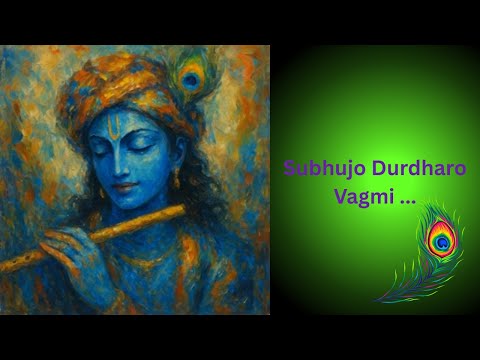
सुभुजो दुर्धरो वाग्मी महेन्द्रो वसुदो वसुः ।
नैकरूपो बृहद्रूपः शिपिविष्टः प्रकाशनः ॥ २९॥
subhujo durdharo vagmi mahendro vasudo vasuh,
naikarupo brihadrupah shipivishtah prakashanah.
-
ॐ सुभुजाय नमः – The Strong-Armed One
His arms are symbols of strength guided by compassion. They lift mountains, crush evil, and embrace devotees. Every act through His arms restores cosmic order. The same hands that hold the discus also hold the heart of a devotee. Power and tenderness coexist in Him — the arms that uphold dharma never fail those who seek His shelter. -
ॐ दुर्धराय नमः – The Unrestrainable
No force in existence can bind or resist Him. He transcends every law that governs creation, for He is the source of all law. When arrogance rises, He shatters it effortlessly. Even the flow of time and destiny bends to His will. The unrestrainable nature of Bhagavan reveals His absolute freedom — unbound, unbroken, unstoppable in His play of creation and protection. -
ॐ वाग्मिने नमः – The Eloquent One
His speech is the music of truth itself. Every syllable from His lips carries wisdom that awakens souls. The Vedas flow from His breath; the Gita is His heart’s song. He speaks not to impress, but to liberate. When Krishna spoke on the battlefield, confusion turned into clarity. His eloquence heals ignorance and guides even the lost mind back toward dharma and peace. -
ॐ महेन्द्राय नमः – The Lord of Indra
He is the king above all kings, the ruler of rulers. Even mighty Indra, lord of heaven, draws power from Him. When pride blinds the Devas, He reminds them of their source. He commands without effort, for His authority is eternal. Through Him, the universe remains in order. He stands beyond thrones and crowns — the silent master of divine governance. -
ॐ वसुदाय नमः – The Giver of Wealth
He gives without depletion, sustains without exhaustion. All forms of prosperity — material, mental, and spiritual — flow from Him. When one seeks with purity, He fills every need naturally. His giving is not a transaction; it is His very essence. Even a moment of remembrance invites His grace. He turns scarcity into abundance and makes every offering return multiplied. -
ॐ वसवे नमः – The Essence of Wealth
He is not just the giver but the wealth itself. The air we breathe, the food we eat, the love we feel — all are His manifestations. The eight Vasus are His aspects, reflections of His brilliance. He pervades every element as its sustaining richness. To see Him is to see prosperity in all things. True wealth is recognizing His presence everywhere. -
ॐ नैकरूपाय नमः – Of Many Forms
He manifests in countless appearances — the child, the sage, the storm, and the stillness. Each form reveals a fragment of His infinite being. To devotees, He becomes approachable in their chosen image. Yet, behind all forms is the same boundless consciousness. He multiplies Himself to meet every heart’s need, proving that the one who is many remains eternally one. -
ॐ बृहद्रूपाय नमः – The Vast Form
He encompasses everything — the sun, stars, earth, and all worlds. When Arjuna saw His Vishvarupa, the limits of imagination broke apart. His body is the cosmos; galaxies are but sparks of His light. In His vastness, every being finds space. He is the great expanse where creation arises and dissolves. To meditate on Him is to touch infinity itself. -
ॐ शिपिविष्टाय नमः – The Inner Light
He is the golden glow within all beings. The Upanishads call Him the flame inside the heart. Even in darkness, His light burns quietly as consciousness. It is He who makes thought aware of itself. The sun and fire borrow their brilliance from Him. To find this inner radiance is to realize that divinity is not distant — it lives and shines within. -
ॐ प्रकाशनाय नमः – The Illuminator
He is the light behind all lights, the awareness behind perception. Through Him, eyes see, minds understand, and truth reveals itself. Without His illumination, even wisdom remains hidden. He does not just brighten the world; He awakens the soul. His radiance exposes falsehood and guides seekers toward realization. When He shines within, ignorance vanishes like shadows at dawn.
-
Why is it said that Vishnu has many forms if the Supreme is formless?
Because each form is a window into one aspect of the infinite. To the bhakta, the divine becomes tangible in relatable ways — as Krishna, Rama, or Narasimha. Chanting any nama from the Vishnu Sahasranama 108 times helps the mind shift from surface variety to the unchanging reality beneath all forms. -
Isn't 'many forms' just storytelling to comfort people?
The idea of multiple forms arises from human cognition needing structure. Just as light refracts into colors, the infinite expresses in forms to be grasped. Ancient texts describe these as symbolic lenses — not illusions, but teaching tools grounded in centuries of meditative experience. -
How can the same Vishnu be vast enough to contain the universe and still appear to Arjuna?
Because His vastness is not spatial but existential — He pervades without occupying. Just as space is in and around everything, His 'brihad-rupa' includes every being without being limited by any. Chanting the full Sahasranama slowly brings the mind to feel this non-local, non-linear vastness. -
How can something be both a 'form' and contain everything else? That sounds self-contradictory.
A 'form' here doesn’t mean a boundary. When Arjuna saw Vishvarupa, it wasn’t a figure — it was a layered vision of totality. Scriptures use form-terms to describe states beyond normal perception, where opposites coexist. It’s not contradiction, but transcendence. -
Why is inner light important if we already have external light to see the world?
External light reveals objects; inner light reveals meaning. The 'shipivishta' state is the awareness that shines behind thoughts. It makes conscience speak, dreams arise, and truth recognizable. Chanting any nama from the Vishnu Sahasranama 11 times daily keeps that inner lamp bright amid distractions. -
Is there proof that such an 'inner light' even exists?
Yes — it's the witness consciousness you can’t deny. Even in sleep or confusion, there's a knowing that something is happening. Ancient sages called it jyoti — the light that makes experience possible. It’s not a metaphor but a mental constant observed across traditions. -
What does it mean to say Vishnu is unrestrainable — how is that relevant to daily life?
It means no karma, curse, or circumstance can bind Him — and those who take refuge in Him gain strength to overcome the impossible. Obstacles loosen when the uncontainable resides in your heart. Chanting any nama from the Vishnu Sahasranama 108 times breaks inner resistance and awakens hidden will. -
Isn't saying 'He cannot be restrained' just a poetic exaggeration?
It’s a theological way of expressing that no law binds Him, because He is the source of all laws. When something breaks natural limits — like grace, miracles, or intense intuition — it’s seen as the movement of this unbounded reality. That’s what 'Durdhara' captures. -
If Vishnu is the giver of all wealth, why do devotees still struggle financially?
Because wealth isn’t limited to money. It includes health, insight, and relationships. His giving aligns with dharma and inner readiness. Regular chanting of any nama from the Vishnu Sahasranama clears mental scarcity and invites fullness in all aspects of life — not just the bank account. -
If He gives wealth, why isn’t that visible across His temples? Many remain poor.
Giving is not distribution by whim. Scriptures say He responds to purity, not pressure. A farmer doesn’t complain that seeds didn’t grow on rock — preparation matters. His gifts require vessels — faith, effort, timing. Wealth flows through that alignment, not instant entitlement. -
Why does the text say Vishnu is not just the giver, but wealth itself?
Because what He gives is not external — it’s His very presence manifesting as abundance. The air, earth, mind, and life itself are forms of wealth arising from Him. Recognizing this reframes even challenges as grace. Chanting any nama from the Vishnu Sahasranama 11 times builds that awareness of divine sufficiency. -
Isn't calling Him 'wealth' just a way to spiritualize poverty?
Not at all. It’s a redefinition of wealth. Scriptures distinguish between artha (material wealth) and daivi sampat (divine riches like peace, wisdom). The point is not to reject money but to see its source rightly. What you call 'wealth' depends on what you value. -
How is Vishnu said to be eloquent — what's the spiritual use of eloquence?
Because words shape worlds. His speech isn’t decoration — it’s revelation. The Gita changed Arjuna's fate through clarity of speech. Chanting the full Sahasranama slowly trains the tongue and mind in sacred articulation, which refines thought and sharpens inner direction. -
Isn't eloquence just a personality trait? How can it be divine?
Eloquence here means the power to awaken and transform through speech. It’s not charm, but command over meaning. When words open minds or calm wars, they act beyond style. That’s the kind of eloquence Vishnu embodies — the origin of Vedic sound itself. -
Why is Vishnu called the one who reveals everything? Doesn’t science reveal more than religion now?
Science reveals how; Vishnu reveals why. His light is not factual data but the power to understand, choose, and transcend. Prakasha is what lets truth be seen in all domains. Chanting any nama from the Vishnu Sahasranama makes that inner clarity steadier and more discerning. -
Isn’t it dishonest to claim one being is the source of all light or truth?
It’s not about physical light. Prakasha means the principle of illumination — the ability to see rightly. In Vedantic terms, it's consciousness, the basis of all knowing. Attributing this to Vishnu is a metaphysical shorthand, not a denial of other methods.





English
Vishnu Sahasranama
Click on any topic to open
7
30
Astrology
Bhagavad Gita
Bhagavatam
Bharat Matha
Devi
Devi Mahatmyam
Ganapathy
Garuda Puranam
Glory of Venkatesha
Hanuman
Kathopanishad
Mahabharatam
Mantra Shastra
Mystique
Practical Wisdom
Purana Stories
Radhe Radhe
Ramayana
Rare Topics
Rigveda Explained
Rituals
Sages and Saints
Shiva
Spiritual books
Sri Suktam
Story of Sri Yantra
Temples
Vedas
Vishnu Sahasranama
Yoga Vasishta
26
17
10
0


